After 650 years, Brussels church removes antisemitic stained glass window, apologizes for killing of Jews
Brussels archbishop says antisemitism ‘stands in contradiction to the Gospel of Christ’




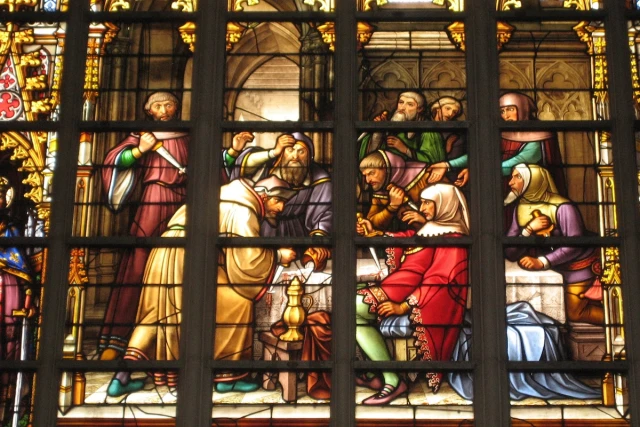
The Cathedral of St. Michael and St. Gudula recently corrected a centuries-old injustice against the Jewish community of Brussels, Belgium.
In a ceremony held at the cathedral in Brussels, a stained-glass window depicting the events of a blood libel against the Jewish community from the late 1300s was removed and replaced with a plaque acknowledging and apologizing for antisemitism.
In 1370, several Jews were wrongly accused of stealing the Communion hosts – the wafers used in taking Communion – and stabbing them with knives to desecrate them. The allegations, rooted in widespread antisemitic blood libels, accusing Jews of a variety of evil actions – such as killing young Christian boys to make Passover matzah, or poisoning wells – were often accompanied by violent mob attacks on Jewish communities.
The stained glass window depicted a supposed miracle associated with the incident, in which at least six Jewish men were accused of stabbing Communion hosts with a knife, supposedly causing the wafers to bleed the blood of Jesus.
The accused Jews were burned at the stake for the alleged crime, while the rest of the Jewish community of Brussels was banished.
The stained glass window commemorating this Sacrament of Miracle was added to the church in the early 1900s.
However, in last Wednesday's ceremony, representatives of the Catholic Church in Brussels, including Archbishop of Mechelen-Brussels Luc Terlinden, apologized to Brussels Chief Rabbi Albert Guigui, acknowledging the history of antisemitism and false accusations, while asking the Jewish community for forgiveness “for the suffering caused by these accusations.”
The plaque contained messages in several languages, including Hebrew, stating, “We acknowledge that in various parts of Europe, baseless accusations of desecration of the Eucharist were made against Jewish communities. These defamations led to unjust persecution, massacres, and expulsions. We ask forgiveness from the Jewish people for the suffering caused by these accusations.”
Terlinden, who signed the declaration, said that theological and social antisemitism stand in direct contradiction to the Gospel message of Christianity. He hailed the shift in Christian-Jewish relations and requested forgiveness for the “suffering caused by the events of 1370 and the anti-Judaism that followed.”
“Anti-Judaism, both theologically and socially, stands in contradiction to the Gospel of Christ, which calls for truth, justice, and fraternity,” he said.
Rabbi Guigui said he was pleased that the Catholic Church in Brussels had begun to dialogue with the Jewish community.
“What is essential today is how we look at these images: They should not be erased, because they are part of history, but they must be accompanied by explanatory language, by ethical and spiritual insight that allows us to understand, contextualize, and above all avoid repeating the past,” Guigui said regarding the removed stained glass windows.
“In that sense, today’s approach transforms these stained-glass windows: they are no longer only a reflection of a painful past; they also become the starting point for a shared reflection on truth, memory, and responsibility.”
Want to help more people find our reporting from Israel? Leave a quick Google review of our website here.
You might also like to read this: