What is Lag B’Omer?





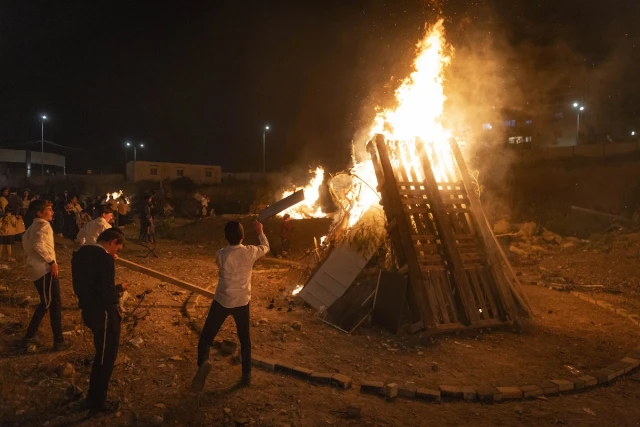
To the uninitiated, Lag B’Omer seems to be a fun bonfire party that happens in the spring in Israel, but the origins are deeper and darker than they first appear.
The word “Lag” represents the number 33 in Hebrew, formed by combining the letters lamed (30) and gimmel (3). “Omer” refers to the “Counting of the Omer,” a 50-day period between Passover and the Feast of Weeks (Shavuot), commanded in Leviticus 23.
So Lag B’Omer is the 33rd day in the Counting of the Omer. God commanded the children of Israel to count the Omer for those 50 days, but He didn’t say anything about the 33rd day. Indeed, that day interrupts the counting to focus on something else entirely.
Today on Lag B’Omer in Israel, bonfires are lit up and down the country together with barbecues and all kinds of family fun. There are two stories told about the origin of the tradition, but neither leaves a good taste in the mouths of those who believe Yeshua is the Messiah.
One story concerns a plague that had broken out among Rabbi Akiva’s disciples in the second century. Some 24,000 died before the plague suddenly stopped on the 33rd day of the Omer, with only five left alive. As a result, it has become tradition to be somber for the first 33 days of the Omer counting period, with no weddings or even haircuts allowed. However, on the 33rd day, celebrations break out, and joy is restored.
Rabbi Akiva was originally a Gentile shepherd but converted to Judaism and gradually gained a large following during the time that the Jews were rebelling against the Romans. With his considerable influence, he declared a man named Bar Kosiba, later called “Bar Kokhba,” to be the messiah. While “Kosiba” means “lie”, “Kokhba” means star. The name change was based on Balaam’s prophecy, which described the Messiah as a star:
"I see him, but not now; I behold him, but not near: a star shall come out of Jacob, and a scepter shall rise out of Israel; it shall crush the forehead of Moab and break down all the sons of Sheth" (Numbers 24:17).
Absolute loyalty was expected as the Jewish rebels faced their Roman oppressors, with those who wanted to fight being expected to cut off a finger as a demonstration of complete commitment to the cause and their leader, according to a Talmudic legend. Bar Kokhba gathered an army of 350,000, but with Akiva declaring him to be the messiah, Jews who believed that Yeshua was the Messiah could not go along with the crowd and were seen as traitors, separating them from their own people in what became a deep and lasting fissure.
The reason for the bonfires harks back to the ancient system of beacons on high places, lighting fires that could be seen from far away – a communication system relied upon by the Jewish rebels in the second century.
Ultimately, the Jews were overcome by the Romans by 136 AD despite all the hopes placed in that false Messiah. “About 580,000 Jews were killed, and 950 communities were destroyed. We embarked on a 2,000-year exile.” HaAretz summarizes.
Another story behind Lag B’Omer is associated with a second-century sage named Rabbi Shimeon Bar Yochai, or Rashbi for short. According to legend, Rashbi was one of the five disciples of Akiva spared by the plague, and when he died, he passed on the deep secrets of Kabbalah in the form of the Zohar – the source texts of Jewish mysticism.
There is scant evidence that the writings existed before the Middle Ages, although Rashbi himself was a key figure in Jewish rabbinic history. By the sixteenth century, however, a belief had emerged that one could gain something of the spirit of the ancient sages by lying on their graves – an idea perhaps inspired by the story in 2 Kings 13:20–21, in which the bones of the prophet Elisha are said to possess miraculous power, even raising the dead. At the same time, the deliberate practice of visiting graves to seek such experiences is explicitly condemned in Isaiah 65:4.
Undeterred, many thousands of Haredi Jews visit Rashbi’s grave at Meron in the northern Galilee area, near Safed – a hotbed of Kabbalism – each year for Lag B’Omer. The huge number who gather to remember this Rabbi and the giving of the Zohar has led to a number of tragedies, with people being crushed to death, and numbers have been restricted by Israeli authorities as a result.
It is said that Rashbi wanted to be remembered with joy rather than sadness, but it seems the giving of the Zohar on the 33rd day of the Omer has eclipsed the giving of God’s word at Mount Sinai and His Spirit on Mount Zion, which was the original point of all that counting in the first place.
You might also like to read this: