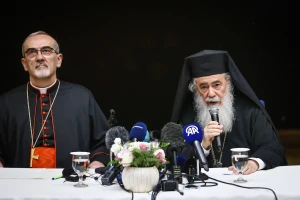
The Jerusalem patriarchs exposed



A recent and regrettable statement by the patriarchs and heads of the Churches in Jerusalem has cast new light on a persistent and troubling undercurrent within certain strands of Middle Eastern Christianity. In condemning "damaging ideologies, such as Christian Zionism," the ecclesiastical leaders did more than critique a theological perspective; they lent their authority to a historical continuum that often blurs the line between anti-Zionism and antisemitism and revealed a deep alignment with political narratives hostile to Jewish sovereignty. To understand this declaration, one must not view it in isolation, but as a modern manifestation of attitudes with roots extending deep into history, compounded by contemporary political pressures.
The Byzantine Bedrock: A Theological Foundation of Antisemitism
The assertion that Christian animosity in the region is a recent or purely political phenomenon is ahistorical. Its roots do indeed extend back to Byzantine times. Long before the rise of Islam, the theological architecture of Christian antisemitism was meticulously constructed. Early Church Fathers within the Roman and Byzantine spheres formulated the doctrine of supersessionism, or replacement theology. This doctrine declared the Christian Church to be the "New Israel," positing that God’s covenant with the Jewish people was irrevocably transferred due to their rejection of Christ. Jews were caricatured as "Christ-killers," and their statelessness was interpreted not as a historical tragedy but as divine punishment.
This theology was not confined to sermons; it was codified into law. The Byzantine Empire, through legal frameworks like the Code of Justinian, institutionalized discrimination, restricting Jewish rights and social standing. This created a normative, state-sanctioned view of Jews as a perpetually subjugated "other." When Islamic armies conquered the Middle East in the 7th century, they did not introduce antisemitism to a blank slate. The vast Christian populations—Greeks, Copts, Assyrians, Armenians—came under Muslim rule already in possession of this deeply ingrained theological and social contempt for Jews. While Islam developed its own complex relationship with Judaism, the Christian communities did not need Islam to teach them antisemitism; they arrived fully equipped with their own virulent version.
Modern Convergence: Nationalism, Nakba, and the Survival Strategy
The modern alignment of Middle Eastern Christian and Muslim attitudes toward Jews and Israel is thus not a simple theological agreement with Islam, but a convergence born of shared historical experience, identity, and political fate.
The Secular Bond of Arab Nationalism: From the 19th-century Nahda (Arab Renaissance), Middle Eastern Christians, particularly in the Levant, became vanguards of a secular Arab nationalist identity. This was a strategic and ideological move to secure equality within the emerging post-Ottoman order and to unite with Muslims against Western colonialism. A core tenet of this nationalism was opposition to Zionism, framed as a foreign colonial implant threatening the Arab homeland. For intellectuals like Syria’s Constantin Zureiq or the Marxist-Leninist George Habash (a Christian founder of the PFLP), anti-Zionism was a secular, anti-colonial creed.
The Shared Trauma of the Nakba: The creation of Israel in 1948 was a defining catastrophe (Nakba) for all Palestinians, Christian and Muslim alike. Thousands of Palestinian Christians were displaced from Jerusalem, Jaffa, and Haifa. This lived experience of loss and refugeedom cemented anti-Zionism as a pillar of Palestinian and broader Arab identity. For Palestinian Christians, their political struggle against displacement is often articulated through liberation theology, which can, at times, risk appropriating biblical narratives in ways that implicitly reactivate supersessionist themes.
The Conflation and the Conspiracies: In the heat of protracted conflict, a dangerous elision occurs. Ancient theological tropes of deicide and treachery are mapped onto modern political actors. Distinctions between "Jew," "Zionist," and "Israeli" collapse in popular discourse. Notably, it was often Christian Arab intellectuals and media figures who imported and disseminated virulently antisemitic European fabrications like The Protocols of the Elders of Zion into the Arab mainstream.
The Minority Survival Imperative: For Christian communities living as minorities in a majority-Muslim region, vocal opposition to Israel serves as a critical demonstration of loyalty. Affirming the national consensus is a social and political survival mechanism, a hedge against accusations of being a disloyal "fifth column" with foreign allegiances.
Why the Prejudice Persists: Inertia and Incitement
The Jerusalem patriarchs' statement is a product of ecosystems that sustain these attitudes:
Unresolved Conflict: The Israeli Palestinian conflict provides a continuous stream of grievance that reinforces anti-Zionist ideology, making theological and historical prejudices feel politically "relevant."
Authoritarian Indoctrination: For decades, state-controlled media and educational curricula in many Arab states have promoted narratives that vilify Zionism while frequently trafficking in antisemitic caricatures. Middle Eastern Christians are consumers of this same media environment.
Theological Stagnation: Unlike many Western churches that undertook profound introspection and reform after the Holocaust, Eastern churches have never undergone a systematic, institutional reckoning with their supersessionist past. These ancient teachings remain embedded in liturgies and popular preaching, unchallenged and unrevised.
Identity Preservation: As the patriarchs’ defensive tone reveals, maintaining control over their flock and asserting their political relevance in a volatile region is paramount. Challenging the anti-Zionist consensus is seen as a threat to communal cohesion and standing.
Refuting the Statement: Zionism and Christian Faith
The patriarchs’ condemnation of Christian Zionism as a "damaging ideology" is not merely a doctrinal disagreement; it is an attempt to discredit a sincere, biblically-rooted stream of Christian thought. Christian Zionism—the belief that the Jewish return to their ancestral homeland is in accordance with biblical prophecy—is not a modern political invention. Its tenets can be traced through church history, from early church fathers who held restorationist views, through medieval scholars, to the Reformation and modern Evangelicalism. It is a conviction that affirms the faithfulness of God to His covenantal promises.
As the International Christian Embassy Jerusalem has rightly noted, support for the Jewish people’s connection to Zion has been expressed by respected figures like Cardinal Christoph Schönborn, who saw it as doctrinally important. To label this sincere faith "damaging" is to arrogate to oneself the sole authority to interpret Scripture and to dismiss the deeply held convictions of millions of Christians worldwide. It also, deliberately or not, echoes the supersessionist claim that the Church has wholly replaced Israel in God’s plan, a theology that has been the seedbed for Christian antisemitism for millennia.
Conclusion: A Call for Honesty and Theological Courage
The statement from the Jerusalem patriarchs is therefore a revealing document. It is not an isolated opinion but a contemporary echo of a deep and dual legacy: the pre-existing Byzantine Christian theological antisemitism that provided a substrate of prejudice, fused with a modern, secular Arab political identity for which opposition to Zionism is a foundational tenet.
To combat the antisemitism that too often lurks within anti-Zionist rhetoric, Middle Eastern church leaders must first demonstrate the courage to confront their own history. This requires a robust intra-Christian theological reckoning—a deliberate effort to purge supersessionist teachings from liturgy and doctrine, and to clearly, consistently differentiate between legitimate political criticism of Israeli policies and the age-old, sinful prejudice against the Jewish people. Until such a reckoning occurs, statements like those of the patriarchs will continue to validate old hatreds, harm Jewish-Christian dialogue, and betray the universal message of their faith by aligning it with particularist animosities. True spiritual leadership in the Holy Land would seek to heal these ancient divisions, not perpetuate them under the guise of communal unity.
Want to help more people find our reporting from Israel? Leave a quick Google review of our website HERE .
You might also like to read this: