'Israel is your home': New plan seeks to bring all 6,000 Bnei Menashe from India to Israel by 2030






Prime Minister Benjamin Netanyahu, at an event honoring recent arrivals last Thursday, announced the plan to facilitate the aliyah of the entire “Bnei Menashe” community in India
Who are the Bnei Menashe, and how did they end up in India?
The Bnei Menashe (sons of Manasseh) claim to be the descendants of Manasseh, one of the 12 tribes of ancient Israel, which were taken from the land and displaced by the Assyrians in the eighth century BC, with some relocated as far away as India.
The Bnei Manashe community points to practices passed down through the generations that indicate their ancestry is rooted in Israel.
However, as ancient as these roots may be, the claim to be part of the house of Israel is relatively recent.
Some anthropologists believe the Chin, Kuki, and Mizo tribal groups, who speak Tibeto-Burman languages, originated in China and became known as the Shinlung people within India itself.
There are some 11,000 Bnei Menashe worldwide, approximately half of whom have already immigrated to Israel, while the remaining 6,000 are currently in northeast India , in the states of Mizoram and Manipur, sandwiched between Bangladesh and Myanmar.
Before the 1950s, they generally held Christian beliefs after some missionaries visited the area in the early twentieth century, but in 1951 a Messianic movement began when one of their leaders had a dream that their ancient homeland was in fact Israel, and the belief started spreading that they were descended from one of the two sons of Joseph, Menashe.
Later, two Israeli anthropologists arrived in the 1970s and noticed that their chants sounded familiar, that they had ancient folk tales about escaping from Egypt. Moreover, in times of calamity they would cry out “Manasseh!” according to the New York Times.
Attempts to verify the claims through DNA testing have been unsuccessful, but these long-established customs, songs, and traditions suggest there is reason to believe the assertions may indeed be true.
The Bnei Menashe community were not officially accepted by Israel at first, nor counted as eligible under Israel’s Law of Return, although from the 1990s onwards, some were granted special dispensation to make aliyah as individuals upon conversion to Judaism.
However, in 2005, Shlomo Amar, then Sephardi Chief Rabbi of Israel, ruled that they were indeed one of the lost ten tribes. Now, twenty years on, it seems the state of Israel is prepared to welcome the whole “tribe” with open arms.
The Shavei Israel organization serves such "lost" Jews around the world and has been working with the Bnei Menashe community, helping to bring them to Israel.
"Initially I didn't believe the whole lost tribe bit," says Michael Freund, chairman of the Jerusalem-based organization. "But I was very taken by them on a personal level, on a human level, by their sincerity, by their desire to become part of the Jewish people. So I thought we should help them. So I became involved, through the bureaucracy then, in arranging for groups to start coming in an organized fashion."
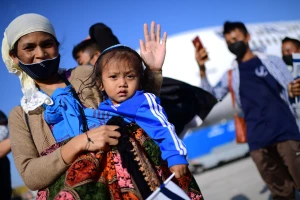
Now it seems the floodgates have opened. In April, the Israeli government organized Operation ‘Wings of Dawn’ to bring 250 Menashe on a flight via Delhi, and has committed to help facilitate and finance the immigration of the rest of the community by 2030.
According to the JPost, the costs related to immigration and absorption for the Bnei Menashe community this year alone is projected to be some 90 million shekels, with more to come.
"We are going to bring the entire community to Israel over the next four years," the prime minister promised at an event honoring new immigrants from India last Thursday.
On arrival, the Bnei Menashe will be received at the new ‘Tavor’ absorption center in Nof Hagalil and will undergo conversion to Orthodox Judaism. This center is designed to help new immigrants as they start their new lives in Israel, providing support with the Hebrew language and integration into Israeli society.
“You are an inseparable part of the Jewish People, and Israel is your home,” Netanyahu told the new immigrants. “I wish you a successful absorption and great success in the Galilee and in Nof Hagalil. Welcome back home to the State of Israel."
Ofir Sofer, Israel’s Aliyah and Integration Minister, also attended the inauguration of the Tavor absorption center, along with Finance Minister Bezalel Smotrich and others.
Both Sofer and Smotrich described the event as “moving” and waxed lyrical about the fulfillment of a long-standing dream as they welcomed the new arrivals.
While it is true the Bnei Menashe community has been longing for Zion, one might reasonably wonder about the reasons for the apparent enthusiasm from such a nationalistic government.
WIth many northern towns still largely abandoned, Netanyahu called Israel’s commitment to finance the aliyah operation “an important and Zionist decision” that would strengthen the North and Galilee, providing a boost to the north.
Sofer agreed, saying it “strengthens Israel's resilience, solidarity, and national renewal,” according to ILTV.
“It's one of the most extraordinary things to see prophecy being fulfilled,” said Chaim Malespin of the Aliyah Return Center. “That is what, 2,700 years of exile coming to an end? … They do their shabbat. They have their Torah scrolls. They light the menorah. They do things, not exactly the way we do in Israel, but very similar.”
Malespin explained that the name of the government-funded aliyah operation, “Wings of the Dawn,” was taken from Psalm 139:9-10, which says, “If I rise on the wings of the dawn, if I settle on the far side of the sea, even there your hand will guide me, your right hand will hold me fast.”
“They're longing for their return to the Promised Land,” Malespin continued. “Let's get them reunited with their families. Let's get them set up in lodging in the Galilee. Let's get them to Hebrew school. Let’s give them the job training.”
“We believe that we’ve been prepared for this moment,” added Malespin, Chairman of the Board of the Aliyah Return Center, “with the Hebrew classes, with the gift vouchers, with the distribution center, with so much more, to help them return.”
Mr. Ngamthenlal, one of the tribe still living in India, said they had faith in the Torah and in the promises of the Israeli government.
“We all have our passports ready,” he said.
Help more people find our reporting from Israel! Leave a quick Google review of our website HERE .
You might also like to read this: