Who is the Lion of Judah?
The meaning of the Lion of the Tribe of Judah



Few titles in all of Scripture carry the weight and the wonder of this one: the Lion of Judah. The question many ask — who is the Lion of Judah? — has a richer answer than most suppose, for the phrase reaches from the deathbed of a patriarch in Genesis to the throne room of heaven in Revelation, gathering into a single image the whole story of a tribe, a king, a city, and a Messiah. It is a golden thread binding the blessing of Jacob to the vision of John, the nation of Israel to the hope of the nations. And for the friend of Israel it is a feast, for the Lion of Judah belongs first to Israel, and only through Israel to the world.
Jacob's Blessing in Genesis 49
The image is born at a deathbed. In the forty-ninth chapter of Genesis, the aged patriarch Jacob gathers his sons to tell them what shall befall them in the last days, and when he comes to Judah he speaks words that would echo for all the centuries after: "Judah is a lion's whelp: from the prey, my son, thou art gone up: he stooped down, he couched as a lion, and as an old lion; who shall rouse him up?" Here, at the very fountainhead, the tribe of Judah is joined forever to the figure of the lion — a young lion grown to full strength, crouched in the confidence of a power none dares disturb.
But Jacob does not stop with the lion. He utters one of the great Messianic prophecies of the Old Testament: "The scepter shall not depart from Judah, nor a lawgiver from between his feet, until Shiloh come; and unto him shall the gathering of the people be." The scepter is the emblem of kingship; Jacob declares it shall remain with Judah until Shiloh comes — a name long understood to mean "he to whom it belongs," the rightful King, the Messiah, to whom belongs the obedience of the nations. In a single breath the dying patriarch links the lion, the scepter, and the Messiah, and binds them all to the tribe of Judah.
The Emblem of the Tribe
From that blessing forward, the lion became the standard of the tribe of Judah. Jewish tradition has long held that Judah's banner bore the figure of a lion; Judah took the leading place in the order of march and went up first to battle. The lion was not chosen at random — it expressed the character Judah was to bear: strength to lead, courage to go before, the dignity of one marked out for rule. To make it the symbol of Judah was to declare that this tribe carried something of the strength that belongs, in its fullness, to God alone — not for its own sake, but as the channel through which the promised King would come.
From the Tribe to the Throne
The promise of the scepter found its first great fulfillment in David. Out of the tribe of Judah, from Bethlehem, God raised up the shepherd who became Israel's greatest king, and made to him a covenant carrying forward the blessing of Jacob: "thine house and thy kingdom shall be established for ever... thy throne shall be established forever." The scepter now rested in the hand of the house of David, and the lion of Judah became the lion of the royal line.
Yet the prophets did not let the house of David fall into the past. Even after the throne was overturned and the last king of Judah carried into exile, they kept the promise alive, looking to a son of David yet to be born: Isaiah's shoot from the stem of Jesse, Jeremiah's righteous Branch, Ezekiel's one shepherd. The line of the lion was never merely a dynasty; it was the appointed channel of the Messianic hope.
The Lion, Jerusalem, and the Jewish People
Because Jerusalem was the capital of the kingdom of Judah, the lion that belonged to the tribe came in time to belong to the city, and it remains among the most recognized symbols of the Jewish people. The visitor to modern Jerusalem finds it everywhere — upon the official emblem and flag of the city, carved into stone, worked into iron. It is no museum relic but a living symbol, worn proudly by a people who know themselves to be, in the main, the descendants of the tribe of Judah, from whom the very name Jew is drawn.
For the friend of Israel this matters greatly. The Lion of Judah is not first a Christian symbol borrowed for the church's use; it is, in its origin and through all the centuries, a Jewish national and cultural symbol — the emblem of the tribe of Judah, the House of David, and Jerusalem. When the believer in the Messiah speaks of the Lion of Judah, he does not take the symbol away from Israel; he confesses that the King he loves came from Israel and fulfilled the hope Israel has carried in that lion for three thousand years. To honor the Lion is to honor the people from whom the Lion came.
The Lion Revealed: Revelation 5
It is in the last book of the Bible that the phrase "Lion of the tribe of Judah" appears at last in its full and explicit form. The apostle John, caught up in vision to the throne room of heaven, beholds in the right hand of Him that sat upon the throne a scroll sealed with seven seals. A mighty angel proclaims, "Who is worthy to open the book, and to loose the seals thereof?" And no one is found — not in heaven, nor in earth, nor under the earth — able even to look upon it. John weeps much, for it seems the purposes of God shall remain forever sealed. And then one of the elders speaks the words that turn his grief to wonder: "Weep not: behold, the Lion of the tribe of Judah, the Root of David, hath prevailed to open the book."
Every strand of the ancient promise is gathered into that announcement. He is the Lion of the tribe of Judah, heir of the scepter that was not to depart; He is the Root of David, the son who is also, mysteriously, the source of his royal father. And He hath prevailed: the long-awaited Shiloh has come.
The Lion and the Lamb
What follows is the most astonishing turn in all of Scripture. The elder announces a Lion; John turns to look upon this conquering Lion of the tribe of Judah — and what he sees is not a lion at all. "And I beheld, and, lo, in the midst of the throne... stood a Lamb as it had been slain." The Lion is the Lamb. The mighty One who prevailed to open the scroll is the same who was slain. Here is the paradox upon which the gospel turns: that the Lion of Judah triumphed not by the force of His strength but by the surrender of His life, that He conquered death by dying, that the King of kings reigns from a cross before He reigns from a throne.
He is the lion in His majesty and coming dominion; He is the lamb in His meekness and atoning death. The believer who knows Him only as the gentle Lamb has not yet seen the Lion who shall return in glory; the one who knows Him only as the conquering Lion has not yet understood that the throne He ascends was purchased at the altar. The Lion and the Lamb are not two saviors but one.
Why Judah
It is worth asking why the kingship was given to Judah, the fourth son, and not the firstborn. Genesis tells the story without flattering its hero, yet it was Judah who, standing before the ruler of Egypt who was secretly his brother Joseph, offered himself as a pledge and substitute for young Benjamin, willing to become a slave that the boy might go free. In that act of self-sacrificing surety, the character of the tribe was disclosed — and the One who would come from it foreshadowed. The lion of Judah was, from the beginning, a lion who would lay down his life for his brethren. The choice of Judah was the first sketch of the gospel.
Carried Through Exile and Return
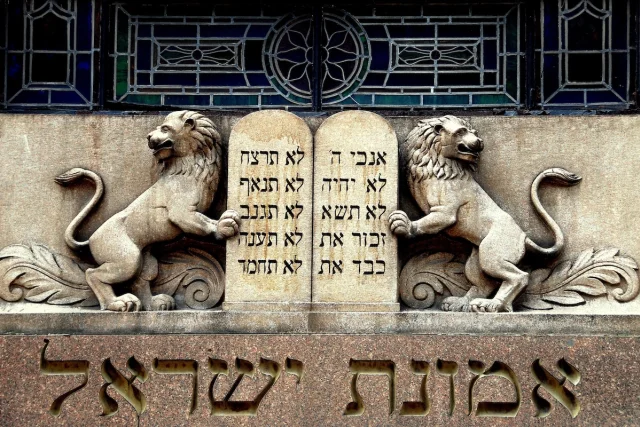
There is something deeply moving in the way the Jewish people carried the lion of Judah through the long centuries of dispersion. When the throne in Jerusalem was overturned and the people scattered, they did not lay the lion down. It appeared above the ark in the synagogues of exile, two lions flanking the tablets of the law — a quiet act of defiance and faith, a declaration made in the very teeth of dispersion that the scepter had not finally departed and the King had not finally failed.
And the return came. The same people who carried the lion through two thousand years of exile carried it home again, and today it stands upon the emblem of Jerusalem, the capital of a restored and sovereign Israel. Babylon fell, and the lion endured; Rome fell, and the lion endured; the long night of the exile passed, and the lion was lifted again over the gates of the very city from which it first arose. To the eye of faith, the survival of the lion of Judah is itself a kind of prophecy — a sign that the God who made the covenant keeps it.
What It Means for the Friend of Israel
Several things follow. The Lion of Judah binds the Christian and the Jew together at the deepest level, for the King whom the believer confesses is the very fulfillment of the hope Israel has carried in that lion through every century. The believer who understands this cannot despise the people from whom his Savior came, nor imagine that God has cast away the nation that gave the world the Lion of Judah. The symbol rebukes every theology that would sever the church from Israel, for the Lion is a Jewish lion, the Root a Davidic root, the King a son of Judah — and it belongs first to Israel, becoming the hope of the world not by being taken from the Jewish people but precisely by remaining theirs. The covenant promises made to Abraham and to David stand unbroken. And there is comfort: the Lion has prevailed; the scroll of the future is in the hands of one worthy to open it; and the people of Israel, like all who trust in the God of Abraham, are kept by a King who does not slumber. When the nations rage against the covenant people, as they have in every generation, the friend of Israel does not despair, for he knows who holds the seals of history.
We end where the vision of John ends, with heaven gathered in worship before the Lion who is the Lamb, and the new song: "Thou art worthy to take the book... for thou wast slain, and hast redeemed us to God by thy blood out of every kindred, and tongue, and people, and nation." Who, then, is the Lion of Judah? He is the one foretold at the deathbed of Jacob, the heir of the scepter that did not depart, the Shiloh to whom the gathering of the people belongs. He is the King who came from the tribe of Judah and the House of David, the one who prevailed to open the sealed scroll — and who prevailed by being slain. He is the Lion who is the Lamb, the King of Israel who is the hope of the nations. The lion that Israel has carried upon her banner for three thousand years still crouches in royal patience, and the day draws near when He shall rise, and roar, and reign — and unto Him shall the gathering of the people be.
You might also like to read this: