Rising anti-Hezbollah voices in Lebanon hope to break Iranian proxy’s power
Can tide turn enough despite terror groups’ influence in Lebanon?




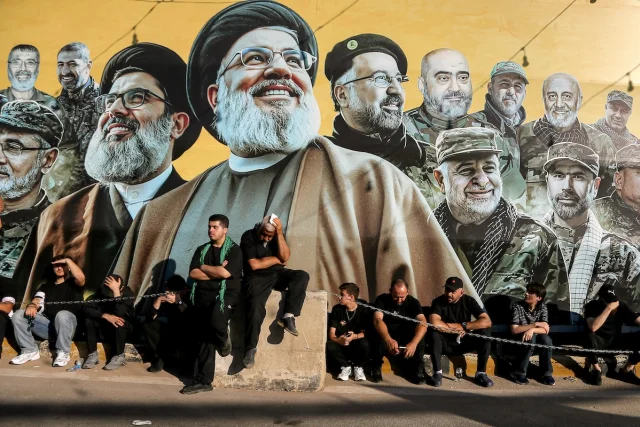
Voices of opposition to and outright disdain for Hezbollah in Lebanon have been amplified more than ever, with many politicians and activists publicly supporting the agreement with Israel as a last-ditch effort to save the country.
The agreement signed last week between Beirut and Jerusalem has emboldened accusations against Hezbollah for dragging the beleaguered country into several devastating wars, including the latest one that ended last month.
Social media posts by activists and politicians and footage compiled by the Center for Peace Communications and Jusoor News show a fomenting tide of hostility aimed at the well-funded and armed Iranian proxy that has dominated southern Lebanon since the 1980s.
“They’re just doing whatever Iran wants, not defending Lebanon,” said Hadi Murad, physician and political activist. “Hezbollah still wants to implement a foreign agenda without thinking for a single moment about the future of their fellow Shiites, about their childcare and the blood of their people.”
Nancy Lakkis, a journalist and outspoken Hezbollah critic who survived an assassination attempt last year, openly said, “We want Hezbollah to be disarmed. We want a peace treaty with Israel.”
Samir Geagea, member of the Christian Lebanese Forces party, thanked U.S. Vice President JD Vance on behalf of Christians.
“The past four decades have been among the most difficult stages experienced by the Lebanese in general, and Christians in particular,” he wrote, claiming the establishment of Hezbollah weakened the state and plunged it into wars linked to “Iranian agendas.”
After the agreement was signed with Israel, Gaegea called it the “greatest opportunity that has come to Lebanon to emerge from the tragic circumstances it has endured over the past 50 years.”
Charles Jabbour, communications chief of the Lebanese Forces party, has been calling for Hezbollah’s surrender for years and insisted that Israel should not withdraw its military until the militia is disarmed.
“Any security agreement preventing the use of Lebanese territory for regional attacks effectively nullifies the justification for keeping weapons outside state control,” he said.
Lebanon voted to disarm all non-state actors last August, a decision largely aimed at Hezbollah.
Another Christian party, Kataeb, published a statement in April welcoming direct negotiations with Israel “as the only viable path toward a ceasefire, an end to hostilities, the withdrawal of Israeli forces from occupied areas in southern Lebanon, the return of displaced residents to their villages, the restoration of stability and the achievement of lasting peace in Lebanon.”
Kataeb members have openly castigated Iran for interfering in Lebanese interests.
“Who gave Iran the right to speak on behalf of Lebanon in the first place?” Nadim Gemayel wrote on 𝕏 on June 23. “Lebanon’s unity is not guaranteed by Tehran, the safety of its lands is not decided in Switzerland, and its sovereignty is not a bargaining chip between two foreign powers.”
Samy Gemayel, also of Kataeb, congratulated the Lebanese leadership and the U.S. for reaching the agreement with Israel.
“Most Lebanese are not prepared to live as hostages to Hezbollah,” he said a few days before the deal. “We will not coexist with Hezbollah’s weapons, no matter what the outcomes of the external negotiations may be. They must place themselves under the roof of the state and the law and adhere to the state’s conditions.”
Lebanese parliament member Fouad Makhzoumi, a Sunni member of parliament, called the Israel-Lebanon agreement “a historic milestone and a decisive step on the path to achieving a just and sustainable peace with Israel, to resolving longstanding issues through diplomacy, to strengthening the authority of the Lebanese state, to ensuring the state’s exclusive right to bear arms, and to ending the existence of Hezbollah’s weapons and those of all militias.”
Criticism of the group from Hezbollah’s own Shiite community has also been plentiful.
Zeinab Saad said Hezbollah tries to project representation of all Shiites, but many voices are rising up saying, “‘No to wars’ and ‘We stand with the state.’”
Another Shiite political activist, Mahmoud Shuaib, slammed Hezbollah for staging its war against Israel from villages in southern Lebanon. He said residents who sent their families away from danger “stayed behind in their homes to protect them—not from Israel but from these individuals who are causing the destruction regardless of what cause they claim to represent.”
“Israel is an enemy, but Iran is more of an enemy to us and those who work for Iran … have caused more harm to the people of southern Lebanon than Israel has,” he said.
Lynn Harfoush – former Hezbollah follower turned critic – blamed the militia for dragging her country into war again in March.
“I am here to tell you: Millions of Lebanese – including many Shiites – want a different future,” she said in an address to the United Nations Security Council in March where she pleaded for international support in eradicating [freeing] Lebanon from “a suicidal faction.”
“As I speak, thousands of Israeli soldiers are massed at our southern border, and we Lebanese fear that the conflict will only widen further. …Who is paying the price? Not the men who deliver speeches about resistance from protected bunkers,” she said.
Mariam Kesserwan, a Shiite and outspoken anti-Hezbollah activist and founder of the social media channel Lebanon Uprising, said the time has come to decriminalize pro-Israel speech.
For their part, Hezbollah leaders have warned that an agreement with Israel will lead to internal divisions.
Parliament Speaker Nabih Berri, an Hezbollah ally, called the agreement with Israel “sedition” while Hezbollah lawmaker Hassan Fadlallah warned that implementing the deal would spark a civil war.
“What happened in Washington is an attempt to disrupt the Islamabad path, and without the resistance (Hezbollah) nothing will pass,” Fadlallah said, referring to the MOU between the U.S. and Iran.
Only time will tell if this sentiment will be enough to extricate Hezbollah from Lebanese society.
You might also like to read this: