In southern Lebanon, PM Netanyahu vows no Israeli withdrawal as long as Hezbollah ‘armed and present’
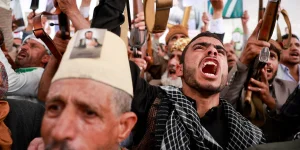
Hezbollah continues to ignore agreement, threatens civil war to prevent disarmament



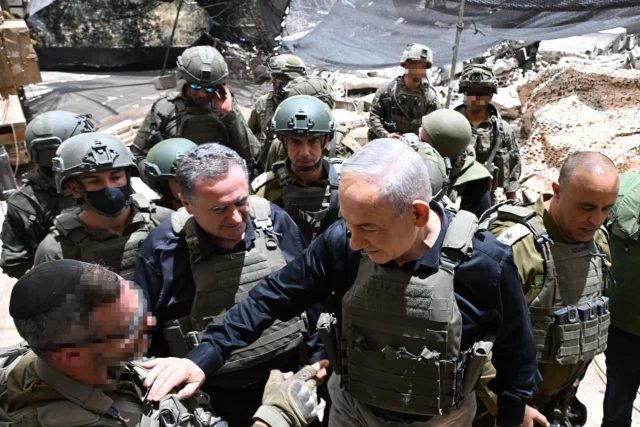
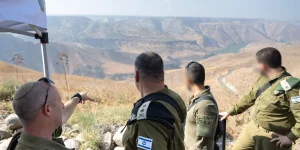
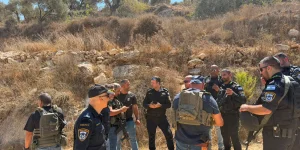
Israeli Prime Minister Benjamin Netanyahu toured the Israeli-held security zone in southern Lebanon on Tuesday, praising the soldiers for “crushing” the Hezbollah terrorist organization, which he described as the Iranian axis’ “most important link.”
“There were 150,000 missiles and rockets, the highest density of missiles and rockets on planet Earth. Today, they have about 8% left,” Netanyahu said, vowing that the IDF would not withdraw from the area “as long as Hezbollah is armed and present here, posing a threat to us.”
Netanyahu spoke against the background of the Israel-Lebanon agreement, whose implementation reportedly began this week with the first deployment of the Lebanese Armed Forces (LAF) in parts of two pilot zones under U.S. supervision.
Meanwhile, the Iranian regime and Hezbollah officials continued railing against the “traitorous” agreement, though fighting in the area has been relatively scarce these past few days.
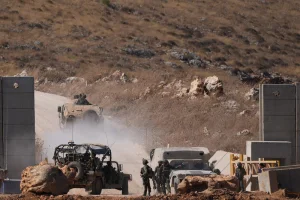
On Tuesday, the IDF said it struck a Hezbollah terrorist near the security zone. The day before, an IDF reserve soldier was severely injured as a result of an explosion, though the military has not published detailed information about the incident yet.
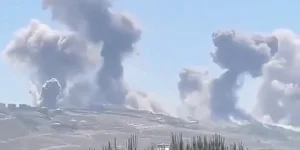
The latest large-scale strikes came on Sunday, when the IDF hit three Hezbollah command centers “in response to Hezbollah’s violations of the ceasefire agreement in the form of continued attacks on IDF soldiers in the Security Zone.”
The government has faced strong criticism in recent weeks for allegedly limiting the military’s ability to respond to Hezbollah violations, following U.S. pressure to keep the Lebanese front quiet.
Speaking to the troops, Netanyahu stressed that “our directive – mine and that of the Defense Minister, Chief of the General Staff and Deputy Chief of the General Staff – is to protect yourselves as your first priority. If you identify a threat to your security, to your lives or the lives of your soldiers – act!”
Netanyahu and Defense Minister Israel Katz were also presented with “a showcase of innovative ammunition and weaponry for tackling the drone threat,” according to an official statement.
The prime minister also praised security zones in Lebanon, Syria and Gaza as “a paradigm shift. The meaning is that we no longer allow an army of terrorists to have a foothold on our border.”
“Since we have achieved – thanks to your operations here – Lebanon's recognition of Israel and Israel's recognition of Lebanon, we say to both Iran and Hezbollah: get out of here, you have no business being here,” Netanyahu declared.
On the other side of the border, meanwhile, the controversy over the agreement signed by the government in Beirut continued.
According to the Hezbollah-affiliated Lebanese newspaper Al-Akhbar, Egyptian officials recently advised Lebanese President Joseph Aoun and Prime Minister Nawaf Salam not to use force to disarm Hezbollah, warning of a possible armed confrontation.
Citing American sources close to the Pentagon, the anti-Hezbollah newspaper Nidaa al-Watan reported that this week’s visit of the U.S. CENTCOM chief, Adm. Brad Cooper, was meant to assuage these concerns, particularly those of LAF commander Gen. Rodolphe Haykal, regarding the preservation of “peace within Lebanon.”
The discussions with Cooper reportedly focused on plans to deploy LAF troops to the towns of Zawtar and Froun, which are currently controlled by the IDF. The LAF’s role there would be to ensure that there are no weapons or militants left in those areas, sources told the newspaper al-Modon.
All of these activities continued to draw strong criticism from Iran-aligned leaders in Lebanon. On Tuesday, Parliament Speaker Nabih Berri, an ally of Hezbollah, claimed that, regarding the agreement, “We would act as if nothing happened.”
Iran's cultural advisor in Lebanon, Mohammad Reza Mortazavi, warned that Iran would not abandon Lebanon in any future negotiations, warning Israel – the “despicable entity” – to leave its territory.
Hezbollah Member of Parliament Hussein al-Hajj Hassan stated, “The agreement is full of commitments by Lebanon, while the enemy has no commitments... Compared to what Iran demanded and achieved in the American signature, Lebanon committed itself to fully carrying out the Israeli requests.”
Another Hezbollah lawmaker, Ihab Hamadah, once again hinted that Hezbollah might be ready to start another civil war. Speaking from a village in southern Lebanon, he warned that the government is “gambling” on there being no internal Lebanese fighting.
Meanwhile, the newspaper Ad-Diyar cited diplomatic sources saying that the U.S. is planning another round of Israel-Lebanon talks during the first half of July, following a CENTCOM report on progress in implementing the agreement.
The sources noted that Beirut would have no more than two months to implement its commitments, after which the U.S. would not fully oppose renewed Israeli military operations to address security concerns if the Lebanese side failed to comply.
Please take a moment to join believers worldwide praying for Israel right now. Add your light to the live prayer map—and show the world one more watchman praying for the peace of Jerusalem.

You might also like to read this: