RFK Jr rejects Israel ‘genocide’ claims in one of his most forceful defenses of Jewish state



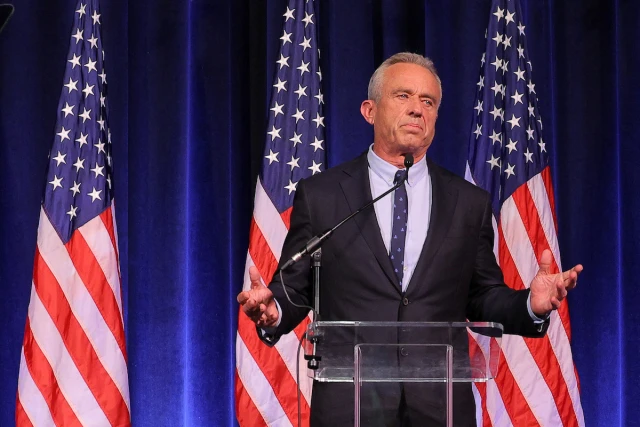
For years, despite being a key part of the Trump Administration, Robert F. Kennedy Jr. has occupied a political space that often overlaps with progressives who have become increasingly critical of Israel. But this week, the U.S. Secretary of Health and Human Services delivered one of the strongest public defenses of the Jewish state by any member of the Trump administration, forcefully rejecting accusations that Israel is committing genocide in Gaza.
Appearing on Fox News, Kennedy didn’t hedge his words. “If Israel wanted to commit a genocide against Palestinians, they could do it in a minute,” Kennedy said. “It’s doing the opposite.” He’s absolutely right. Truthfully, if Israel’s goal was a genocide, they’re doing a horrible job at it.
RFK Jr’s remarks came as accusations of genocide against Israel have become increasingly common among anti-Israel activists, some Democrats, woke right influencers, international organizations and protesters on college campuses. Kennedy argues that the facts simply do not support that narrative.
His central argument wasn’t based primarily on military strategy or international law. Instead, he pointed to demographics.
Kennedy noted that Israel’s Arab population has grown dramatically since the country’s founding in 1948. He observed that roughly 150,000 Arabs lived inside Israel at its founding and that today nearly two million Arab citizens live in the country, accounting for roughly one-fifth of Israel’s population. In Kennedy’s view, those numbers directly contradict the allegation that Israel is attempting to eliminate the Palestinian people.
“If you want to see where a real genocide is happening,” Kennedy continued, “It’s not in Israel. It’s happening in all the nations around it.”
He then shifted the discussion beyond Gaza, arguing that religious minorities throughout the Middle East tell a very different story than the one often portrayed by Israel’s critics.
Kennedy pointed to the dramatic collapse of Jewish communities across the Arab world. Following Israel’s establishment, approximately one million Jews lived throughout neighboring Arab countries. Today, only a tiny fraction remain.
He also highlighted the sharp decline of Christian communities across much of the Middle East, arguing that while Christians and Muslims continue to live openly inside Israel, religious minorities have largely disappeared from many surrounding nations.
What he is pointing out is factual and not rocket science, to say the least. Sadly, his voice is not the majority opinion you hear in the American media.
Yet his comments represent one of Kennedy’s clearest attempts to flip the genocide narrative on its head. Rather than portraying Israel as the perpetrator, he argued that history shows religious cleansing has overwhelmingly occurred elsewhere in the region.
While Kennedy’s comments surprised some observers because of his long political career as a Democrat, they were hardly new.
Long before joining President Donald Trump’s administration, Kennedy had repeatedly defended Israel during interviews with progressive journalists who challenged his views.
One of the most memorable exchanges came during a lengthy interview with political commentator Krystal Ball.
When Ball repeatedly accused Israel of committing genocide and ethnic cleansing in the Gaza Strip, Kennedy pushed back aggressively, arguing that Israel possessed overwhelming military superiority and could destroy Gaza quickly if extermination were truly its objective.
Instead, Kennedy argued that Israel has repeatedly accepted ceasefires, taken steps to reduce civilian casualties and fought an enemy deeply embedded within civilian infrastructure.
Throughout that conversation, Kennedy insisted that the Hamas terrorist organization intentionally places military assets among civilians, making the battlefield unlike almost any other modern conflict.
He also rejected comparisons between Israel and colonial powers, arguing that Israel faces existential security threats unlike those confronting most Western democracies.
Perhaps most notably, Kennedy challenged what he viewed as selective outrage. He questioned why international activists frequently single out Israel while paying comparatively little attention to atrocities committed throughout Syria, Yemen, Sudan and elsewhere in the Middle East. It’s a legitimate question that has no legitimate answer.
That theme surfaced again during this week’s interview. But the timing here is crucial: his remarks also stand out because they come from an official whose portfolio has nothing to do with foreign policy.
As Health and Human Services secretary, Kennedy is responsible for America’s public health system, not Middle East diplomacy. Yet his comments immediately drew attention because they departed sharply from the rhetoric increasingly heard on the political left, where allegations of genocide have become commonplace.
Supporters of Israel applauded Kennedy’s willingness to challenge what they view as one of the most inflammatory accusations leveled against the Jewish state.
Critics, meanwhile, continue to argue that Israel’s military campaign has resulted in unacceptable civilian casualties and humanitarian suffering in Gaza.
The debate is unlikely to disappear anytime soon. But Kennedy’s comments underscore an increasingly interesting political reality in America. Support for Israel is no longer falling neatly along traditional partisan lines.
While many progressive Democrats have become increasingly hostile toward the Jewish state, Kennedy – despite his Democratic roots – has emerged as one of Israel’s most outspoken defenders inside the Trump administration.
Please take a moment to join believers worldwide praying for Israel right now. Add your light to the live prayer map—and show the world one more watchman praying for the peace of Jerusalem.

You might also like to read this: