Muslims in Israel prepare to celebrate Eid al-Adha, the story of Abraham’s sacrifice



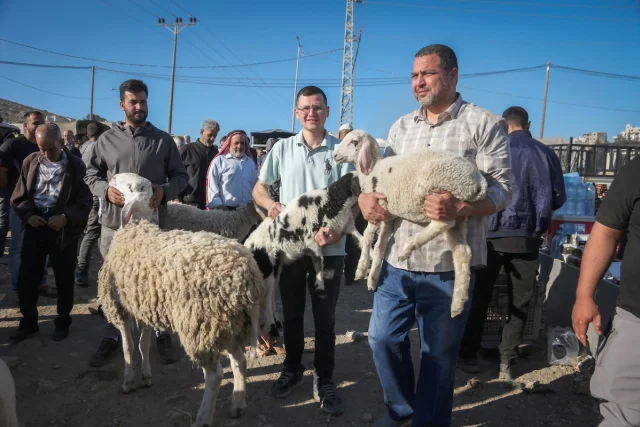
The Muslim population of Israel and around the world is about to celebrate the story of when Abraham almost sacrificed his son, except with a significant twist.
Eid al-Adha (The Feast of the Sacrifice) begins on Tuesday evening and continues until the weekend as an official holiday for Muslim, Druze and Circassian communities in Israel who make up almost 20% of Israel’s population.
The celebration is centered on the story of Abraham’s willingness to sacrifice his son – a sacrifice he ultimately did not carry out. However, unlike the biblical story, in Islamic tradition, it is Abraham’s other son, Ishmael, who was almost sacrificed rather than Isaac.
The feast is one of only two major Muslim holidays, the first being Eid al-Fitr at the end of Ramadan, breaking the month-long fast, and Eid al-Adha being the second, coming some 70 days later on the 10th of Dhu'l-Hijja, the last month in the Islamic calendar, and is connected to the annual Hajj pilgrimage period.
Festivities begin after the call to the Eid prayer, which typically draws tens of thousands to the Al Aqsa Mosque in Jerusalem.
Eid al-Adha is also known as “the Great Feast,” “the Feast of Sacrifice,” “the Feast of Oblation,” and “the Feast of Hajj.” As these names suggest, a lot of feasting is involved, with delicious meals and hospitality adding to the celebrations.
The plot twist
This is how the story is presented in the Quran:
“Then, when he was old enough to accompany him, he said, ‘O My son, I see in a dream that I am sacrificing you; see what you think.’ He said, ‘O my Father, do as you are commanded; you will find me, God willing, one of the steadfast.’ Then, when they had submitted, and he put his forehead down. We called out to him, ‘O Abraham! You have fulfilled the vision.’ Thus We reward the doers of good. This was certainly an evident test. And We redeemed him with a great sacrifice. And We left with him for later generations. Peace be upon Abraham" (Quran chapter 37:102-109).
Aside from the central element of the switched son, there are several variations from the biblical narrative. While the biblical account focuses on Abraham, the Quran emphasizes the son and his willing participation. He encourages his father Abraham to go through with the sacrifice, and states his steadfast agreement, even going so far as to cooperate by making it physically easier for his father to slaughter him.
Both father and son are being tested, with little hesitation shown by either party. In the Quranic reworking of the story, Abraham had a heads-up about the plan in a dream, which he shares with his son, who wholeheartedly agrees.
Unlike the biblical text, the Quran narrates the story from Allah's perspective, who refers to himself in the third person and rewards Abraham for his good deeds.
While the original story as told in Genesis 22 is thousands of years old, either written by Moses around 1400 BC or while the Jews were exiled in Babylon no later than the fifth century, the Quran was written in the seventh century AD and was influenced by the fact that Mohammed believed himself to be a descendant of Ishmael.
However, in another twist, the observant will notice that the name Ishmael does not appear in the Quranic text. Nonetheless, it has become assumed in Islamic tradition.
How Eid al-Adha is celebrated
It is customary in Islamic countries for the head of the family to sacrifice an animal on behalf of his household, specifically camels, two kinds of cows, sheep or goats. This requirement is waived in most countries where Islam is not the majority religion, but is permitted in Israel.
People lay hands on the sacrifice to transfer sin onto the animal, similar to the practice laid out in the biblical instructions for the “scapegoat” on the Day of Atonement.
As part of the celebrations, celebrants publicly declare the “takbīr” — the Arabic phrase Allahu akbar, “God is greater” — and give gifts to family, friends and the poor.
“Eat some, store some and give some in charity,” as Muslims are instructed in Hadith An-Nasa’i.
The meaning of the story
Submission and obedience to Allah are core values in Islam, and in Saudi Arabia, devotees symbolically “stone the devil,” as a way of taking a stand against the temptation to disobey Allah.
Abraham and his son, like all the heroes of the Quran, are portrayed as perfect saints. They passed the sacrifice challenge perfectly, enthusiastically, and flawlessly. Muslims commonly believe that only the very best-behaved people will meet the exacting standards of Allah; most have no assurance that they will be accepted when they finally meet their Maker.
In contrast, the Bible shows the mistakes and even failures of its key characters, but emphasizes God’s grace and love for fallen humanity. In fact, it is in this very story of sacrifice that the word “love” is used for the first time in the Bible:
“Take your son, your only son Isaac, whom you love, and go to the land of Moriah, and offer him there as a burnt offering on one of the mountains of which I shall tell you” (Genesis 22:2).
According to the Christian understanding of the story, the last-minute substitution foreshadows the cross: Carrying the wood for his own sacrificial death on his back up that mountain in Jerusalem, Abraham’s son points to the Messiah, the Lamb of God who carried the cross on which he died for all our sins and failures, making us acceptable to God. That includes the sons of Isaac, the sons of Ishmael, and all the families of the earth.
“For God so loved the world, that he gave his only Son, that whoever believes in him should not perish but have eternal life” John 3:16.
You might also like to read this: