Reaching Gen Z
What speakers at the Jerusalem Summit 2026 said about the youngest generation—and how to help them find their way out of darkness.



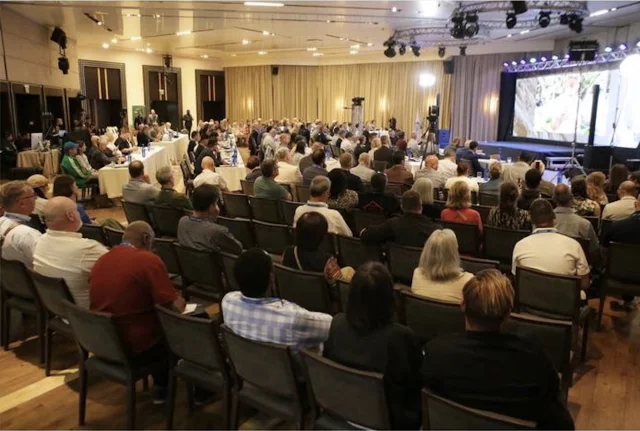
For three days in Jerusalem, while missiles flew and world leaders spoke, a quieter alarm sounded through the conference hall. It came not from the battlefields of Gaza or Lebanon, but from the screens in teenagers’ pockets and the empty pews in Europe’s churches. The subject was Generation Z—the most digitally saturated, socially isolated, and biblically illiterate generation in living memory. And the question was urgent: how do we reach them before they are lost?
Generation Z also known as known as Gen Z or Zoomers refers to the demographic cohort born between 1997 and 2012
The Perfect Storm
Christopher Keel, a theologian who has spent years speaking on college campuses, painted a stark picture. “Gen Z has the highest rate of mental-health issues—depression, social anxiety, and existential dread,” he told the summit. “It turns out that giving young adults an endless stream of information and dopamine hits without spiritually forming them first was not the best way to raise a generation.”
The numbers bear him out. A recent Yale Youth Poll found that only twenty-four percent of Americans aged eighteen to twenty-two believe Israel should exist as a Jewish state. Fifty-five percent agreed that America should end its “slavish surrender” to Israel. And among confessing Christians, biblical literacy is collapsing in six of eight essential worldview categories, biblical perspectives among the youngest believers do not rise above five percent.
“We are losing the cultural conversation long before we get to the issue of Zionism,” Keel warned. “If I cannot get someone to accept a biblical anthropology, do you think I will succeed in convincing them about the God who works through history in regard to the Jewish people?”
What Gen Z Actually Wants
The irony, several speakers noted, is that Gen Z’s deepest desires run counter to the digital hellscape they inhabit. They are hungry for rootedness. “There has been a resurgence of interest in Church history and in older liturgical and apostolic traditions,” Keel observed. “When the sands are shifting and the winds are whipping, people look for things that feel ancient and stable.”
They want authentic connection—not more screens. “They want to be instructed; they want to have meaning; they want to be formed; they want to see a world that makes room for them,” he said. “This is not a radical demand; it is an ancient desire.”
Reverend Paul O’Higgins agreed: “Young people are looking for two things: identity and destiny. The destiny and identity of Israel show that God gives people both.”
Why the Old Playbook Fails
Ambassador George Deek, Israel’s special envoy to the Christian world, argued that the traditional case for supporting Israel no longer resonates with young people. “The old model was based on two elements,” he explained. “First, a biblical obligation to support Israel. Second, that you should care about Israel because the Jews have been victims. Those two elements are not enough in today’s world. Nobody is going to show up and have the courage we are talking about because of these two elements.”
What is needed instead, Deek said, is a partnership model. “Stop treating Israel as a client or someone who needs help. Show young Christians that Israel is relevant to them—that it is a country making things happen, not a country that things happen to. Step out of the victimhood position.”
What Works: Seven Strategies from the Summit
Across the three days, speakers offered a coherent set of practical approaches for engaging Gen Z.
1. Go Analog
“Get offline and into physical spaces,” Keel urged. He shared how he reaches young men attracted to online extremism not by arguing with them on social media, but by going on a hike or to the gym. “Love them back into the light. Bring them out of social isolation.” He predicted a coming revolt against the digital world: “There has to be, if we are going to survive as a species.”
2. Bring Them to Israel
Nothing changes a young person’s mind like the land itself. Sasha Roitman, CEO of the Combat Antisemitism Movement, told two stories: a Black South African who believed Israel was an apartheid state until he landed at Ben Gurion Airport and discovered that there were no “white only” restrooms; and a former Yemenite Islamist who became a Zionist after a Jewish student simply hugged him. “The answer is experiencing Israel,” Roitman said. “That is what changes people’s minds.”
Baruch Kvasnica, who has led study tours for decades, added: “People do not remember lectures as well as they remember experiences. Getting young people here with the right mentors is key. If they come with the wrong people, they amplify the wrong narrative.”
3. Mentor Relentlessly
Bishop Robert Stearns gave the summit one of its most quotable challenges: “Each one of us must choose at least one person under the age of twenty-nine and determine that we are going to disciple them into being the next generation of Christian Zionist leaders.”
Keel echoed this: “Do not underestimate how much holy war you can make by recreating yourself in another person. You cannot rival Tucker Carlson’s media empire, but you can transmit what you believe to the people coming behind you.”
4. Teach the Bible—All of It
Dr. A. J. Nolte, a professor at Regent University, was blunt: “The most important five words you will take away from my talk are: teach your kids the Bible.” But not as a disconnected collection of moral tales. Dr. Trisha Miller urged a change in vocabulary: stop saying “Old Testament” (which implies superseded) and say “Hebrew Bible” instead. “The whole Bible is Jewish,” she said. “Our Messiah was, and is, Jewish.”
Dr. Susan Michael, who has developed college-level courses on Israel, noted that seminaries are finally adapting. “They are replacing entrance exams with survey courses because incoming students lack foundational knowledge. They are integrating biblical theology to combat fragmented knowledge.” The crisis, she said, is also an opportunity.
5. Use New Media Strategically
Roitman surprised some in the audience by urging churches not to fight technology but to master it. “If you cannot beat it, join it. Every child needs a very strong Instagram account, a strong Facebook presence. Make your faith accessible.” He pointed to the Chabad movement as a model: “The old synagogues get empty, but the Chabad houses are full—they have music, young rabbis, social media, a sense of community.”
6. Be Courageous, Not Naïve
“We need to stop being naïve that facts matter,” Stearns warned. “We are living in a generation where feelings matter more than facts—where an emotional soundbite determines truth more than actual facts on the ground.” He called for defending Israel from three angles: biblical, legal, and moral-ethical.
Trisha Miller added: “We have to be fearless, no matter the cost. It is a false hope to think that if we keep quiet in the face of rising evil we will somehow be safe.”
A Generation Worth Fighting For
Despite the grim statistics, the speakers were not without hope. Keel noted that many eighteen- and nineteen-year-olds are already refusing to have phones. “They realize that something disastrous is happening.” He believes a revolt against the digital world is coming.
“There is going to be a tail end of Gen Z or the beginning of Gen Alpha that sees through all of this,” he said. “What works is simple: they are looking for flesh-and-blood community. That is what we can offer.”
Bishop Stearns closed the theology track with a prayer that captured the summit’s spirit: “May God find us as a remnant people for the re-rooting of his global church in Jerusalem, to prepare the way of the Lord for the King of glory.”
The crisis is real. The strategies are clear. And the clock is ticking—not only for Israel, but for a generation that is starving for the very things only the church can provide: rootedness, identity, destiny, and a God who keeps his promises.
You might also like to read this: