Birth under fire: One woman’s labor in an underground hospital ward
As war pushed maternity care below ground, lack of privacy and routine forced many expectant mothers to adapt to makeshift conditions




A few weeks before her due date, Danielle had lined up nearly every detail of her son’s arrival: delivery at a hospital in Haifa, a stay at a nearby mother-baby hotel, a visit from her in-laws flying in from abroad and a brit milah (Jewish circumcision ceremony) with family and friends.
She began her maternity leave at the end of February, expecting a quiet stretch before the birth.
“And then, right then and there, the war happened,” she said.
Nine months pregnant, Danielle was suddenly running to a bomb shelter several times a day with her four children, who were all at home after schools closed nationwide.
As the fighting dragged on, her plans unraveled one by one. Her in-laws’ flights were canceled. The hospital moved maternity services into protected underground spaces. The venue she had reserved for the birth celebration shut down under wartime restrictions.
Finally, the mother-baby hotel closed.
“That’s the day that I cried,” she said.
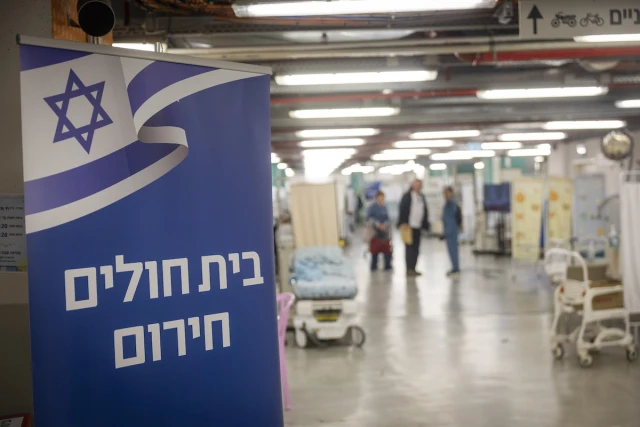
When the war broke out on Feb. 28, hospitals across Israel shifted to emergency mode, moving critical departments underground where care could continue in protected spaces despite missile fire.
Like many expectant mothers in Israel, Danielle was hoping the war would wrap up before she went into labor, she said last month in an interview interrupted by frequent sirens. However, the days stretched on with no sign of a ceasefire, and in the early hours of March 9 – after two overnight sirens sent her family scrambling to their shelter – Danielle’s contractions began.
At the hospital, she found that the safety of underground hospital bunkers comes at the expense of privacy and space for both patients and staff adapting to the new setup. Danielle was taken to a makeshift delivery area – an open space underground where beds were separated by thin white curtains.
“I was walking past people – men, women, everybody – clearly in labor. I felt so exposed. I’m just trying not to make eye contact with them,” she recalled. “And I don’t care, but at some point, I’m like, ‘This is just weird.’”
But labor waits for no woman – and neither do sirens.
“We’re all together in this room and you hear all the initial emergency messages going off (on everyone’s phones) and then the sirens are going off,” Danielle said, describing the manic scene.
Her son, Nadav, was born at 2:51 p.m.
“Of course, it was a joyful moment – and I'm just thinking, ‘I’m so glad it’s over,’” she said. “Had it been my first time, I probably would have fallen apart even more because it just felt so raw. It felt like, ‘Who are all these people? This is not private in the least bit.’”
The section for new moms was similar, a long corridor of moms separated by curtains. Loud, bright and exposed, with one shared bathroom and no call button to summon a nurse, the makeshift ward occupied one hallway while other departments spilled into adjacent corridors.
“I had this tiny little corner space, literally just enough room for my bed and the baby's bed,” Danielle said.
For her, one piece of good news came just in time: the mother-baby hotel had just reopened.
“That was all I needed,” Danielle said. “I would have gone home if it didn’t open.”
Of course, on the way there the following day with her husband, a newborn and the four older children, a siren blared as they crossed the parking lot toward the hotel.
“So we are rushing in like, ‘Hi guys, we just arrived!’ It was a crazy scene,” she said.
Danielle returned home to several more weeks of war – running to the shelter now with a newborn, managing remote schooling and hosting a modest brit milah.
“It was not at all what I desired, but it makes for a great story,” she laughed.
The phrase, “Man makes plans, and God laughs,” helped Danielle navigate the disappointment.
“You can have as many plans as you want – and it’s wonderful to make plans – but you have to be ready to let them all basically fall apart and slip away and be willing to be flexible,” she said.
After years of disruption – from the COVID pandemic to successive rounds of conflict – Danielle said the experience has underscored how essential adaptability has become for Israeli families navigating repeated crises.
“That’s the main thing I’ve really been thinking about lately – how can I help my children learn to be okay with being flexible?” she added.
You might also like to read this: