Armed guards, panic buttons and fear: The new reality for Jewish worship in America



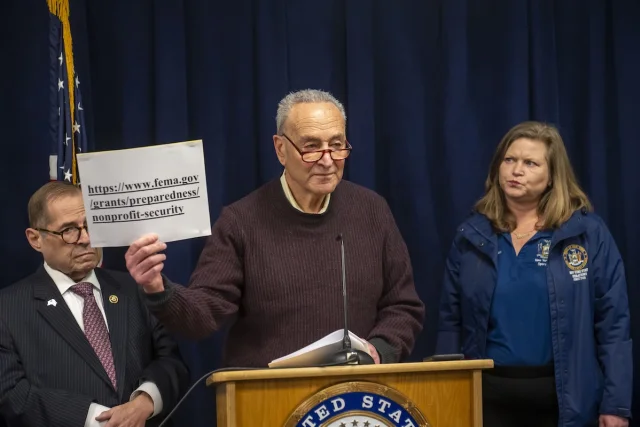
Just days after another wave of antisemitic threats and increasing security fears at Jewish places of worship across America, religious leaders descended on Capitol Hill this month with a blunt message for lawmakers: houses of worship are under siege and many congregations simply cannot afford to protect themselves alone. They need help…and financial assistance.
Rabbis, pastors, Muslim leaders and other religious and security officials spent the past week urging the U.S. Congress to significantly expand federal funding for synagogue, church and mosque protection. The vehicle for doing so is the Nonprofit Security Grant Program.
The request is pretty massive – an increase of funding to $1 billion annually as threats against faith communities continue to rise nationwide.
The coalition includes multiple religious groups, but the reality is that much of the urgency surrounding the push centers on the Jewish community.
For many Jewish Americans, synagogue life today comes with armed guards, metal barriers, surveillance cameras and active shooter drills. In some cases, Jewish schools resemble hardened security compounds more commonly associated with government facilities than religious education centers.
Rabbi Yaakov Menken, Executive Vice President of the Coalition for Jewish Values, told ALL ISRAEL NEWS that the transformation of Jewish life in America is painfully obvious.
“It is very common today for a synagogue to have a combination lock on the door, to deter an invader. How many other American houses of worship have to lock their doors?”
Menken says the changes extend far beyond synagogue entrances. “My children all went to school in what you would describe as an armed compound, with high metal gates. Some even have guards with automatic rifles strapped to their chests. That has become the new normal.”
That “new normal” is visible at synagogues across America. The concern is not theoretical anymore. Jewish institutions across the country remain on edge following months of escalating antisemitic incidents tied to the aftermath of the Oct. 7 Hamas terror attacks against Israel and the war in Gaza.
Protest activity outside synagogues, threats against Jewish schools and rising online extremism have forced many congregations to significantly rethink security.
The truth of the matter is that for many Jewish Americans, especially, it can feel more like entering a hardened security zone. Welcome to the new reality of Jewish life in America.
During the recent Capitol Hill lobbying effort, Jewish leaders warned lawmakers that demand for security funding has far outpaced available federal resources.
Synagogues are applying for grants to install reinforced doors, bullet-resistant glass, panic buttons, fencing, surveillance systems and trained security personnel – but many are being turned away simply because the money is running out.
According to reports tied to the recent Capitol Hill push, only about one-third of applicants for the Nonprofit Security Grant Program received funding last year because demand vastly exceeded available resources.
The effort to increase federal funding comes as antisemitic incidents continue to surge nationwide. Jewish leaders argue the security burden on synagogues has become financially overwhelming and emotionally taxing.
At a recent Shabbat service in West Bloomfield, Michigan, Rabbi Jen Lader of Temple Israel spoke openly about the growing fear many Jewish families now carry with them into synagogue life. Temple Israel itself became the site of a frightening attack earlier this year. It helped fuel the lobbying push in Washington.
Eric Fingerhut, president and CEO of the Jewish Federations of North America, says synagogues increasingly operate under conditions once associated with airports, embassies or government buildings.
Take the Tree of Life Congregation in Pittsburgh, Pennsylvania, as an example. After the 2018 massacre that killed 11 worshippers there, security became key to rebuilding the synagogue in the safest way possible.
Armed security personnel, controlled entry systems and enhanced surveillance are now considered essential components of any future reopening effort. The attack permanently altered how many Jewish institutions nationwide approach security planning.
Meanwhile, Temple Emanu-El in New York City has invested heavily in layered protection measures, including expanded camera systems, reinforced entrances and close coordination with the NYPD.
Security officials at the synagogue consistently assess threats tied to anti-Israel demonstrations and online rhetoric targeting Jewish institutions.
In Los Angeles, Wilshire Boulevard Temple has dramatically increased physical security in recent years. The synagogue now employs extensive surveillance systems, controlled-access entry points and visible armed security presence during major events and Jewish holidays.
Leaders there say the climate changed substantially after antisemitic protests increasingly targeted Jewish neighborhoods and institutions following Oct. 7.
The federal grant program at the center of this additional funding was originally designed to help nonprofits vulnerable to terrorist attacks.
Funds can be used for fencing, reinforced doors, security cameras, alarms, training and armed personnel, but nowadays, the demand has exploded in ways that many religious leaders, especially Jewish officials, would rather not see.
You might also like to read this: