Tel Aviv ranked as leading tech hub, predicts future depends on urban infrastructure





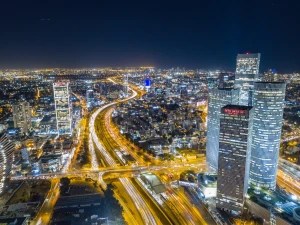
Israel’s financial capital, Tel Aviv, ranks among the world’s leading hubs for technological innovation, according to a new report compiled by U.S. real estate giant JLL. However, the study warned that the city’s future competitiveness will depend less on innovation alone and more on its ability to improve housing, transportation and urban infrastructure.
The report examined 135 cities worldwide with a combined population of 866 million residents and an annual economic output of $US54 trillion. The surveyed cities included 38 million tech workers and 937 million square meters of office space, with rankings based on innovation output and talent concentration.
The San Francisco Bay Area ranked first globally in innovation, followed by Beijing, Boston, London, New York, Paris, Seoul, Singapore and Tokyo.
The study placed Tel Aviv among 18 emerging international tech centers, alongside cities including Los Angeles, Berlin, Shanghai, Copenhagen, Stockholm, Zurich, Sydney, Toronto, Washington D.C., Cambridge and Amsterdam. Tel Aviv was specifically grouped with Berlin and Seattle as cities with rapidly rising tech profiles.
Looking ahead, the report concluded that future tech leadership will increasingly depend on whether cities can provide sufficient housing, efficient transit systems and modern urban infrastructure.
“The report places Tel Aviv in a clear position on the global innovation map, alongside cities such as Austin, Berlin, and Seattle,” Yaniv Lotringer, CEO of JLL Israel, said.
However, Lotringer warned that Tel Aviv must address potential bottlenecks, including limited office space, housing shortages, and transportation inefficiencies.
“But it also sharpens the next challenge: innovation does not exist only inside companies and fundraising rounds. It needs a city that works, with quality offices, transportation, housing, research institutions and an environment that creates connections between people, companies and ideas,” Lotringer explained.
“For Tel Aviv and Israel, the next question is not only how many companies will be founded here, but whether we can create the infrastructure that will allow them to stay, expand and attract talent,” he continued.
“Those who know how to plan today the work and living environments of 2030 will hold a significant advantage in the competition for global companies and top employees,” Lotringer concluded.
Tel Aviv has struggled for years with congested roads and insufficient public transportation, though major infrastructure projects are now underway. In November 2025, Israel officially launched the first phase of the historic $17 billion Tel Aviv Metro project, a central component in upgrading the city’s transportation network.
The JLL report nevertheless praised Tel Aviv’s innovation ecosystem. It noted, for example, that the city’s migration rate is 3.8 times that of San Francisco and other established anchor cities, which JLL viewed as evidence of strong human capital attraction.
Israel, widely known as the “Start-Up Nation,” has emerged in recent years as one of the world’s leading tech centers outside Silicon Valley, with Tel Aviv serving as the focal point of the country’s tech industry.
A 2023 study ranked Tel Aviv as the world’s fifth-largest producer of unicorn companies. The term “unicorn” refers to privately held startups valued at $1 billion or more.
Tel Aviv Mayor Ron Huldai hailed the city’s status as a global innovation center.
“I am proud that the City of Tel Aviv-Yafo is so well ranked in the ‘Global Founders Factory’ and that 27 leading local companies have ‘given birth’ to 108 innovative companies, founded by former employees of large companies.
These are the achievements of democracy, freedom and human rights, which have allowed the local high-tech industry to show amazing creativity and success over the past year,” Huldai stated.
You might also like to read this: