Women with weapons: Why the IRGC arms Iranian civilians



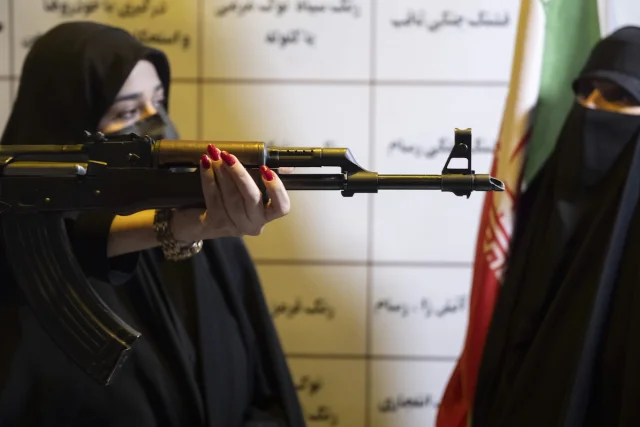
Footage of hijab-clad women loading assault rifles emerged from Tehran last week, trained and equipped by the Iranian regime ostensibly to defend Iran from the United States, but dissidents suspect a more sinister motive.
One video showed IRGC soldiers coaching civilians to shoot at life-size pictures of U.S. President Donald Trump and key figures with target markings on their foreheads. However, the true target, dissidents fear, is the Iranian people in the event of another uprising.
“They want to use the people against their own people because they know these children, women, they cannot fight against the Israelis or Americans,” said dissident and campaigner Gio Esfandiary of the Lotus Advocacy group.
“They worry about another round of national protests across the country. So they train them to use these guns against the people. Which is very sad,” he added, referring to the IRGC’s new scheme.
Many thousands of Iranians were killed earlier this year after nationwide protests and reports suggest that mercenaries from neighboring countries had been paid to crush the uprising. But now the regime is fast running out of money.
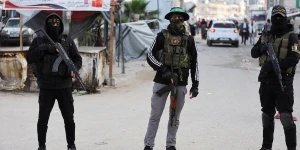
In what has been named the “Janfada” movement, revolutionary guards are teaching ordinary civilians how to assemble, disassemble, load and fire an AK-47 at military training booths, leading to the surreal scenes of flowing burkas with the sound of weapons being charged.
"The aim ... is to promote the culture of martyrdom and avenging the blood of the leader," said Nasser Sadeghi, a member of the IRGC at a booth in Haft-e Tir.
"The response from people, from women and men, has been extraordinary. It is entirely voluntary," Sadeghi told AFP, adding that more weapons could be introduced in the near future.
In agreement with Sadeghi’s words, an Iranian housewife said her motive was to avenge the blood of Ayatollah Khamenei:
"We bring our children and teenagers alongside us so they can see the military training, and whenever our leader, dearer than our lives, gives the command, we will all come to the field," she said, adding that they would continue fighting "until we take our rightful revenge for the blood of our dear leader."
“It is our duty to at least learn how to shoot and work with weapons,” said another mother of three who was learning to wield a Kalashnikov.
The stated aim of the Janfada movement is to “help the people of Iran play an effective role in confronting the American Zionist enemy and defending Islamic Iran.” According to Turkey Today, the official campaign encourages Iranians to sacrifice their lives for the cause.
The Iranian regime claims that millions have already registered, and that the Janfada campaign is being extended to Iranians living overseas.
However, many Iranians have expressed strong opposition to the regime, especially in the diaspora, where they are free to do so without fear of reprisals.
California-based Iranian artist and campaigner, Hooman Khalili, said he was “dead against” the regime’s new campaign but has instead created artwork on the same theme with the opposite message.
“My point is about self-defense, deterrence, and the imbalance of force – not promoting indiscriminate violence,” he said, referring to his latest mural, which ironically also calls for the armament of Iranian women.
Invoking biblical characters Deborah the judge and Yael, who struck down Sisera, a commander of the Canaanite army, he also quotes from Deuteronomy 32:35: “Vengeance is mine, and recompense, for the time when their foot shall slip; for the day of their calamity is at hand and their doom comes swiftly.’”
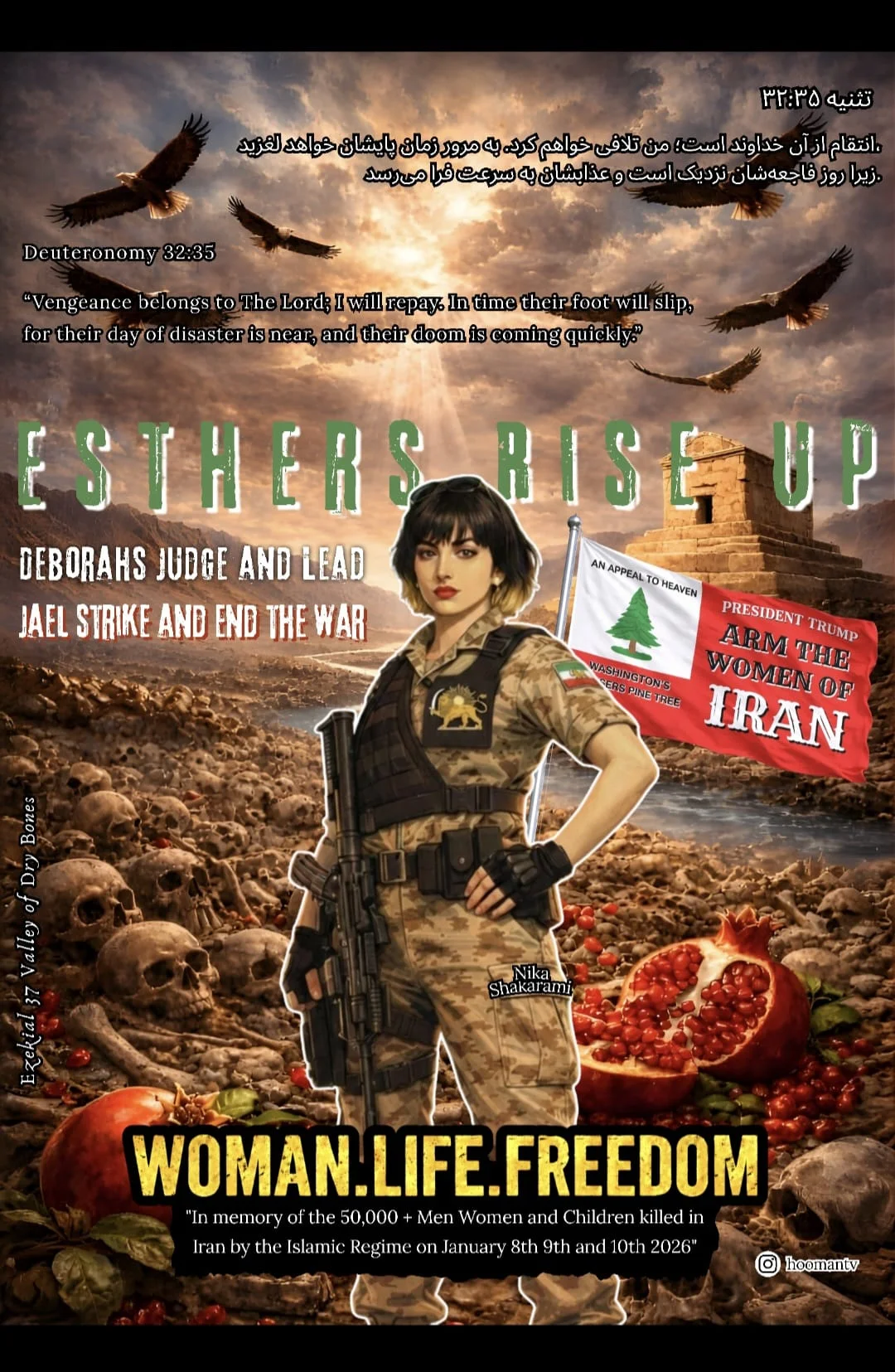
“When I use the phrase 'Arm the Women of Iran,' it comes from a place of heartbreak over what Iranian women and civilians have endured for decades,” said Khalili. “My murals have always had three goals: to inspire the people of Iran to keep fighting for freedom, to give a voice to the voiceless, and to remind the world of the ancient spiritual connection between Persians and Jews.”
Khalili, whose art has been displayed throughout the land of Israel, recently completed a piece now hanging in Indiana, USA, which includes the charge, “Arm the women of Iran,” alongside the cedar of Lebanon on a flag, with the words, “An appeal to heaven.”
“One of the painful realities in Iran is that ordinary civilians – especially women protesting oppression – stand overwhelmingly defenseless against a heavily armed state apparatus. Young women have marched into the streets carrying courage, conviction, and hope, while facing batons, prisons, bullets, and in many cases death,” stressed Khalili.
“My murals are declarations that the struggle of the Iranian people is being witnessed. They are reminders that tyranny is not permanent, that freedom matters, and that women risking everything for liberty should not be forgotten,” he added.
You might also like to read this: