First Druze female doctor in Israel honored for breaking social barriers and helping women




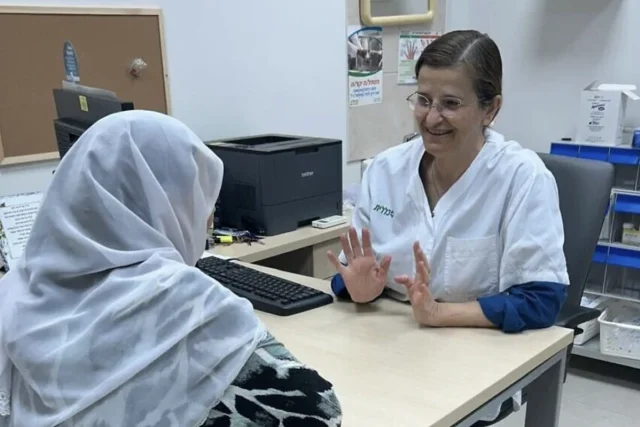
Dr. Nadia Khir received the Habama Shelahen Prize last week in recognition of her pioneering role as Israel’s first female Druze doctor, a milestone she achieved 35 years ago that helped open the medical profession to Druze women.
Khir (58) who lives in the Druze village of Julis, works as a gynecologist at four clinics in northern Israel and said her motivation stemmed from the lack of accessible care for women in her community who could not be treated by male doctors.
Because it is socially unacceptable in the conservative Druze society for men to touch women unless they are first-degree relatives, it has been difficult for women to seek help from male gynecologists. “This affected me so much, and I wanted to help,” Khir recalled.
“Choosing Dr. Nadia Khir means choosing a woman who broke barriers not only for herself, but for an entire generation of women in Druze society,” a spokesperson for the Habama Shelahen (Hebrew for "Their Stage") prize for women said in an official statement.
“She succeeded in changing deeply rooted social perceptions and proved that education, leadership, and personal fulfillment can strengthen an entire community. Her impact continues to this day,” the spokesperson added, noting that Khir paved the way for future generations of female Druze doctors. Today, there are around 40 Druze women practicing medicine in Israel.
During an interview with the Times of Israel, Khir traces her journey back to a moment in school when her biology teacher first suggested the then-radical idea that she become a doctor. “I was 18 and wanted to learn medicine, but at the time, it was forbidden for Druze women to go to university,” she explained, noting that young women who pursued higher education risked social exclusion from their families and the Druze community.
In 1985, Khir was accepted to study medicine at the Technion-Israel Institute in Haifa. She told the then-leader of the Israeli Druze community, Sheikh Faraj Fadul, that she wanted to study medicine, but she was afraid her mother would be punished for the decision.
“The sheikh looked at me,” Khir recalled. "Then he said, ‘Don’t worry, I will not punish your mother.’ He gave me the peace of mind to study.”
“But I needed so much courage.”
Around 180,000 Druze live in Israel today. The Druze are an Arabic-speaking ethnoreligious group that emerged in the 11th century as an offshoot of Ismaili Shiite Islam and maintains a distinct identity, with no acceptance of converts. Since Israel’s founding in 1948, the Druze community has developed close ties with the state, and many Druze men serve in the Israeli military.
Haifa University recently launched the "Northern Radiance" program designed to help Druze IDF veterans pursue an academic education. The program was established to express gratitude towards the Druze community’s contributions to the Jewish state and Israeli society.
You might also like to read this: