Israeli researchers suggest aging may be regulated, perhaps even reversed





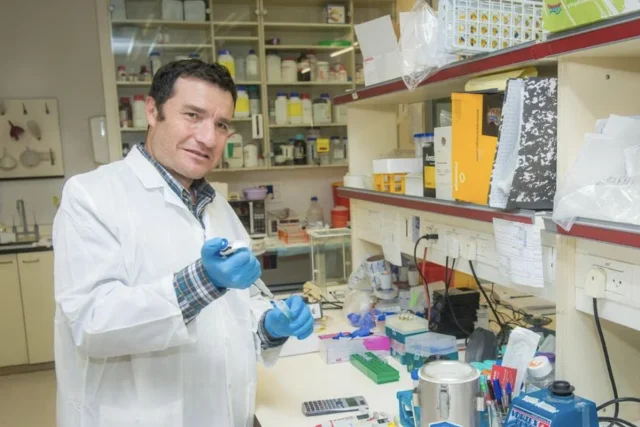
A recently published study by researchers at Bar-Ilan University has sparked speculation that the aging process can be regulated, if not reversed.
The study, conducted by a team led by Prof. Haim Cohen and including doctoral students Ron Nagar and Zecharia Schwartz, appeared in the journal Nature Communications. The researchers detailed experiments showing that increasing the expression of a protein called SIRT6 affected chromatin structure, which determines which genetic structures are activated and which are not.
Scientists believe this process plays a central role in aging. As chromatin function deteriorates over time, tissues begin to degenerate. The researchers suggest that if chromatin activity can be regulated to continue functioning at younger levels, the breakdown of living tissues could potentially be slowed.
Professor Cohen, who is part of the university’s Faculty of Life Sciences and heads the Sagol Healthy Human Longevity Center, has spent years researching the role SIRT6 plays in the human body.
“We previously showed that SIRT6 is a key player in longevity and that mice engineered to overexpress it live 30% longer,” he explained. “It causes a variety of positive health changes: lower cancer risk, improved blood chemistry, more efficient sugar and fat metabolism and, of course, better use of energy reserves. When we’re young and exhausted, we know how to find and use energy sources in the body. In old age, we fail at that. This protein enables that process.”
Other experiments have demonstrated that genetic markers and materials in living tissues are activated or deactivated in ways that determine how tissues function. Although the tissues in a human liver and heart contain the same genetic material, they behave differently because different genetic sequences are activated in their cells.
Professor Cohen explained that the activation and deactivation of these genetic processes are also linked to aging and tissue degeneration. In some people, this process occurs more slowly than in others, a phenomenon researchers believe may be connected to varying levels of chemicals in the body that influence how genetic sequences operate.
“We found that this packaging process becomes disrupted with age,” Cohen said. “When you are young, certain regions are closed, and in old age they suddenly open. On the other hand, regions that were open suddenly close in old age. Many of the genes that activate the liver are no longer expressed and lose synchronization. This has enormous significance, and we also showed that it is not random; it happens in very specific regions.”
Further research determined that chromatin levels are among the factors influencing how these genetic sequences proceed. Since SIRT6 plays a role in controlling chromatin structure, Cohen hypothesized that regulating SIRT6 levels in the body could influence the aging process itself.
“We know that one of its roles is determining what chromatin packaging looks like,” Cohen explained. “It interacts with proteins located in the chromatin and slightly modifies them. It essentially controls how chromatin is packaged, which genes are expressed and which are not.”
“This has enormous potential,” he said. “A company we founded in Israel called SirTLab is developing such a drug and is currently preparing for clinical trials. The goal is to target the liver and improve the physiology of older individuals.”
He cautioned that a great deal of further research would need to be conducted before such treatments become available to the general public, though interest in anti-aging therapies is likely to attract the necessary funding.
The study has also attracted interest beyond the scientific community. The Bible’s early chapters describe people living for hundreds of years before the Flood, though Genesis 6:3 states: "My Spirit shall not strive with man forever, for he is indeed flesh; yet his days shall be one hundred and twenty years."
Additionally, the developments carry political implications, as Israeli universities have been targeted by campaigns seeking to remove them from the European Union’s Horizon research program, which funds scientific and medical research.
You might also like to read this: