When geography tells the story: a biblical lesson from the Valley of Jezreel





We are all familiar with parallels between stories in the Bible – where one narrative reminds us of another, both in content and in the repetition of similar words.
For example, Noah is portrayed as a continuation of Adam and receives blessings and roles similar to those given to Adam after the world was corrupted by the flood. Joshua is marked as the successor of Moses when he leads the Israelites through the waters of the Jordan River, just as Moses led the people through the waters of the Red Sea. Likewise, the prophet Elisha repeats the miracles performed by his teacher, the prophet Elijah, thereby establishing his role as a prophet over Israel.
But did you know that the Bible also contains geographical analogies? Going back to a location from a past story to recount a tale that mirrors the former one in both literary and geographical aspects.
In this article, we will discuss one such example: two stories that take place in exactly the same location but end very differently. The first story creates a stage for the second, so the reader naturally assumes the ending will also be similar. Yet, the narrative tension – built upon the same geographic setting – leads to a surprising and opposite conclusion.
The location: Jezreel Valley at the foot of Mount Gilboa
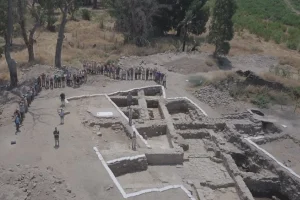
Both of our stories take place in the same valley at the foot of the same mountain. In both cases, the army of Israel prepares to fight a threatening enemy. At the foot of the mountain, the Israelites gather at a spring in both accounts, and a unique night vision is present in both stories.
In both stories, one army wins while the other flees toward the Jordan River and beyond. The key difference between the stories is who wins and who loses.
The initial story we'll cover is that of Gideon.
We read in the Book of Judges, chapters 6-8, about Gideon's battle against the Midianites. After prolonged negotiations between Gideon and the Lord, Gideon accepted the mission to fight the Midianite army that threatened the tribes of Israel. Gideon prepared for battle in the Valley of Jezreel (Judges 6:33), at the foot of Mount Gilboa (7:3), by the Spring of Harod (7:1), facing the Hill of Moreh (7:1).
At the spring, the well-known scene took place in which Gideon allowed his soldiers to drink from the water and sent home those who did not drink in the correct manner. Only 300 soldiers remained with him.
In the middle of the night before the battle, Gideon and his servant went to spy on the enemy camp. There, they overheard a soldier recounting a prophetic dream indicating that Gideon and the Israelites would strike a decisive blow against the Midianite army. Indeed, Gideon prepared his forces, and they created a panic in the Midianite camp. The Midianites and their allies fled eastward beyond the Jordan River.
The story is so dramatic and the victory so remarkable that it is also mentioned in Psalm 83:11 and in Hebrews 11:32.
A parallel story: The fall of King Saul
Now, in exactly the same place and under very similar circumstances, another story unfolds – one that even begins similarly.
At the end of 1 Samuel, we read about King Saul going out to fight the Philistine army. Saul and his army assembled in the Valley of Jezreel (1 Samuel 29:1), at the foot of Mount Gilboa (28:4), by a spring (29:1), opposite a village at the foot of the Hill of Moreh (28:4).
Yet, despite the strong similarity between Saul’s story and Gideon’s story, several important differences can be noticed from the beginning.
First, Saul didn’t have any dialogue with the Lord. While Gideon was afraid to go out to battle, he nevertheless received encouragement through divine revelations. Saul, however, receives no answer from God despite repeatedly seeking guidance (1 Samuel 28:6).
Another difference is the size of the army: while Gideon decimated his forces to only 300 men, Saul gathered all Israel (1 Samuel 28:4).
Similar to Gideon's experience of receiving a message via a vision, Saul also got one through a supernatural vision. But what a terrible message it was! Saul consulted the medium of Endor, who summoned the prophet Samuel. Samuel declared that Saul's fate was to fall in battle against the Philistines.
And indeed, in contrast to the story of Gideon – where the Midianites were defeated and fled toward the Jordan – in Saul’s story, the Israelites themselves were defeated and fled toward the crossings of the Jordan.
The lesson hidden in the landscape
The parallel between the two stories highlights their essential difference: in one story, a leader called by God to save Israel was guided by God to victory. In the other, a king chosen by the people rather than by God – and who has lost his connection with the Lord – brought destruction and defeat upon his people.
The Valley of Jezreel teaches us that the same circumstances can lead either to triumph or tragedy – depending on whether God is truly leading the battle.
You might also like to read this: