Ancient Israelite mansion stone may provide evidence of King Hezekiah’s biblical reform




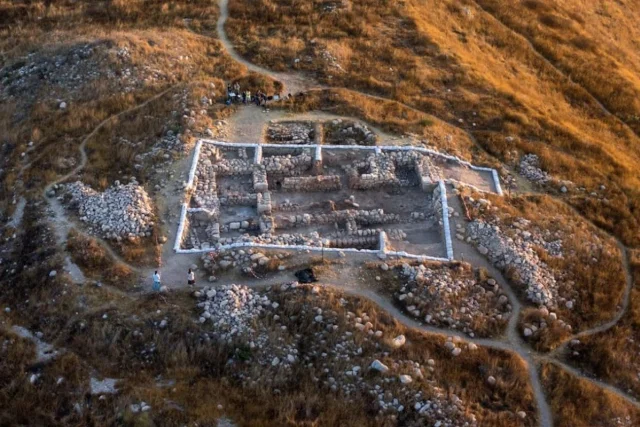
A 2,750-year-old standing stone discovered in an Israelite mansion at Tel Eton, south of Jerusalem, could provide new archaeological evidence related to the biblical King Hezekiah’s efforts to centralize Jewish worship in Jerusalem, according to a new study from Bar-Ilan University.
The study, authored by Prof. Avraham Faust, argues that the artifact may have functioned as a massebah, or standing stone, a religious feature commonly used throughout the ancient Near East. If the interpretation is correct, its apparent destruction could align with Hezekiah’s biblical campaign against local worship sites and religious symbols outside of Jerusalem.
The ancient artifact weighs around 750 kilograms (1,650 pounds) and measures 1.4 meters (4.6 feet) high.
“Standing stones were a common religious feature in the ancient Middle East and beyond from prehistory to a much later period, and are attested in both archaeological finds and written sources, including in the Bible,” Faust said in an interview with The Times of Israel.
“People used large stones as a symbol,” he continued. “Their exact meaning is debated, but all scholars agree that they were used in religious contexts."
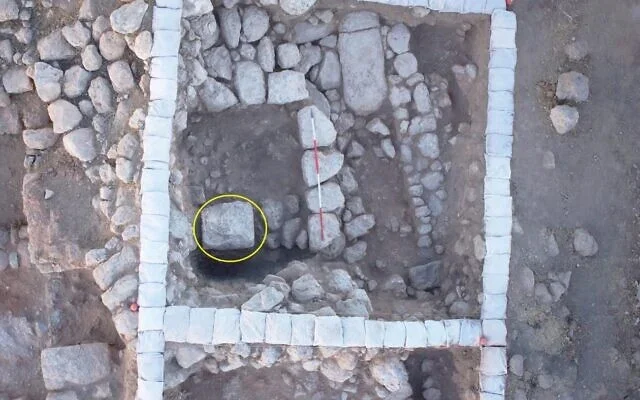
According to the study, the stone was originally incorporated into the structure of a typical Israelite four-room house. Following the destruction of the home, however, it appears to have been removed from its original position and repurposed.
The stone was uncovered during excavations conducted between 2014 and 2015, but researchers did not immediately recognize its significance.
“We did not immediately understand what we had found,” Faust recalled.
“At the beginning, we thought the stone layer was part of the collapse of a wall, and that the large stone was part of it. We removed all the other stones, but the large one was far too heavy. We initially considered breaking it into pieces to make it easier to remove, but after starting the process, we decided against it. Only later, we understood that it must have been a massebah,” he explained.
“Most scholars consider and debate two main reforms that led to religious changes during the Iron Age, Hezekiah’s and King Josiah’s,” Faust said.
He added, “Since Josiah’s reform is thought to have happened later in the 7th century, it is not really relevant, but Hezekiah is believed to have reigned in the 8th century, so it could fit.”
A passage in II Kings (18:3-4, JPS translation) specifically refers to the destruction of standing stones during Hezekiah’s reign: “[Hezekiah] did what was pleasing to God, just as his forefather David had done. He abolished the shrines and smashed the pillars (massebahs) and cut down the sacred post.”
Faust acknowledged that scholars remain divided over the extent of cultic activity in local buildings throughout the Kingdom of Judah.
“The debate has focused on public buildings devoted to cultic activity, but we have very few such buildings from Judah, and even considering additional evidence for public cult, we are left with evidence from three or four sites,” he said. “Their interpretation is debated. For some scholars, they are enough to prove the reform; for others, they are not. But if we look carefully at domestic architecture, we might find additional evidence.”
Faust said several questions remain unresolved, including whether the stone was still standing during the building’s final phase and whether the room was used exclusively for religious purposes.
“Contrary to its last phase, we do not have anything that tells us about the daily life there when the stone stood, but I think it’s more likely that the room was also used for other purposes.”
Help more people find our reporting from Israel! Leave a quick Google review of our website HERE .
You might also like to read this: