US & Iran officially sign Memorandum Of Understanding, as Trump warns he could resume strikes if ‘they don’t behave’
Negotiations over nuclear issue will not limit ballistic missiles, Iran says





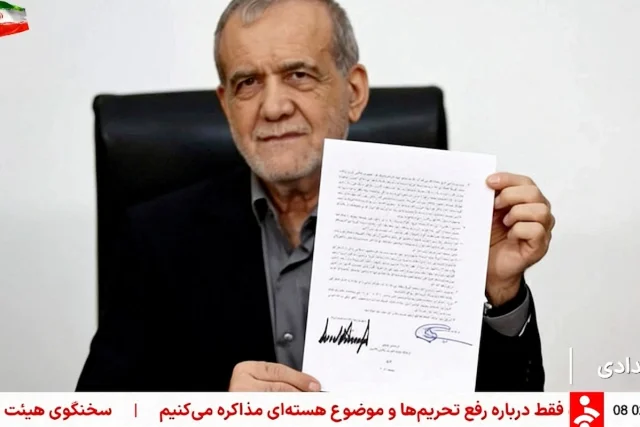
U.S. President Donald Trump and Iranian President Masoud Pezeshkian officially signed the Memorandum of Understanding on Wednesday, the White House acknowledged early Thursday.
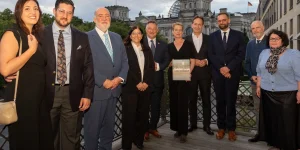
President Trump signed a physical copy of the MoU at Versailles, while attending the G7 summit in France, alongside several world leaders, including French President Emmanuel Macron.
Shortly thereafter, Iranian state media reported that Iranian President Masoud Pezeshkian had received a copy of the MoU with Trump’s signature, and had officially added his signature.
“The text of the Islamabad Memorandum of Understanding was finalized with the signatures of the presidents — now it is time to test the implementation of the agreement,” Iranian Foreign Ministry spokesman Esmaeil Baghaei was quoted as saying by state news agency IRNA.
🚨 President Donald J. Trump has SIGNED the Iran Memorandum of Understanding at Versailles in France. 🇺🇸 pic.twitter.com/JQ6qlbvFAF
— The White House (@WhiteHouse) June 17, 2026
Additionally, U.S. Vice President JD Vance and Iranian Parliament Speaker Mohammad Bagher Ghalibaf were said to have digitally signed the MoU.
Pakistani Prime Minister Shehbaz Sharif announced the signing of the agreement by both sides, saying it would lead to the immediate opening of the Strait of Hormuz.
“The signing of this agreement at the highest level of the respective governments demonstrates the commitment of both sides to a diplomatic resolution of the conflict. Islamabad MoU shall enter into force with immediate effect and as a first step, [the] Islamic Republic of Iran will instantly reopen the Strait of Hormuz and the United States of America will immediately lift the naval blockade,” Sharif posted to social media.
The signing of the MoU also meant that the full text of the memorandum was finally revealed. The final text is very similar to the version leaked on Arab news outlets earlier this week.
Israeli government and security officials believe the deal is a bad agreement, despite the fact that Israel is not mentioned in the memorandum.
"This is not what we bargained for," Israeli sources told Ynet.
Israeli leaders are particularly vexed that the memorandum not only does not place any limits on the Islamic Republic’s ballistic missile or proxy programs, both of which have largely been used to target Israel and its partners in the Middle East, but that such topics are also not part of the agenda for the negotiations to take place over the next 60 days.
Iranian Foreign Ministry spokesman Baghaei went so far as to say that Iran will not discuss any of its “defensive capabilities.”
"Iran's defensive capabilities will not be discussed in any process or with any party," Baghaei said. "Our missiles don't like it at all when anyone talks about them.”
Baghaei’s statements came after President Trump said that the U.S. and its Gulf partners would be working to address “nonnuclear issues, such as the conventional ballistic missiles.”
However, Trump himself ruled out any attempt to prevent Iran from having ballistic missiles, saying, “They have to have some because other people have some.”
He pointed out that other countries in the region, such as Saudi Arabia, also have ballistic missile stockpiles.
🚨WATCH: In another stunning statement, Trump just normalized Iran having a ballistic missile program: “In other words, they must have missiles to some degree, because others have them. When others have them, you need to have them too. There are people who say: 'It is forbidden… pic.twitter.com/OUwiuSoehy
— Raylan Givens (@JewishWarrior13) June 17, 2026
“A ballistic missile is not the same thing as what we’re talking about when we talk nuclear,” Trump told reporters in France.
Iran targeted Israel, the United Arab Emirates, and Saudi Arabia with its ballistic missiles during Operation Roaring Lion, and sent hundreds of ballistic missiles towards Israel during 2025’s Operation Rising Lion, and following the assassination of Hamas leader Ismael Haniyeh in Tehran in 2024.
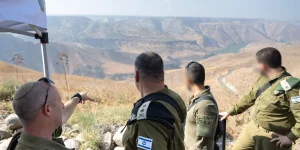
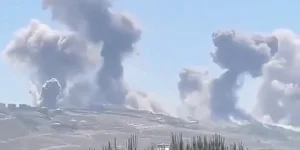
Israeli officials are also frustrated that the agreement forbids any military action in Lebanon, where the IDF and Hezbollah have continued to trade blows since the start of the ceasefire. Israel does not believe that Hezbollah will abide by the ceasefire.
Iranian Parliament Speaker Mohammad Bagher Ghalibaf said the memorandum represents a “failure” for the United States.
“The agreement is a record of US failure. People will see it and judge,” Ghalibaf said in a statement to Iranian state TV.
Ghalibaf also admitted that Iran plans to charge for transit of the strait after the 60-day period of agreement has passed.
“The Strait of Hormuz will not return to pre-war conditions,” Ghalibaf said, adding, “Iran has the right to sovereignty over the Strait of Hormuz and of course we will receive a fee for services.”
Earlier on Wednesday, Trump appeared to say the memorandum is not the final agreement between the U.S. and Iran, saying he could return to military operations against Iran, if “they don’t behave.”
“It’s a memorandum of understanding. If I don’t like it, if they don’t behave, we’ll go right back to dropping bombs right smack in the middle of their head, okay? Because they’ve misbehaved for 47 years,” Trump said in remarks alongside Egyptian President Abdel-Fattah el-Sissi at the G7 summit.
BREAKING: "If I don't like it, we'll go back to shooting at them, dropping bombs on their head."
— Fox News (@FoxNews) June 17, 2026
President Trump warns Iran that any change to the peace agreement or failure to comply could bring an immediate military response.
"If they don't behave, we'll go right back to… pic.twitter.com/67JRcDptYS
He went on to say his deal is better than the JCPOA negotiated by former U.S. President Barrack Obama, because that deal included the delivery of over $1 billion in cash to the Islamic Republic.
You might also like to read this: