Jewish settler violence in West Bank is surging, Israeli volunteers are showing up anyway
Israeli volunteer organization, Bnei Avraham, stands between settlers and Palestinian farmers


Israeli settler violence against Palestinians in the West Bank has reportedly reached levels human rights organizations describe as unprecedented – and it is getting worse.
Since the Hamas attacks on Oct. 7, 2023, the United Nations has documented a sharp rise in settler attacks on Palestinian farmers, including crop destruction, livestock theft, physical assaults and the rapid construction of outposts designed to displace entire communities.
Concern over the trend has also been voiced by some Israeli political figures who have historically favored expansion in the West Bank. In March, former Israeli Prime Minister Naftali Bennett condemned the rise of settler violence.
"We did not establish a Jewish state so that violent gangs would operate within it," Bennett wrote on 𝕏.
Volunteers who regularly accompany Palestinian farmers say the attacks are part of a broader effort to drive Palestinians from their land.
“The purpose is to terrorize them, defeat them and make them want to go away,” said Chen, a volunteer with Bnei Avraham, an Israeli organization, and who asked to be identified by her first name only.
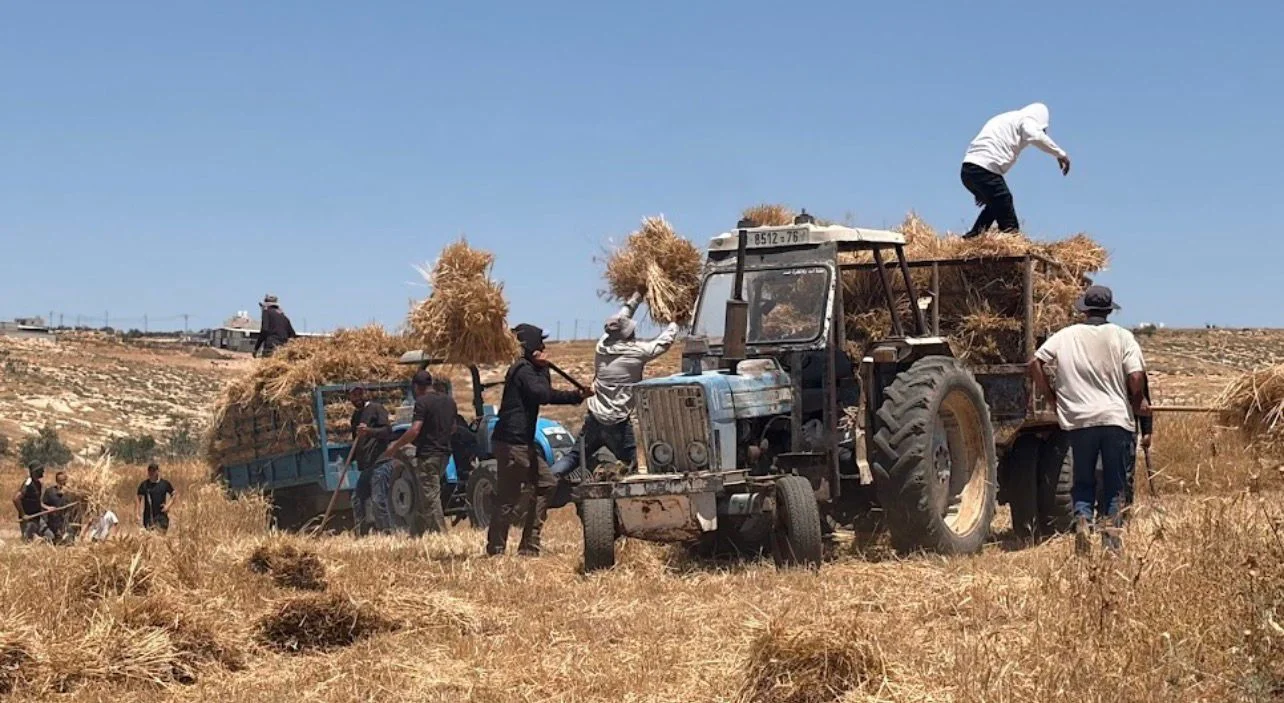
This year's wheat harvest has become a confrontation zone for Palestinians who depend on agriculture to survive. Bnei Avraham volunteers have been standing between settlers and Palestinian farmers during harvest season in what they call “protective presence.”
The escalation did not emerge in a vacuum. After Oct. 7, Israel closed its borders to Palestinian workers employed inside Israel, eliminating a vital income source for tens of thousands of families and pushing them back toward agriculture, which many hadn’t practiced in years.
At the same time, Israel's far-right Finance Minister Bezalel Smotrich began implementing what volunteers call the “tochnit hakra’a" – a plan that treats the Oslo Accords as void and calls for rapid settler-outpost expansion across the West Bank.
Bedouin communities near Jericho have already been displaced. And in the southern Hebron hills, the area of Dahariya has seen multiple new outposts built in the past month alone.
Palestinian farmers face a compounding legal pressure: West Bank land law requires active cultivation to maintain ownership. Abandoning fields, whether from fear or displacement, can mean losing them permanently.
The violence is not abstract. Two days ago, the Times of Israel reported that a group of Palestinians and Jewish activists were attacked alongside a CNN media crew near the Hebron area town of Halhul.
A few weeks ago, a Palestinian farmer named Morad and his 11-year-old son were beaten with a baseball bat by settlers while working his land near Dahariya. Morad was hospitalized and his son was left traumatized.
Attacks like this have become increasingly common and go largely unanswered by Israeli security forces, Palestinians say.
Founded around the time of the Second Intifada and more active since Oct. 7, Bnei Avraham now counts roughly 200 members drawn from across the Israeli religious spectrum, including ultra-Orthodox, modern Orthodox and religious Zionist Jews.
The group is currently one of the most active protective-presence organizations in the West Bank, providing regular accompaniment to Palestinian farmers nearly every day.
Bnei Avraham is also planning a fundraising trip to the United States to help cover transportation costs and food packages for Palestinian communities, which they will distribute during the holidays.
The premise of protective presence is straightforward: settlers armed with drones, binoculars, and cameras are less likely to attack when Israeli citizens or international observers are watching. “The blood of the Palestinians is allowed,” Chen said, “but if they hurt me, it’s not okay.” That asymmetry is the whole strategy.
Distinguishing it from similar groups, Bnei Avraham is rooted in Jewish religious identity and committed to its cause.
“It’s not just protective presence and then we leave,” she said. “We build relationships and friendships. We believe in the same God. We’re all sons of Abraham.”
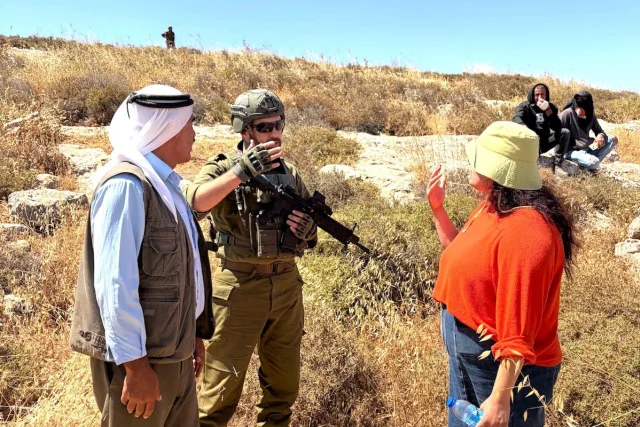
Meg Corbus, an American Israeli who has been involved in caring for Palestinians in the West Bank for 12 years, faced off against settlers when she joined Bnei Avraham to stand with Palestinian farmers near Dahariya on June 5.
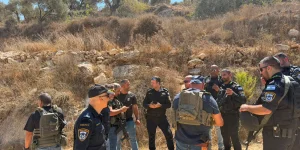
Shortly after they arrived, settlers appeared on a hill above the field, followed by the Israeli military and police.
“We could see the settlers up on a hill, then the army came and then the police came and then the settlers came up to us,” Corbus said. "The settlers photographed the face of each person present – Palestinians and all volunteers."
According to Corbus, soldiers instructed the Palestinian farmers to leave part of their land, after which settlers took 10 to 15 bales of harvested wheat along with the farmers' equipment. He said a soldier later gave the farmers 10 minutes to collect the remaining wheat, but the deadline was withdrawn after a settler approached the soldier and spoke to him privately.
Chen said the soldier immediately reversed his order after that.
“A moment after he whispered it, the IDF said to leave,” Chen said. “In that moment, he flipped and kicked us out. Two hours after the volunteers departed, settlers returned in government-issued vehicles and drove through the remaining wheat fields, destroying the crop.”
Chen captured the incident on video.
She believes the footage demonstrates "cooperation between the IDF and the settlers.”
Corbus said that although she remained safe, it was “total intimidation."
For both women, the question is ultimately a moral one – and a religious one.
Chen cannot justify the violence with her faith.
“They say they’re doing it in the name of Judaism,” she said. “For me, I can’t stay silent with people doing this in the name of my religion and my God. This is not what God wants.”
Corbus, a Christian, agrees.
“If I were a Polish or German person and I saw Jews being persecuted and didn’t do something, how different would I be?” she said, careful not to compare Jews to Nazis.
She is especially troubled by what she called a reflex among American Christians to conflate Palestinian existence with opposition to Israel.
“They look at every Palestinian and immediately think they’re against God’s purposes and lump them all together with Hamas,” Corbus said. “If I could undo something, it would be that.”
Neither woman believes a few hundred volunteers can completely reverse what is happening. But they’re not stopping.
“When we see the occupation end, we don’t want to go back to drinking coffee in Tel Aviv. We want to build the shared future we see together,” Chen said.
If you are interested in supporting Bnei Avraham's work, you can donate by clicking here.
You might also like to read this: