France’s ban on Israeli participation at major defense expo exposes strategic shift in defense relations
Paris weaponizes expo regulations to bar Israeli state officials and offensive tech, forcing a multi-million euro diplomatic showdown and accelerating a global market pivot



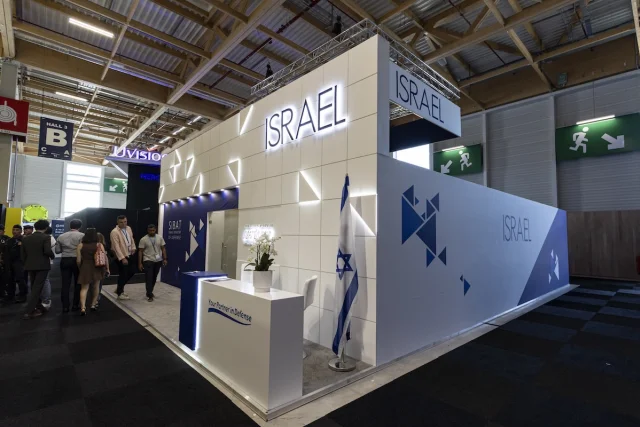
France’s move to bar official Israeli participation at a major security exhibition has turned a commercial defense event into a barometer of political strain between Paris and Jerusalem.
The decision combines a ban on government representation with tight limits on what Israeli firms may exhibit, continuing a clear pattern that has emerged over the past two years at the 2026 Eurosatory International Defense and Security Exhibition.
France informed Israel’s Defense Ministry that official Israeli presence at Eurosatory 2026, set for June 15-19 in Paris, is banned.
Eurosatory is a leading global defense expo that showcases military systems and security innovations from around the world. The event operates under the official patronage of the French Ministry of Armed Forces.
Under the current edict, government representatives, including the export directorate SIBAT and the International Defense Cooperation Directorate of the Israel Ministry of Defense, which orchestrates critical government-to-government sales, are barred from attending or operating a national pavilion.
Conversely, France and show organizer COGES Events frame the decision as a matter of principle, stipulating that Israeli companies may only exhibit if they restrict themselves exclusively to air- and missile-defense systems, with offensive weapons explicitly banned, as detailed by Defense News.
Israel’s Defense Ministry issued an official statement, condemning the move as disgraceful, selective and discriminatory. Jerusalem notes that the restrictions apply uniquely to Israeli exhibitors while leaving other participating nations free to display strike hardware.
This double standard directly violates the core principles of global trade conventions, which require fair market access and prohibit national discrimination at commercial expos, and it also ignores France's own domestic trade laws.
Writing for the strategic defense journal Defence24, European security expert
Dr. Aleksander Olech warns that this targeted restriction carries severe systemic consequences.
"The case of Eurosatory shows that defense exhibitions are no longer neutral industrial spaces," he said, adding that they are rapidly "becoming political battlefields."
By allowing political morality to dictate market access, analysts emphasize that France is introducing commercial protectionism into international security forums, a move that will ultimately force targeted democracies to permanently decouple their supply chains from erratic European hosts.
This clash represents a tactical evolution for Paris. After the Paris Commercial Court struck down France’s attempted blanket ban on Israeli companies and defense officials at Eurosatory 2024 as discriminatory, Paris shifted toward narrower, category-based restrictions.
This regulatory strategy was tested at the 2025 Paris Air Show, where French officials erected physical black partition walls around Israeli displays of offensive weaponry.
By 2026, targeting offensive systems and blocking ministerial bodies allowed the French executive to bypass domestic legal hurdles, successfully erasing Israel’s official military showcase while barring defense officials from attending altogether.
Commercial rivalry runs alongside these political dimensions, as Israel’s defense sector competes directly with French manufacturers in high-value areas such as UAVs and precision munitions.
Despite diplomatic friction with the Israeli government and fierce accusations from left-wing opposition parties in the French National Assembly, French Defense Minister Sébastien Lecornu declined to call it an embargo.
He said Israel, instead, is imposing the embargo by halting French weapons procurement. In reality, Israel stopped buying French weapons in 2025, alleging that Paris was planning to hold back vital spare parts to use as political leverage against the Jewish state.
Dozens of Israeli firms had planned to attend and still may under the new rules. However, without an official pavilion or strike weapons, their collective impact and visibility are crippled.
Meanwhile, non-democratic states face no restrictions on assault weaponry, highlighting a sharp, punitive contrast when compared to the restrictive rules applied solely to Israeli participants.
The episode reflects a wider breakdown in defense ties between Jerusalem and Paris. Earlier this year, Israel reportedly halted defense exports to France over a pattern of hostile policies.
This followed growing French criticism of operations in Gaza and Lebanon, France’s recognition of a Palestinian state and the inclusion of "Palestine" on Eurosatory's official guest list, according to National Defense Magazine.
Regionally, the policy aligns with France’s bid to position itself as a defender of humanitarian law while pressing for de-escalation in Lebanon.
France has traditionally had a say in Lebanon, but the French government has recently been entirely excluded from U.S. mediated talks between Beirut and Jerusalem.
Ultimately, Eurosatory 2026 serves as a harsh reminder that European defense platforms are no longer neutral ground for Israel, raising broader questions about France's predictability as a host and partner in defense.
Fearing future weaponized bureaucracy, Jerusalem is pivoting its technological and strategic alliances toward more reliable partners in Asia, Eastern Europe and the United States.
You might also like to read this: