Why every Israeli politician is suddenly clamoring for a ‘unity government’ – and why it’s unlikely to happen
In the Israeli psyche, there is a distinct danger posed by the lack of unity



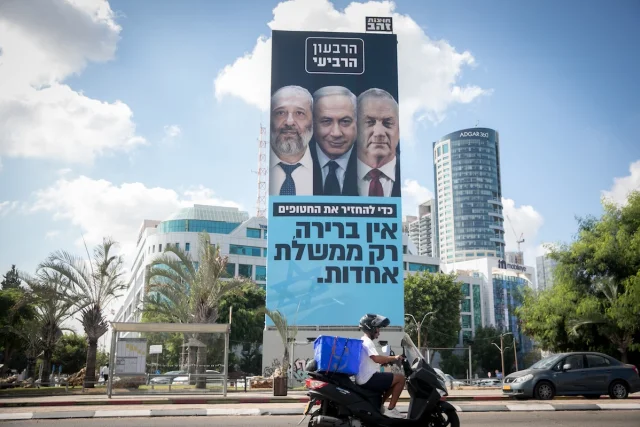
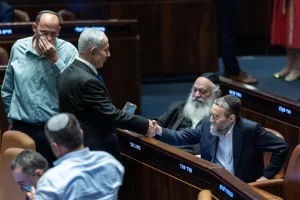
With elections creeping closer and the parties slowly ramping up their election campaigns (this author already received a first campaign SMS from Ben Gvir), Prime Minister Benjamin Netanyahu this week revealed his first big campaign slogan: He now claims to want a “broad, national government.”
Notably, this alludes to, but is slightly different from, a more commonly used Hebrew political phrase: “broad unity government,” or memshelet ihud rehava.
In the Israeli psyche, there is a distinct danger posed by the lack of unity.
Particularly religious Jews, but also other segments of society, are often warning of sinat chinam, meaning baseless, senseless hatred among the Jewish people. According to the Babylonian Talmud, it was this particular sin that caused the destruction of the second Jewish temple.
These existing sentiments took on new significance after Oct. 7, which had been preceded by years of intense conflict between the pro- and anti-Netanyahu political blocs, and is now often interpreted as a period of sinat chinam that led to another catastrophe.
Accordingly, the demand for unity has been almost universal since then.
A poll by i24 News this week showed that an overwhelming majority of respondents favor a broad, unifying government, with a full 50% supporting a true cross-bloc unity government. 27% said they want to see a coalition of the current opposition parties with (some of) the Arab parties, while 23% want a repeat of the Likud-Haredi-led coalition.
As the war has progressed, the opposition has increasingly resumed its accusations that Netanyahu and his government don’t represent most Israelis. It has particularly marked issues like the hostage crisis, and now the military service of Haredim (the ultra-Orthodox), as points where the government diverged from the majority opinion of (Jewish) society.
Knesset Seat Poll
— Israel Elects (@israel_elects) July 1, 2026
🔵Likud: 21 (-2)
🔴Yashar: 20
🔴Together: 17 (+2)
🔴Democrats: 11 (+1)
🔴Yisrael Beteinu: 10 (-2)
🔵Shas: 9 (+1)
🔵Otzma: 8 (-1)
🔵UTJ: 8
🟢Hadash-Ta'al: 6
🔵RZP: 5
🟢Ra'am: 5 (+1)
changes w. June 24
via Hamadad/Chan13, July 1 pic.twitter.com/PpaCc6ALaA
Therefore, in the political discourse of the last few years, the term “unity government” has mostly been used to mean either a governing coalition without Netanyahu (only opposition parties), or a government with him, or at least with the Likud under new leadership, but without the Haredi parties.
Making matters worse, none of the blocs are currently projected to win a majority, making some kind of cross-bloc cooperation necessary to avert another cycle of repeat elections.
All of this made the veteran campaigner Netanyahu decide to flip this slogan to his advantage.
Speaking during a press conference ostensibly focusing on Lebanon, Netanyahu suddenly began demanding unity: “We have enemies on the outside, and they are undoubtedly waiting for us to descend into civil war… I intend to establish a broad national unity government.”
But in a statement released shortly afterwards, the phrase was honed, and now read, “I intend to establish a broad national government that will rest on the broadest possible consensus on the central issues.”
In the press conference, he explained that this meant “not a narrow government, not a left-wing government that depends on Arab parties, but a broad national government… enough with the boycotts.”
In the follow-up statement, Netanyahu also laid out his positions on the “central issues” around which he wants unity: Israel as the nation-state of the Jewish people; self-defense by its own means; ensuring economic, energy, and defense-industrial independence; and no Palestinian state between the Jordan River and the Mediterranean Sea.
This, in theory, is acceptable to nearly all political parties, with the exception of the Arab parties, and possibly the left-wing Democrats; however, there is no mention of the issues that have been most divisive – like the judicial reforms, ultra-Orthodox enlistment into the IDF, and his continued premiership despite the ongoing corruption trial.
And finally, in an interview with Channel 14, Netanyahu revealed his hand, acknowledging that while he wants “the broadest possible consensus you can achieve, that doesn’t mean unity, because you won’t achieve complete unity… But you can broaden the base.”
How Many Cross-Bloc Switchers Are There?
— Israel Elects (@israel_elects) June 27, 2026
⬜️ Stayed with their 2022 bloc: 60%
⬛️ Undecided / won't vote: 32%
🟥 Netanyahu bloc → Opposition: 7%
🟦 Opposition → Netanyahu bloc: 1%
Source: Midgam/Chan12
Channel 12’s political correspondent, Amit Segal, argued this is less of a formal election platform than a slogan. “Netanyahu tries to hit a sentiment here. For a decade, Netanyahu talked about ‘full right’ [governments]… now he looks at the polls,” he said.
As the public yearns for unity, Segal continued, “these around 8-10 mandates are located there… There is a significant public that will swing the elections, which voted for Netanyahu in the last elections, and now one of the reasons it doesn’t want to vote for Netanyahu is that he is the prime minister of ‘disunity’.”
Notably, Netanyahu's election slogan gives the prime minister a competitive advantage as his main challengers, “Eisenkot and Bennett, don’t offer a unity government… but a ‘change’ government,” Segal explained.
Netanyahu’s gambit also has the added benefit of amping up the public’s expectation and hope for a unity government, putting pressure on center-right opposition leaders, like Gantz and his prospective partners, to join Netanyahu lest they be perceived as those preventing unity.
More Suited to Lead a Unity (cross-bloc) Government:
— Israel Elects (@israel_elects) July 1, 2026
🟥Eisenkot (Yashar): 44%
🟦Netanyahu (Likud): 40%
via Hamadad/Chan13, July 1
Not surprisingly, Netanyahu’s rivals immediately responded by questioning his sincerity and claiming that only they can offer the “real” unity government.
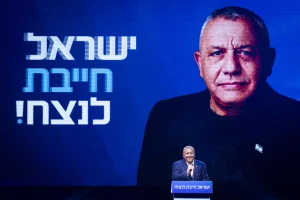
“A prime minister who blindly led to a historic low, who works day and night on division and incitement, who invests all his energy in encouraging draft dodging, is unworthy of this nation and certainly not fit to preach morals about unity,” charged Gadi Eisenkot, who most polls currently see as Netanyahu’s main challenger.
“What are you (Netanyahu) talking about? You won't form any more governments in Israel,” Yair Lapid of the Together party replied. “One has to pay for disasters, for dysfunction… We'll form a good government, professional, decent, we'll make a new covenant with the country.”
Finally, Benny Gantz, current leader of the Blue and White party, hit back: “We don't believe you. If it were up to you – you'd form another government with the Haredi parties and with extremist elements,” alluding to Ben Gvir and Smotrich.
Gantz is in the center of negotiations with several popular center-right figures, and their potential merger could establish a party whose eventual decision of which bloc it wants to join – if it receives enough votes – could be the only path to establish a unity government after the elections.
“The fact that you read polls and understood what Israel wants after the elections – doesn't mean you'll break your alliance with ‘the bloc’ and respect the will of the people. My friends and I will form the bloc of the people of Israel and ensure that after the upcoming elections, a broad Zionist government will rise here,” Gantz vowed.
But the most revealing reaction came from Itamar Ben Gvir, whose Jewish Power party is once again projected to have a strong showing in the coming elections, despite the ongoing controversies and the fact that no party leader really wants to ally with him.
He blasted Netanyahu’s new slogan as “very troubling,” charging that previous Netanyahu-led governments included moderates who “paralyzed the government's ability to advance a firm right-wing agenda.”
Israel Hayom’s political correspondent Ariel Kahana said that Ben Gvir’s reaction was “no coincidence… throughout this decade, Netanyahu has been the one who was boycotted, not the one leading the boycott.”
Support/oppose a Netanyahu-led unity government
— Israel Elects (@israel_elects) July 1, 2026
❌Oppose: 51%
✅Support: 29%
via Hamadad/Chan13, July 1
As Ben Gvir rightly pointed out, Netanyahu historically preferred to lead centrist governments to provide himself more political flexibility. He has also reportedly repeatedly chafed against Ben Gvir’s extreme statements and sidelined him from key decisions throughout the war.
“He knows that Netanyahu would likely be happy to part ways with him – if only he could,” noted Kahana.
And this may be the crux of the issue – due to a variety of reasons, a true unity government of the Zionist parties that could represent the “consensus on the central issues” among the majority of the society, like the enlistment of Haredim to the military and other security issues, and even the economy, education, and more, is almost impossible.
In theory, this spectrum could include Yashar, Together, Yisrael Beitenu, as well as Gantz, the Likud and Religious Zionism.
But Eisenkot, Bennett, and Liberman have ruled out a coalition with either Netanyahu or the ultra-Orthodox, and Gantz says he doesn’t believe Netanyahu, who won’t agree to play second fiddle or even retire to enable a unity government, especially if he again leads the largest party.
So, despite nearly all parties and most of the electorate clamoring for unity, it seems like this, once again, will not happen.
Please take a moment to join believers worldwide praying for Israel right now. Add your light to the live prayer map—and show the world one more watchman praying for the peace of Jerusalem.

You might also like to read this: