Post Iran war: Could a new Middle East order emerge?
One analyst believes Iran’s 'behavior is driving' the region toward Israel









Tehran’s aggression against Gulf nations, from the United Arab Emirates, Bahrain, Kuwait, Saudi Arabia and even towards Qatar, is likely to create an anti-Iran coalition post-war that places Israel as a key ally, according to one analyst.
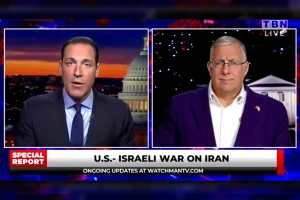
“Iranian behavior is driving everyone in the region closer to Israel,” said former Trump administration envoy Jason Greenblatt. “My personal belief is that these countries have always understood who the real threat is.”
Some 83% of Iranian missiles fired since 28 Feb. have been launched against the Gulf and Iraq, while only 17% have targeted Israel, according to an infographic posted on 𝕏 (in both English and Arabic), titled “Targeting the Gulf and bombing the Jews as a smokescreen.”
As of Monday, Iran had launched at the UAE alone 519 ballistic missiles, 26 cruise missiles and 2,210 drones, according to the country’s Ministry of Defense.
With this hostility, the Gulf states are coming to terms with “one way or the other the Iranian regime has to be finished or it would remain a long-term threat to everything that they’re trying to do,” Greenblatt said in a recent briefing with reporters hosted by the Jerusalem Press Club.
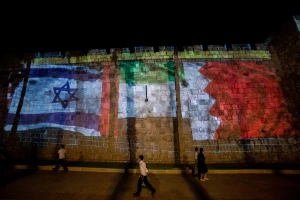
“They’ve seen what the regime has done throughout the Middle East. They all know that Israel is not a threat to them. They all know that Israel could be a phenomenal partner to them, hence the Abraham Accords.”
Greenblatt believes that even realignment with Qatar is possible.
“They too understand who the regime is. They understand what the threat of Hamas is to the whole region, the threat that Hamas and the Iranian regime are to everything they are building as well,” he said.
While these nations most likely wanted to avoid this conflict in the first place, now facing daily attacks by Iran, the Gulf states are each taking a more belligerent position against the Islamic Republic.
TURNING AGAINST IRAN
Officials from Saudi Arabia, the United Arab Emirates, Kuwait and Bahrain have privately urged U.S. President Donald Trump to continue the war until Iran is weakened and can no longer pose a threat in the region, according to a report in The Associated Press.
UAE Ambassador to the U.S. Yousef Al Otaiba took a hardline stance against the regime in a Wall Street Journal op-ed on March 25, calling for “a conclusive outcome that addresses Iran’s full range of threats: nuclear capabilities, missiles, drones, terror proxies and blockades of international sea lanes.”
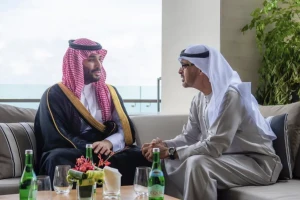
Saudi Crown Prince Mohammed bin Salman (MBS) also pressed Trump to continue fighting the regime, lest a premature ending leave an angry Iran with continuing regional influence, according to a New York Times report.
Former Dubai Police Chief Dhahi Khalfan Tamim – who previously criticized the Jewish state – set off a firestorm on social media, calling for closer ties with the West and Israel.
“This war has proven that western countries are the friendly countries... and that those we call sister countries... are actually separate from us,” he wrote, adding, “Oh, people of the Arabian Gulf, put trust in Israel. My advice to you: Nothing good will emerge from the countries of the region.”
Editor-in-Chief of Arab Times, Ahmed al-Jarallah, placed full responsibility on Iran for the escalation in an interview with Kuwait TV.
“The idea that the Gulf states brought Israel into the situation is a gross oversimplification,” the article reported. “The real escalation began with Iranian rhetoric, as Tehran raised the stakes of its threats, highlighted its cross-border military capabilities, and promoted its controversial nuclear program while repeatedly obstructing international monitoring efforts. These Iranian policies prompted the international community to adopt a more stringent stance, not the other way around, holding the Gulf states responsible ignores the roots of the crisis and its true context.”
Arab League Secretary-General Ahmed Aboul Gheit told the United Nations this week that Iranian attacks on Gulf states “cannot be accepted or justified under any pretext or claim.”
Dr. Anwar Gargash, diplomatic advisor to the UAE president, who initially sought to persuade Iran to “deal with your neighbors with reason and responsibility,” has now toughened his position.
“We don’t want a ceasefire that fails to address some of the main issues that will create a much more dangerous environment in the region…notably (Iran’s) nuclear program, the missiles and drones that are still raining down on us and on other countries,” Gargash told reporters this weekend.
NEW OUTCOMES & ALLIANCES
Even as the sides venture into a ceasefire, the war is likely to lead to geopolitical shifts and establish a new order in the Middle East.
Defense and economic agreements could emerge, potentially spanning alliances from the Persian Gulf to the Mediterranean.
As one of the original architects of the Abraham Accords, Greenblatt sees normalization agreements with Israel deepening. Riyadh will join in some way “even if it's not a full-blown Abraham Accords,” he predicted.
“It’s certainly important to Saudi Arabia. I think they recognize that Israel as a partner and, therefore, some formula of the Abraham Accords benefits everybody,” he said.
Greenblatt said that from a tactical perspective, these countries must consider their own futures vis a vis all potential scenarios of a current Iranian regime that is weakened or a successive regime that is similar.
Qatar can continue to support the Palestinians – not Hamas, Greenblatt clarified – while redefining its rocky relationship with Israel.
“This would be another benefit of what the Iranian regime has done, which is to realign countries like Qatar and others who, I wouldn’t say are anti-Israel, but maybe they’ll be more pro-Israel in the coming period of time because they see who the real enemy is clearly.”
Anything less than a “conclusive outcome” that eliminates Iran’s capacity to threaten its neighbors would merely delay the next confrontation, the former Trump envoy said.
“I think the Iranian regime is a murderous, theologically driven regime that doesn’t want to make a deal.”
You might also like to read this: