Iran’s Mashhadi Jews who pretended to be Muslims for 120 years



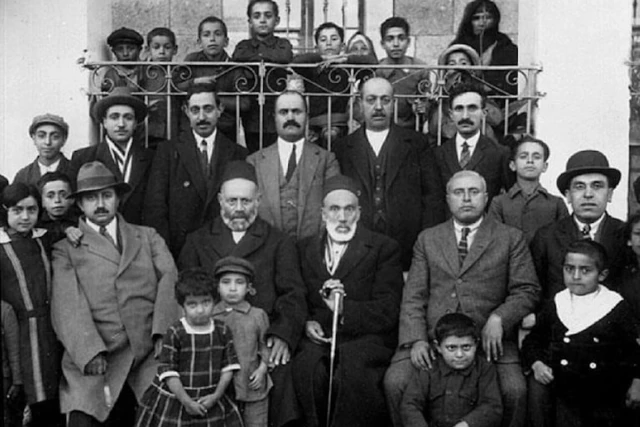
Not all of the Jewish exiles in Persia returned to Israel when King Cyrus granted permission, and those who remained did not all share the same fate. Some concealed their Jewish identity, living publicly as Muslims while secretly maintaining a Jewish way of life. These were the Mashhadi Jews, who preserved their secrecy for 120 years.
Jewish communities had lived in northern Iran since the time of Queen Esther, but in the mid 1700s, the Persian ruler Nader Shah uprooted 40 Jewish families and brought them to Mashhad, way out in the east, to guard treasures he had taken from India. When the king was later killed, the Jewish families stayed in Mashhad, living together in a ghetto, as the Muslims of the area were strict and intolerant of non-Muslims.
The two communities lived uneasily together for about a century, but on March 26, 1839, tensions exploded and around 30 Jews were massacred on the basis of a fallacious blood libel.
“They were looking for an excuse to attack the ghetto, the Jewish quarter,” explained Nissim Bassalian, a Mashhadi Jew. “They accused us of a blood libel, saying we killed a boy, and attacked our houses three days before Pesach. Some people say they killed 28 or 36 people,” he said in an interview with Mizrachi World Movement.
Bassalian was born in Mashad in Northeast Iran in 1940, almost exactly 100 years after the massacre, now known as the Allahdad (God decided it) pogrom. In events recorded by an Anglican missionary, Joseph Wolff, in his 1845 travelogue, the synagogue was burned, their homes were looted, and children were taken. Jewish girls were forcibly married to Muslim men. The community of 2,400 Jews was then given a terrible decision to make:
“They gave the community two choices – either they would kill all of us, or we would convert to Islam and they would leave us alive. We asked for 24 hours to decide, and the community discussed it. The community decided that they would tell the Muslims they would convert to Islam, but it would be a show and they would keep Judaism in private,” Bassalian relayed.
According to the Times of Israel, when the Jewish community collectively recited the Shahada, the Islamic statement of faith declared on conversion, some mumbled “Musa” (Moses) in place of “Muhammad.”
Like the Marranos of Spain or “Anusim” who pretended to convert to Catholicism in order to survive, the “Marranos of Mashhad,” as the Anu Museum of the Jewish People calls them, somehow managed to live undercover for generations.
It was in large part the women of the community who made the enterprise possible, since they had to wear the long Muslim garments and could act as couriers, carrying kosher food, prayer shawls, and even Torah scrolls from house to house without suspicion. They also worked to maintain Jewish dietary traditions, publicly buying and baking food forbidden for Jews but surreptitiously cooking according to kosher laws at night.
“It was very difficult for the Mashadi Jews to keep their Judaism. They had to show they didn’t keep Shabbat and moadim [Jewish holidays], but kept them in private. Because they were living in a ghetto, all the houses were connected – they had small doors connecting the houses. They did shechita [kosher slaughtering of animals] in one house and brought the meat to another; on Pesach, they prepared matzah in one house. On Shabbat, they would put a boy in the shop, and when a customer came, the boy would say his father went out and was coming back,” Bassalian explained.
He continued, “Marriage was important – they said they were naming their children’s spouses from when they were 2 years old, deciding who they would marry as a way of ensuring marriages stayed within the community. It was very difficult – Imam Jomeih was the chief Imam, and they took two of the Jewish girls for him. After many years, they came back to the community. They didn’t have any children with him; they did everything they could to keep true to their faith even in such difficult circumstances.”
Teaching the children to keep their secrets and remain discreet was a big challenge, and parents were also very guarded about what they allowed their children to know and see in case they were questioned.
“The authorities would ask them questions like, 'What did you eat yesterday?' They would buy the non-kosher meat and throw it away, while getting their own meat inside. They would buy bread and throw it away, but they managed to survive,” said Bassalian.
However, Bassalian himself grew up under the more lenient rule of the Pahlavi dynasty. By then, the Jewish community was letting its guard down and becoming a little more visible.
“Things were a little more relaxed – we still had to be very private about our Jewish life in Mashad, but by this point, many Muslims realized that we had remained Jewish. The Shah was very good to minorities, so they couldn’t do as much to us,” he said.
When the community was attacked in 1946 at Passover due to yet another malicious blood libel, the Shah sent troops to stop it. “The local Muslims in Mashad were angry that the Jews had fooled them for decades by secretly remaining Jewish,” Bassalian recalled. “I remember as a boy getting hit by rocks that they were throwing at us.”
After that incident, Bassalian and his family left Mashhad as it had become too dangerous. “I got married in Tehran and had four children there. We had many synagogues. The Shah was very kind to minorities; we loved him. There was equality,” he said.
Some made aliyah to Israel following its foundation two years after that Passover attack of 1946, and many more fled to the US – Bassalian’s family included. Of course, most Jewish people had to leave Iran after the Islamic Revolution of 1979. The Iranian diaspora is spread all over the world, testifying today to what they have seen and experienced in the lands they have lived in for generations. Many of them are from the Mashhadi community.
There are as few as ten Jewish people left in Tehran, and while they are able to maintain their Jewish identity, they have to steer well clear of politics and anything to do with Israel. There are none left at all in Mashhad – everyone fled.
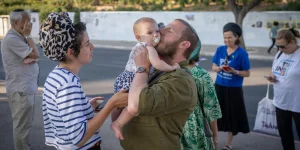
“We are one big Mashadi family. We know everyone. In America, most communities are built around the synagogue, but we’re not just going to synagogue together,” said Bassalian. “If anything happens to a Mashadi, we get the news within minutes. We know who got married to whom, and who passed away.”
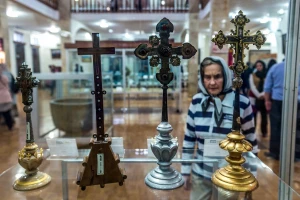
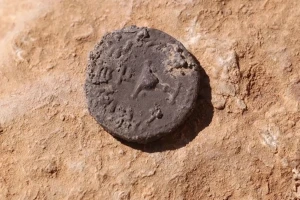
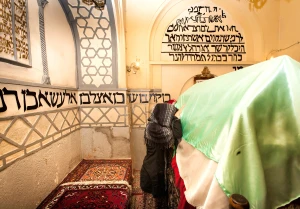
Mashhad may be empty of Jews, but against all odds, they survived to tell the tale. Their legacy still continues. Now a new exhibition is on display in Israel’s National Museum to tell the story, something that curator Chaim Neria believes is all the more important during the war with Iran.
“Many pogroms against Jews have been recorded in history in Islamic countries – and, of course, Christian countries – but stories of forced conversion are very rare,” said Neria.
Fortunately, this tragedy has a sort of happy ending, like the Passover story, with the restoration of Jewish life in the land of Israel.
“We are trying to tell the young generation before Pesach about what happened in 1839, what happened in 1946; otherwise, they won’t know their own story,” Bassalian said.
You might also like to read this: