Israeli archaeologists uncover 2,000-year-old half-shekel coin from Great Jewish Revolt in Judean Desert



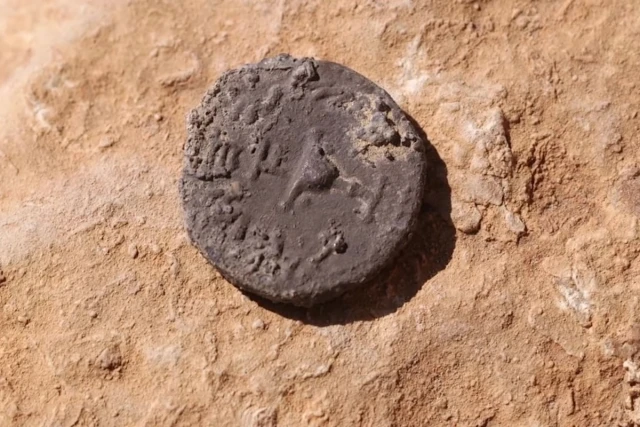
Archaeologists from the Israel Antiquities Authority’s (IAA) Robbery Prevention Unit have discovered a rare ancient half shekel coin in the Judean Desert.
The IAA said the coin is approximately 2,000-year-old and dates from the time of the Great Jewish Revolt against the Roman Empire between 66 and 74 C.E. The ancient Hebrew artifact was uncovered in cooperation with Israel’s Heritage Ministry and the Civil Administration's Archaeology Staff Officer.
“The coin bears the Hebrew inscription 'Half Shekel' alongside a chalice motif, a characteristic symbol found on Jewish coins from the late Second Temple period,” IAA researcher Yaniv David Levy explained. “Above it appears the letter Aleph, denoting the first year of the outbreak of the revolt.”
The large number of antiquities in the Holy Land have resulted in the emergence of a black market that illegally trades ancient artifacts on the international market.
Last month, the IAA revealed that some 450 ancient counterfeit coins had been seized during the raid of an East Jerusalem resident who was suspected of illegally smuggling and selling antiquities. Officials noted at the time that the suspect had already incorporated several of the ancient artifacts into jewelry and pendants.
“One of the pendants held what appeared to be a counterfeit sela coin from the first year of the Bar Kokhba revolt,” said Ilan Hadad, an IAA archaeologist and inspector.
Last September, archaeologists from the IAA and Zefat Academic College, discovered a collection of 22 bronze coins in northern Israel that were estimated to be 1,600 years old.
“It seems that the people stashing this hoard carefully planned its hiding place, hoping to return to it when the threatening troubles were over,” explained IAA archaeologist Uri Berger and Prof. Yinon Shivtiel of Zefat Academic College.
“The coins were discovered in a pit, deliberately dug at the end of a narrow winding tunnel,” they said, adding that the discovery is significant because it provided a better understanding of multiple Jewish uprisings against imperial Roman rule.
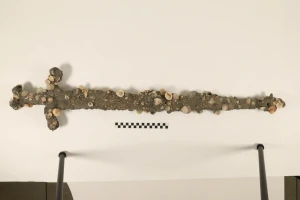
Earlier this week, a student from the Archaeological Department at the University of Haifa discovered a rare 12th century Crusader sword off the coast in northern Israel south of Haifa, which is rich in archaeological discoveries.
“In the Middle Ages, the sword became a symbol of knighthood and of the Christian faith,” said Dr. Sara Lantos of the Haifa University's Department of Maritime Civilizations.
“It was also one of the most common weapons used by Crusader knights, and their lives depended on it. Swords were valuable objects, carefully maintained and preserved. The discovery and study of such a symbolic and personal object are rare and enrich our understanding of the material culture of the Crusader period. They also provide a unique opportunity to learn about the lives of Frankish knights in the Holy Land,” Lantos explained.
You might also like to read this: