British Museum removes 'Palestine' from certain Middle East exhibits



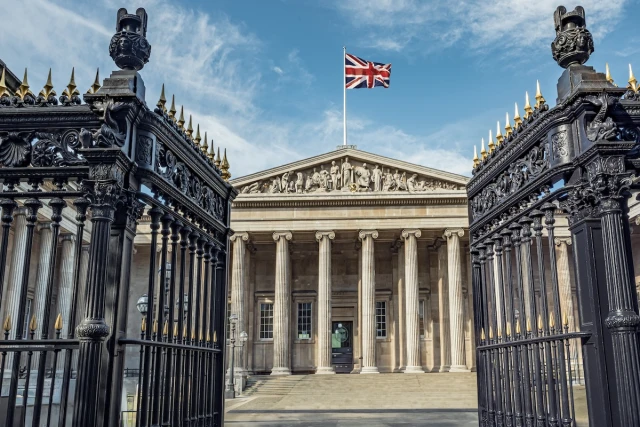
The British Museum’s decision to remove references to “Palestine” from some of the displays at the British Museum was made public on Saturday, stirring controversy and making the museum the latest battleground in the Israeli-Palestinian conflict.
However, several key facts have been consistently overlooked, namely, the extent of the removal of the name Palestine from the museum, the historical evidence for the term, and the cause for the changes to the museum’s labeling.
While it remains true that specific displays from 1700–1500 B.C. have been relabeled to describe the area now known as Israel as “Canaan” rather than “Palestine,” and its inhabitants as being of “Canaanite” rather than “Palestinian” descent, the reason for the change is disputed.
It has been repeated that the decision was made in response to a letter of complaint from UK Lawyers for Israel (UKLFI), but Museum Director Nicholas Cullinan reportedly said otherwise.
Historian and author William Dalrymple posted his correspondence with Cullinan on 𝕏, indicating that reports of the term Palestine being canceled are incorrect. Quoting Cullinan, Dalrymple wrote, "To reassure you we are not removing mention from [sic] Palestine from our labels," Nick told me. "Indeed, we have a display on at the moment about Palestine and Gaza. I know this is something our curators have thought long and hard about - as you can imagine. We amended two panels in our ancient Levant gallery last year during a regular gallery refresh, when some wording was amended to reflect historical terms.”
Even more surprisingly, Cullinan claimed he was unaware of the UKLFI complaint and only found out about it after the controversy arose, saying he was “disgusted by the whole thing."
The letter from UKLFI had asked Cullinan to review the museum’s collections and “revise terminology so regions are referred to by historically accurate names such as Canaan, the Kingdoms of Israel and Judah, or Judea, depending on the period being described.”
They objected that the term Palestine “has the compounding effect of erasing the kingdoms of Israel and of Judea” and also objected to “re-framing the origins of the Israelites and Jewish people as erroneously stemming from Palestine."
The advocacy group states on their website that they received a response from the museum about their concerns, saying, “the British Museum’s spokesperson confirmed that the Museum was in the processes of reviewing and updating panels and labels on a case-by-case basis. For example, the information panels in the Levant gallery, covering the period 2000-300 BC, have all been updated to describe in some detail the history of Canaan and the Canaanites and the rise of the kingdoms of Judah and Israel using those names. A revised text devoted to the Phoenicians was installed in early 2025.”
They added, “Some changes have already been made elsewhere in the Museum. According to the spokesperson, a panel in the Egypt galleries was recently amended to replace 'Palestinian descent' with Canaanite descent.'"
Middle East Eye (MEE) reported that the museum said the name Palestine was not “meaningful” as a historical geographical term in the context of ancient Egypt and the Phoenicians in the second millennium B.C.
Although many believe the term Palestine was invented by the Romans in 70 A.D., there is historical evidence that the area was known by that name prior to the destruction of Jerusalem, during the 4th and 5th centuries B.C.
Aristotle wrote about Palestine around 350 B.C. when describing the Dead Sea: “There is a lake in Palestine, such that if you bind a man or beast and throw it in it floats and does not sink, this would bear out what we have said. They say that this lake is so bitter and salt [sic] that no fish live in it" (Meteorology, Book II, Part 1, Translated by E. W. Webster).
Even further back, the ancient historian Herodotus who lived between 484–425 B.C. also mentioned Palestine, “These Phoenicians dwelt in ancient time, as they themselves report, upon the Erythraean Sea, and thence they passed over and dwell in the country along the sea coast of Syria; and this part of Syria and all as far as Egypt is called Palestine” (Herodotus, Book VII of THE HISTORIES, called POLYMNIA, 89, Translator: G. C. Macaulay).
Palestine rightly referred to the general area historically, perhaps similar to terms such as “The Levant” or “Mesopotamia” which describe an area rather than a defined nation state. Still, the term does not appear before the writings of Herodotus and would have been ahistorical in earlier exhibits. The British Museum affirmed that the term Palestine is “appropriate for the southern Levant” only in the later second millennium B.C.
In its letter, UKLFI pointed to several maps and descriptions in the museum that retroactively used the term “Palestine” for periods in which no such entity existed, expressing concern that the labels could “risk obscuring the history of Israel and the Jewish people.”
The group said the ahistorical application of the term “erases historical changes and creates a false impression of continuity” and asked that “historically accurate names such as Canaan, the Kingdoms of Israel and Judah, or Judea” could be used instead, depending on the period being described.”
A UKLFI spokesperson said, “We welcome the British Museum’s willingness to review and amend terminology which is inaccurate or liable to convey an incorrect meaning today. The finding of its audience testing, that the term 'Palestine' is in some circumstances no longer meaningful is relevant to and should be taken on board by other museums and cultural institutions.”
They added, “Museums play a vital role in public education, and it is essential that descriptions reflect the historical record with precision and neutrality. These changes are an important step toward ensuring visitors receive an accurate understanding of the ancient Near East.”
A museum spokesperson accepted that the term Palestine “no longer holds a neutral designation and may be understood in reference to political territory” and clarified, "We use the UN terminology on maps that show modern boundaries, for example, Gaza, West Bank, Israel, Jordan and refer to 'Palestinian' as a cultural or ethnographic identifier where appropriate."
However, they denied that they had acted in response to the UKLFI letter, saying that museum staff “began their review and update of the labelling over a year ago."
You might also like to read this: