New Dead Sea Scrolls display opens for Israel Museum's 60th anniversary






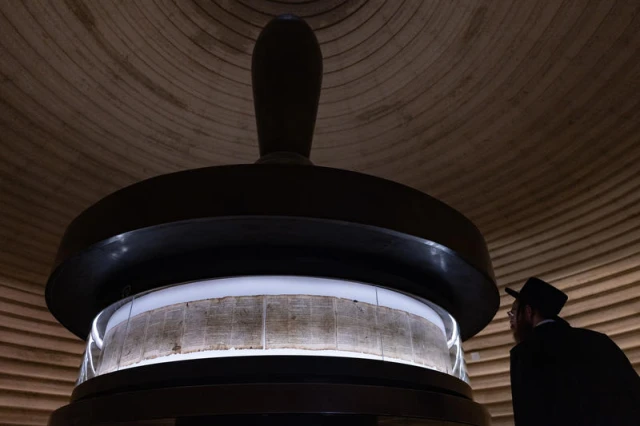
Home to the “Great Isaiah Scroll,” the oldest copy of the Book of Isaiah known to man, the Israel Museum in Jerusalem has plans to celebrate its 60th anniversary by putting all 717 centimeters (23.5 feet) of the historic document on display for the first time since 1968.
The exhibition is entitled “A Voice in the Desert,” referring both to the discovery of the scrolls in the Judean Desert and to a verse from Isaiah: “The voice of one crying in the wilderness: ‘Prepare the way of the LORD; make straight in the desert a highway for our God’” (Isaiah 40:3).
For those who think the Bible has been altered and exaggerated over the years, a visit to the Israel Museum will bust that myth. The Dead Sea Scrolls, of which the Great Isaiah Scroll is just one example, demonstrate that the biblical text we have today has changed very little over more than 2,000 years. It is nearly identical word for word.
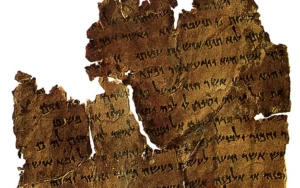
Previously, the most ancient copy of the Bible was a Greek translation called the Septuagint (LXX), written on parchment in the 4th century CE. The earliest Hebrew version was the Masoretic text from the 10th century, but when the Dead Sea Scrolls were discovered in 1947 by a shepherd boy in Qumran, they revealed the incredible accuracy of the Jewish scribes who had been copying the biblical texts for generations.
The Great Isaiah Scroll is kept in the Shrine of the Book, a portion of the Israel Museum dedicated specifically to housing the priceless artifact. The scroll is the oldest known manuscript of a complete biblical book, but is not typically displayed in its entirety due to conservation considerations. In the new display, visitors will be permitted 10-minute time slots in order to maintain the conditions necessary to preserve the precious manuscript.
The scrolls are believed to have been penned by the Essene community, who lived at Qumran near the Dead Sea, not far from Jerusalem. They were a sect of ascetics who sought a life of purity and holiness in the desert. Around half of the scrolls were copies of biblical texts, including parts from every book of the Bible except Esther, with the other half containing their own writings. Some books, such as Deuteronomy, Isaiah and Psalms, were found in their entirety.
The late Eleazar Lipa Sukenik, a renowned Israeli archaeologist and professor at Hebrew University, described his experience of being the first person to study the Isaiah scroll. It was on the evening of Nov. 29, 1947, and he was poring over the ancient text while listening to the news.
“My hands shook as I started to unwrap one of them,” he wrote in his journal. “I read a few sentences. It was written in beautiful biblical Hebrew. The language was like that of the Psalms, but the text was unknown to me. I looked and looked, and I suddenly had the feeling that I was privileged by destiny to gaze upon a Hebrew Scroll which had not been read for more than 2,000 years.”
“While I was examining these precious documents in my study, the late news on the radio announced that the United Nations would be voting on the resolution that night – whether or not Israel would be allowed to become a nation… It was past midnight when the voting was announced. And I was engrossed in a particularly absorbing passage in one of the scrolls when my son rushed in with the shout that the vote on the Jewish State had passed. This great event in Jewish history was thus combined in my home in Jerusalem with another event, no less historic, the one political, and the other cultural.”
The remarkable timing of the discovery of the Dead Sea Scrolls put flight to accusations that the Bible had been a much later work, fabricated to fraudulently claim rights to the land of what was previously considered Palestine. The ancient scrolls were like a title deed to the land and proof of Jewish indigeneity.
“The Dead Sea Scrolls made for a symbolic birthday gift for the state still struggling to survive out of utero. The texts are celebrated icons of Israel’s heritage,” wrote Shelley Neese in her book on the subject, "The Copper Scroll Project."
“The Egyptians have their pyramids and the Chinese have their wall… but the Jews have their scrolls, monuments built from words rather than mortar.”
Appropriately, the Book of Isaiah is replete with promises that the people of Israel would return to the land, and it is fitting that the Great Isaiah Scroll would be displayed with such honor.
“Who has heard such a thing?
Who has seen such things?
Shall a land be born in one day?
Shall a nation be brought forth in one moment?
For as soon as Zion was in labor
she brought forth her children.
Shall I bring to the point of birth and not cause to bring forth?”
says the Lord;
'shall I, who cause to bring forth, shut the womb?'
says your God.”
(Isaiah 66:8-9)
The Israel Museum has sent an invitation, encouraging guests to come and see the full scroll and promises visitors “a rare opportunity to explore the rich history of this precious artifact.”
The exhibition will be held in the Bella and Harry Wexner Gallery from Feb. 24 to June 6.
Visitors are required to reserve a time slot for the exhibition, which can be booked when purchasing museum tickets.
You might also like to read this: