Iranian regime fortifies Isfahan nuclear tunnels as US military buildup continues, despite ongoing talks
'Preparations like these were last observed in the days before Operation Midnight Hammer'




The Iranian regime has covered tunnel entrances at the Isfahan nuclear complex with soil to protect them from airstrikes, according to new satellite images analyzed by the Institute for Science and International Security (ISIS).
The preparations for possible U.S. or Israeli strikes come despite both sides describing the first round of talks between the regime and the U.S. as “good,” and having agreed to hold another round of talks soon.
Ali Larijani, a senior adviser to Supreme Leader Ali Khamenei and head of the regime’s highest security body, arrived in Oman on Tuesday morning, where the nuclear talks were held only days before.
Iran’s state news agency IRNA said Larijani would meet with Foreign Minister Badr bin Hamad al-Busaidi, who is mediating the talks, as well as Haitham bin Tariq, the sultan of Oman, to discuss the latest regional and international developments.
NEW: High resolution satellite imagery taken yesterday shows the extent to which Iran has covered the tunnel entrances at the Esfahan nuclear complex with soil. The middle and southern entrances are unrecognizable and fully covered in soil. The northernmost tunnel entrance which… pic.twitter.com/baYI2zCuN0
— Inst for Science (@TheGoodISIS) February 9, 2026
While the talks appear to continue as planned despite Israeli fears that the U.S. may strike a deal seen as “too soft,” several reports also suggest that the U.S. military’s massive buildup in the region has been continuing unabated.
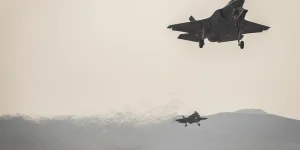
Six more F–35A Lightning II stealth fighter jets crossed the Atlantic and landed in the UK on Monday, accompanied by three KC–135 Stratotanker refueling aircraft, according to flight trackers. On Friday, the UK had deployed six of its own F-35s to Cyprus.
Last week, a third U.S. Air Force E-11A aircraft, a plane carrying a sophisticated airborne communications relay and gateway system, was moved from Crete to Saudi Arabia, according to the BBC, while Spangdahlem Air Base, a major U.S. base in Germany, moved to round-the-clock operations to facilitate the air traffic in the region.
The U.S. Air Force tankers dragging 6x F-35s to Lakenheath are now approaching the UK. I expect that we will likely see the aircraft continue eastwards tomorrow or Wednesday. pic.twitter.com/lwZeMfIsml
— Oliver Alexander (@OAlexanderDK) February 9, 2026
Against the background of these preparations, the Iranian regime apparently decided to fortify its remaining nuclear sites.
“It appears clear that the Iranians are seriously concerned about a US/Israeli aerial attack and/or raid against this particularly hardened nuclear facility. Backfilling the tunnel entrances would help dampen any potential airstrike and also make ground access in a special forces raid to seize or destroy any highly enriched uranium that may be housed inside difficult,” ISIS assessed.
“Preparations like these were last observed in the days before Operation Midnight Hammer struck facilities at Fordow, Natanz, and Esfahan,” the report noted.
The regime has continued to send contradictory messages regarding its nuclear program, while resolutely rejecting any limits to its ballistic missile capability.
After the first round of talks, Iran’s Foreign Minister Abbas Araghchi said unequivocally that the Islamic Republic will not accept a deal that requires the regime to give up nuclear enrichment.
“Zero enrichment can never be accepted by us. Hence, we need to focus on discussions that accept enrichment inside Iran while building trust that enrichment is and will stay for peaceful purposes,” he said.
However, Tehran’s atomic chief, Mohammad Eslami, said on Monday that Iran could agree to dilute its stockpile of 60% enriched uranium in exchange for the lifting of all sanctions.
Other reports suggested the regime could be willing to transfer its stockpile of highly enriched uranium to Russia as part of a deal, though Ali Shamkhani, a senior political adviser to Khamenei, contradicted this last week.
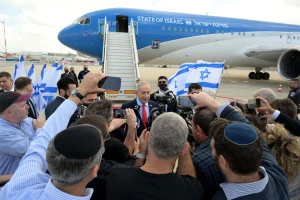
Meanwhile, Prime Minister Benjamin Netanyahu departed for Washington ahead of a meeting with U.S. President Donald Trump, in which he reportedly aims to convince the president not to agree to a deal that would leave the regime with its nuclear and missile capabilities.
You might also like to read this: