PA President Abbas receives draft constitution as step towards establishing Palestinian state
Draft of constitution appears aimed at convincing international community of PA reforms



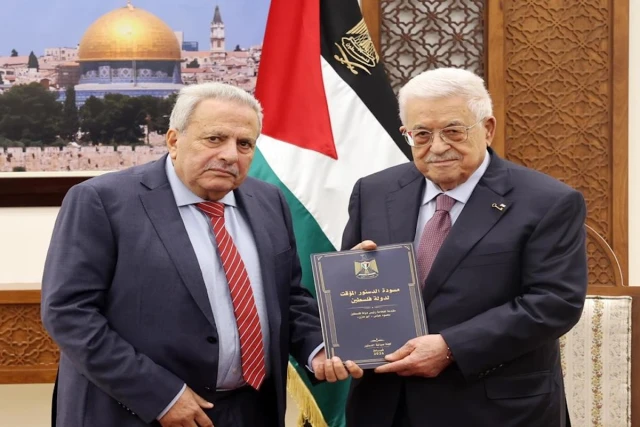
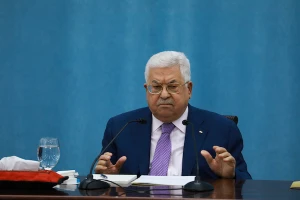
Palestinian Authority President Mahmoud Abbas received a draft copy of the "Interim Constitution" aimed at establishing the foundations of a Palestinian state, Palestinian media reported last week.
The presentation of the 70-page draft constitution occurred during Abbas’ meeting with the committee tasked with drafting the provisional Palestinian constitution, headed by committee chairman Mohammed al-Hajj Qassem, and its members, the Palestinian Authority-affiliated WAFA news agency reported. The draft was finalized after seven months of consultations, and three months of intensive work, including 54 meetings by the constitutional committee.
The draft constitution will first be submitted to the Palestinian Liberation Organization’s Executive Committee for review, before being shared publicly, The Times of Israel reported, citing a Palestinian official.
While the Palestinian Authority often refers to itself as a full-fledged state in official and international statements, it has been operating under a set of basic laws drafted after the PA was formed as part of the Oslo Accords.
Abbas stated, "This year is the year of democracy. We have set a date for the Palestinian National Council elections, both within Palestine and abroad, as well as for the eighth Fatah conference, in addition to holding local elections next April.”
The draft constitution is intended to provide a legal foundation for political institutions and to modernize the legislative framework of the Palestinian Authority ahead of an expected announcement of an independent Palestinian state. The receipt of the draft constitution by PA President Abbas comes amid a growing movement in the international community to recognize a Palestinian state as a means of pressuring Israel into accepting the two-state solution proposed under the Oslo Accords.
According to Palestinian media, the draft constitution seeks to establish a “modern constitutional and legal framework with both national and international legitimacy.”
In radio statements, Dr. Ahmed Majdalani, a member of the Executive Committee of the Palestine Liberation Organization (PLO), emphasized that the draft constitution aims to establish a democratic, pluralistic, and civil state. He also claimed its provisions draw upon the latest global and Arab constitutional developments.
Constitutional committee chairman Mohammed al-Hajj Qassem claimed that the draft “preserves political pluralism and the separation of powers, while also empowering the legislative branch to exercise oversight and legislative authorities.”
Arab media cited anonymous Palestinian officials who claimed that the draft constitution will serve as a legal roadmap for ending divisions among several Palestinian factions and addressing other internal issues, in order to prepare for comprehensive general elections.
The draft is expected to be presented to various national groups and political figures within the Palestinian factions for approval or amendment before its official adoption.
Majdalani said that the adoption of the constitution would not be limited to submitting the draft to PA President Abbas, but would be subject to broad societal dialogue, followed by presenting the draft to the Executive Committee and the National Council. Majdalani also expressed his opinion that the best option for gaining popular legitimacy would be a public referendum, allowing the constitution to function as a “social contract” binding the people to the system of government.
The Israeli government would likely try to block a popular referendum on the constitution, as it opposes a unilateral declaration of statehood by the PA, outside of the agreed upon steps in the Oslo Accords, which call for direct negotiations between Israel and the PA before such a move.
Both Abbas and Majdalani said that 2026 would be "the year of Palestinian democracy," with popular elections taking place for the first time since 2006, beginning with local council elections on April 25. These elections will take place in the Palestinian territories in Judea and Samaria, East Jerusalem, and the Gaza Strip.
No dates have been set for the PA’s parliamentary or presidential elections, which have repeatedly been cancelled since Hamas won a majority in the 2006 elections. The refusal of the PA to conduct such elections is widely believed to be because of a fear of Hamas winning a dramatic sweep of both parliamentary and presidential sections of the Palestinian government, leading to harsher restrictions by and possible military confrontation with Israel.
The drafting of the constitution also appears aimed at appeasing the international community, particularly the United States, which have demanded that the PA engage in reforms before being granted recognition and normalization. The Gaza Peace Plan proposed by U.S. President Donald Trump restricts the PA from assuming authority in the Gaza Strip until after satisfactory reforms are made.
The Israeli government has withheld billions of shekels in tax revenue from the PA, citing the lack of reforms and the continued support for terrorism.
You might also like to read this: