The first two-state solution: The forgotten partition of 1922



When the International Court of Justice (ICJ) issued its July 2024 advisory opinion on Israel's presence in Judea, Samaria (the West Bank) and East Jerusalem, it framed the legal analysis almost exclusively around the "1967 baseline." This has become the default setting in international discourse: treating these areas as "Occupied Palestinian Territory" without reference to the legal framework that existed before.
Yet, the true legal foundation of modern Israel, and the region as a whole, begins not in 1967, but over four decades earlier. It is rooted in binding international commitments from 1920 and 1922 that partitioned the land long before any modern Palestinian statehood claim arose.
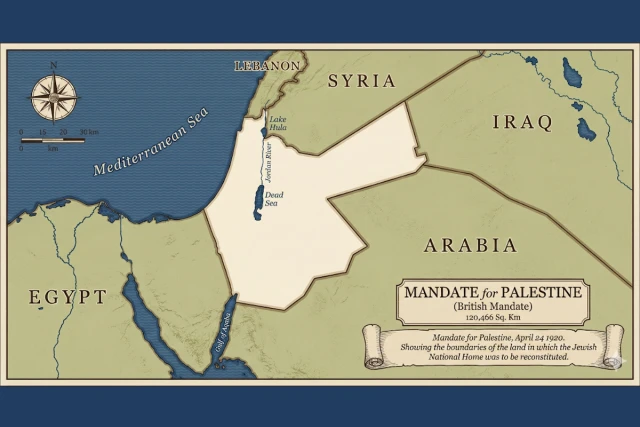
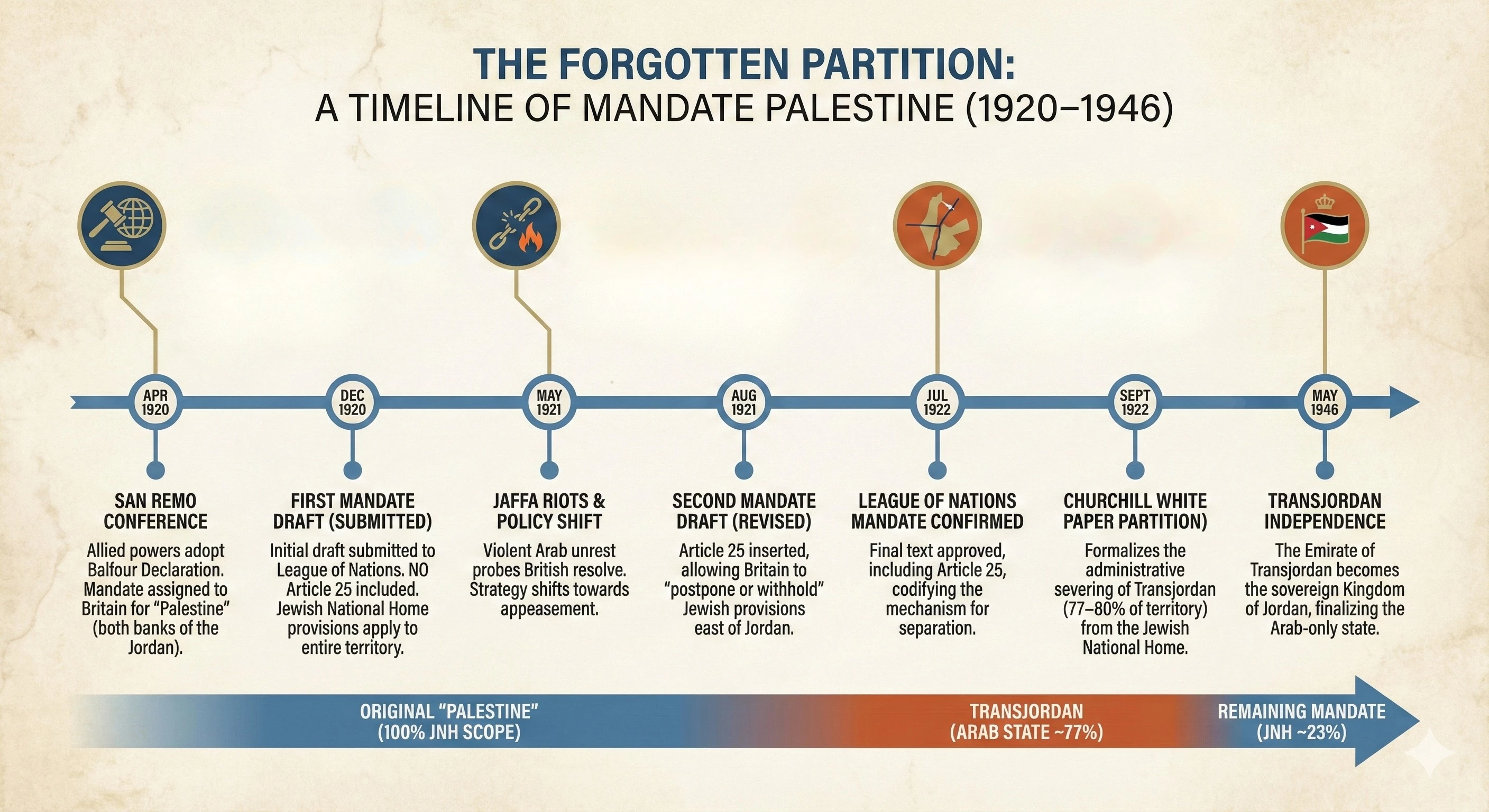
The historical record reveals a different story, a forgotten partition: 77–80% of the original Mandate for Palestine became the Arab state of Transjordan, fulfilling Arab national aspirations first, while reserving the remaining sliver for the Jewish national home. Understanding this geography changes everything about today's "occupation" debate.
The legal birth of the Jewish home
The story begins at the San Remo Conference in April 1920, often cited as the true legal birth of the Jewish national home. It is here that the Allied Supreme Council (Great Britain, France, Italy and Japan) adopted the 1917 Balfour Declaration as binding international law, explicitly tasking Britain with establishing "the national home of the Jewish people" in the territory known as Palestine.
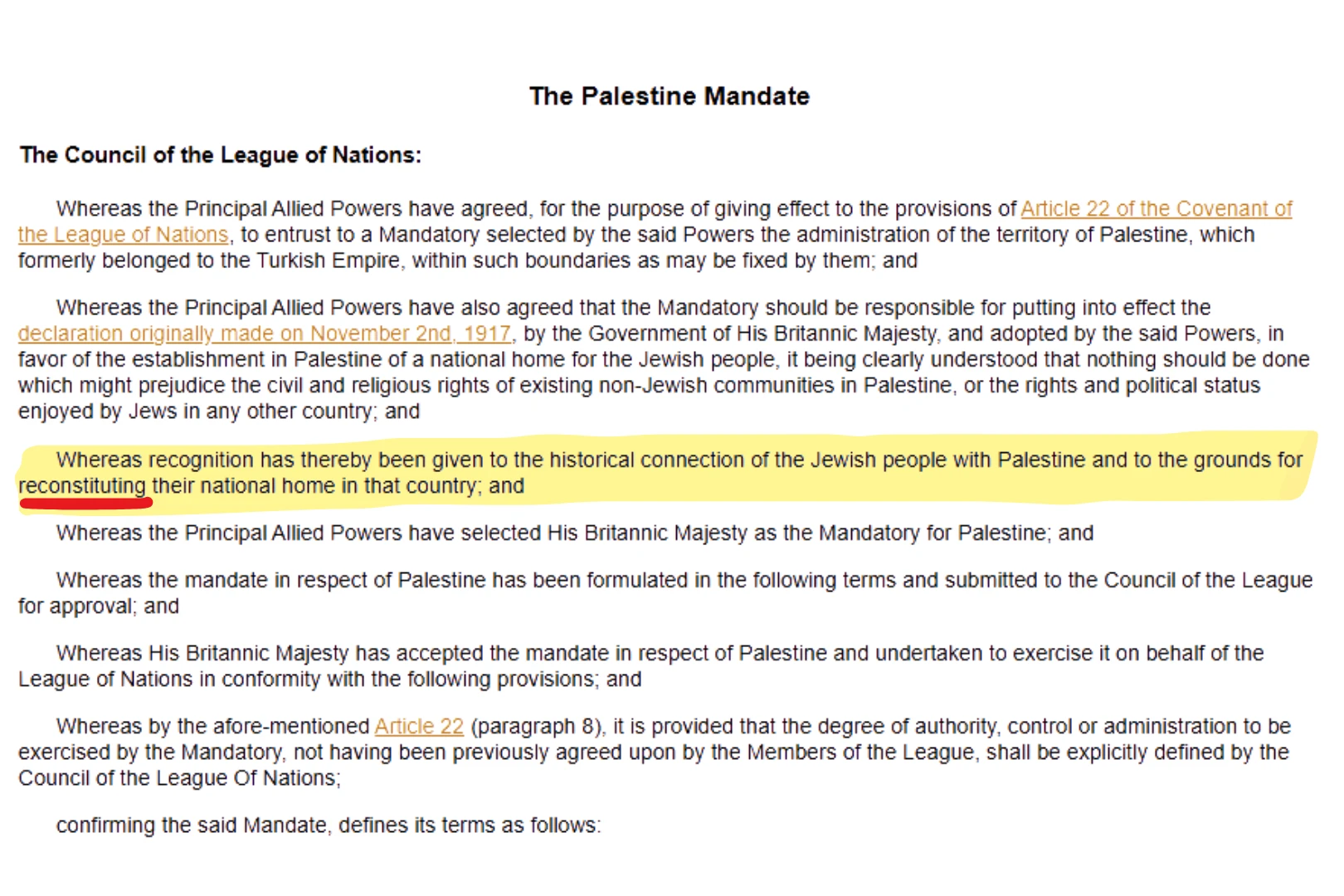
This decision was codified in the League of Nations Mandate for Palestine, confirmed on July 24, 1922. Its preamble contains a critical legal admission:
Whereas recognition has thereby been given to the historical connection of the Jewish people with Palestine and to the grounds for reconstituting their national home in that country.
The word "reconstituting" is vital. It acknowledged that the League was not creating a new entity out of thin air, but was recognizing a pre-existing right rooted in 3,000 years of indigenous history. At this stage, "Palestine" was a geographical term that encompassed territory west and east of the Jordan River, a total of roughly 120,000 square kilometers (46,000 square miles).
The strongest proof that this entire area was originally allocated for the Jewish national home lies in the very legal mechanism the British later used to divide it.
The first partition (1922)
Political pressure on the British administration mounted quickly, driven largely by the violent Jaffa Riots of 1921. Fearing that continued unrest would destabilize the region, the British government shifted its strategy from pure legal principle to political appeasement.
In 1921, Colonial Secretary Winston Churchill hosted the Hashemite leader Emir Abdullah. To secure Hashemite loyalty and quell the violence, Britain retroactively inserted a new clause, Article 25, into the Mandate draft. This article, which did not exist in the original 1920 text, allowed the Mandatory power to 'postpone or withhold' application of the Jewish national home provisions in the territories lying 'east of the Jordan.' By amending the text to suit the moment, Britain effectively partitioned the land to satisfy Arab demands.
The insertion of Article 25 is the 'smoking gun' of the Mandate era. You cannot legally exempt a territory from a rule unless that rule originally applied to it. By needing a specific clause to ban Jewish settlement in the east, the British effectively admitted that the default scope of the Jewish national home included both banks of the Jordan.
The September 1922 White Paper formalized this split. While the White Paper attempted to lower the political temperature by clarifying that a "national home" did not necessarily mean the immediate imposition of a Jewish state upon all inhabitants, the geographic consequence was absolute.
All territory east of the Jordan River, approximately 77-80% of the total Mandate territory, was administratively severed. In this vast area, Jewish settlement and land purchase were effectively banned. This new entity, Transjordan, became an Arab emirate under Abdullah, evolving into the sovereign Kingdom of Jordan by 1946.

Critically, no similar carve-out was made for Arabs west of the Jordan. The remaining 20-23% (modern Israel, the West Bank and Gaza) was explicitly maintained for the Jewish national home, alongside the civil rights of existing communities. In effect, Britain had already partitioned the Mandate to satisfy Arab demands.
Transjordan: Arab-only territory by design
Transjordan was not merely an administrative zone; it was an ethnically distinct project. While the area west of the Jordan River was to be a home for the Jewish people, the area east of the river was maintained exclusively for Arabs.
It is essential to note that this partition predated the famous 1947 UN Partition Plan (Resolution 181) by 25 years. While Arab leadership rejected the 1947 plan, the creation of Transjordan had already delivered the lion's share of Mandate Palestine to Arab control. As the late legal scholar and then-U.S. Under Secretary of State Eugene Rostow argued, "In Palestine, Israel and Jordan already exist as states", noting that the original Mandate had already been partitioned to satisfy Arab claims.
Why this history matters today
Today's demands, that Israel withdraw to "1967 lines" or fund the reconstruction of Gaza, often ignore this foundational context. The ICJ and UN bodies frequently skip San Remo and Article 25 entirely, starting the clock only when Israel defended itself against Jordanian and Egyptian aggression in 1967.
However, under the principle of uti possidetis juris (the international law principle where new states inherit the boundaries of the preceding administrative unit), Israel’s Mandate-era claims to Judea, Samaria, and Gaza remain legally potent.
If 80% of "Palestine" became an Arab state between 1922 and 1946, on what basis is the remaining 20% now framed as territory that must be further divided? This selective memory fuels a "double standard" where Jewish legal rights are erased, and only recent military lines are recognized.
But what happened next? If the land was partitioned in 1922, how did the West Bank come to be "occupied" by Jordan in 1948?
You might also like to read this: