









all israel edu Uncovering biblical history at Israel’s ancient city of Arad
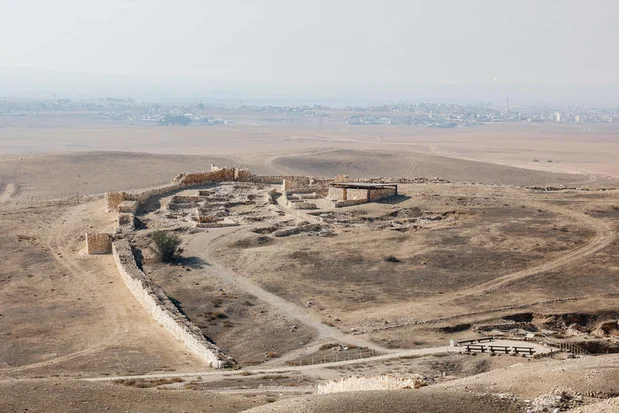
Tour guide Levi Simon takes ALL ISRAEL NEWS correspondent, Oriel Moran, around Tel Arad in Israel’s Negev Desert, explaining what we can learn from the Bible and archaeology.
“We are right now located on the northern peninsula of the Negev in the city called Arad, the ancient Canaanite city,” says Simon, by way of orientation.
“The Jews were wandering through the desert and the king of Arad goes to attack the Israelites and stops them in their way,” he begins. “Then God actually makes a promise to the Israelites that he will destroy the cities of the Canaanites:
“When the Canaanite, the king of Arad, who lived in the Negev, heard that Israel was coming by the way of Atharim, he fought against Israel, and took some of them captive. And Israel vowed a vow to the Lord and said, “If you will indeed give this people into my hand, then I will devote their cities to destruction” (Numbers 21:1-2).
Like the Amalekites who attacked the Israelite survivors escaping slavery in Egypt, the king of Arad makes the questionable decision to attack Israel, and the archaeological ruins tell the story of what happened next.
“To get an understanding who these people were who decided to go and attack the Israelites after they heard about the mighty God of Israel, we could stand inside the city,” says Simon.
“Now we know they (the Canaanites) were aqua (water) geniuses,” he continued, standing in the lowest point of Arad beside a well that dates back more than 4,000 years, to the time of the patriarchs. “The whole city was then created to gather every drop of rain water or flash floods,” he explained, demonstrating how all the water would end up in the enormous cistern which then provided ample water to supply the entire city for many months.
Arad was once heavily fortified, surrounded by a strong wall which was 1,200 meters long (3,937 feet), 24 meters thick (about 79 feet), and approximately 5 meters high (16.4 feet), according to the information given by the Israeli National Park. Simon pointed out the remains of impressive walls with guard towers from which soldiers would have been able to see the Israelites approaching from far away in the distance.
“So Israelites would have been coming from the south making their way to the north,” recounts Simon. The tribes of Israel were moving up through the desert, towards the Promised Land which they eventually conquered under the leadership of Joshua Ben Nun, but not without a fight.
According to the biblical account in Numbers, the Canaanites of Arad went to fight Israel and took some captive, slowing their progress, but they were not ultimately able to keep the Israelites from reaching their destination. “That never works out well, so don't take example from them,” warns Simon.
Showing a courtyard from the 4,000-year-old settlement, Simon explains that it was once the social hub of the city. Still visible are a kitchen – with areas for grinding produce such as seeds and grains and for preparing food from wheat, sesame seeds, dates, or figs – along with a store room. “As you can see, they have a little store room over here where they would keep the jugs.” Recent rain has revealed some small shards of pottery scattered around the site, which are valuable for helping archaeologists learn about life in the ancient city.
The remains of a typical Arad house from the Bronze Age gives visitors a sense of what once stood there. “This is a little bit reconstructed to give you an idea of what it looked like. You would have had one or two columns coming up from the middle… to support the roof which would normally be made of palm leaves or trees or something wooden,” Simon explains. Pointing to the benches lining the walls all around, he says they would be used for sleeping and also providing protection for the walls: “You'd always have these benches surrounding the walls,” he points out, not only for a place to sleep but also to help insulate the walls from the extreme desert heat.
“Each one of these houses look pretty much the same as we can see here inside of this city,” says Simon, adding that it once had between 2,000 to 2,500 inhabitants. While only a few of the structures have been uncovered, the discoveries have proved very valuable. “They give us a window into the people who dared to fight against the Jewish nation 3,000 years ago.”
Moran reflected on the fate of those who stood against Israel, and of Israel itself: “I'm thinking about the amount [number] of nations that have come and gone and come and gone and how faithful God is to bring us back to this land every single time. We see a pattern of how when Israel strays away from God, they pay the price. There are consequences to that, and their enemies overtake them. But when they come back to God, when they repent, God's grace is able to come back with his hand and his covering to help them reach the promises that he has for them.”
Much of ancient Arad remains unexplored, lying deep beneath the surface. The people responsible for this site are local Bedouin. “They love it,” says Simon, adding that they look after the site very well, and official permission was required to dig any further.
"Maybe we'll find canisters of gold underneath," a Bedouin man suggested to Simon. “I think it's actually quite possible that there's serious treasure hidden,” Simon concurred. “So, that's kind of exciting.”
Showing Moran the remains of altars and evidence of temple worship from the Iron Age, Simon explained that they were standing within a sort of palace structure, the seat of governance in the city. “Everyone had a little altar, especially the governor here,” he relates. “Here we found a stone. On the stone we had a figure standing upright to symbolize life and a figure lying down to symbolize death,” showing some of the more existential thinking of the ancient people of Arad. “They thought about those things especially in the governor's house,” he said.
“The temples were actually facing east towards the sun to sunrise. You can see the significance of that.”
The Canaanites of Arad worshiped a variety of deities, and an ancient altar demonstrates the way sacrifices were made thousands of years ago.“This would be a classic altar made of stone. We know for sure that it wasn't a Jewish altar because the Jews are mandated to make an altar of earth. So a mud brick altar instead of a stone altar from the Canaanic period,” Simon explains, pointing out the cultic stone standing vertically in the middle of the structure. “It's called a matzevah,” he adds.
“It’s phenomenal. From seeing the sites that Abraham would have seen, Isaac would have seen, Hezekiah the king would have seen… places that Solomon would have passed by, really gives me a deeper understanding. I love going to these places. It really makes the story so much more meaningful to me... visualizing it and living it,” he concludes.
Want to help more people find our reporting from Israel? Leave a quick Google review of our website here.
Popular article:
interview Easter message of resurrection hope amid war at Jerusalem's Garden Tomb

biblical commentary Let my people go: a Passover message for today

4 IDF soldiers killed, 2 wounded in fighting in southern Lebanon, as Israel eliminates dozens of Hezbollah terrorists

Receive latest news & updates
A message from All Israel News
Help us educate Christians on a daily basis about what is happening in Israel & the Middle East and why it matters.
For as little as $10, you can support ALL ISRAEL NEWS, a non-profit media organization that is supported by readers like you.
Latest articles:

all israel edu North American Jewish organizations to recruit 100 professionals to combat antisemitism

all israel edu ‘No need’ for pre-election Iran strike, IDF chief says as gov’t, opposition trade blame for potential escalation – report

terror attack 2 Israeli soldiers killed, 2 terrorists eliminated in Hebron shooting; IDF says much larger attack was prevented

analysis A people dwelling securely? Israel’s strategic standing, 3 years after Oct 7

all israel edu Hamas on wheels: What I found in Dearborn reveals a troubling history and a battle over Israel