Israel warns US: 'We may strike alone,’ amid fear that Iran deal could leave ballistic missile program intact
Following 12-day Israel-Iran war last June, security officials consider Iran's ballistic missile program an existential threat





As the Iranian regime shows little sign of a willingness to compromise in the negotiations with the United States, Israel is weighing whether to strike out on its own, concerned that the talks will not include the Islamic Republic’s ballistic missile program, which security officials consider an existential threat to the Jewish state.
Iran initially communicated a willingness to discuss the issue of its ballistic missiles, but following the talks in Oman on Friday, Iranian Foreign Minister Abbas Araghchi said it was not on the agenda and told Al-Jazeera on Saturday that Iran’s ballistic missile program is non-negotiable because it relates to a “defense issue.”
Earlier this month, Iranian state media published video footage of a ballistic missile launch, which it claimed was the new Khorramshahr-4 ballistic missile, with a reported range of 2,000 km (about 1,240 miles) while carrying a 1,500 kg (1.65-ton) warhead.
According to claims echoed by Iranian media, the Khorramshahr-4 is a hypersonic missile, reaching speeds of up to Mach 16 outside the atmosphere and Mach 8 inside, making the missile much harder to intercept than conventional missiles.
Latest Islamic regime threat https://t.co/mdWiSaHcUj pic.twitter.com/1QuiElpZ3m
— Open Source Intel (@Osint613) February 5, 2026
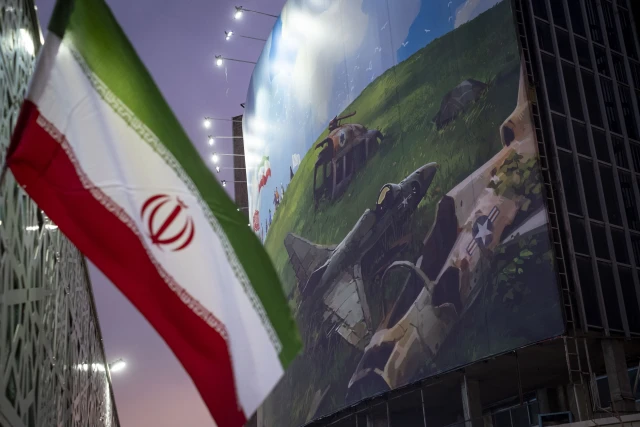
On Sunday, the regime posted a large new banner in Palestine Square in the capital city, Tehran, threatening new ballistic missile attacks on Tel Aviv. The banner contained a threat in Hebrew: “In the face of a shower of missiles, this is a small area.” It also contained a statement in English: “You start … we finish it!”
Iran’s ballistic missile program is considered a significant enough threat that Israeli Prime Minister Benjamin Netanyahu moved up his trip to Washington to request that the U.S. add the issue to the agenda for the negotiations.
A huge banner was raised in Tehran’s famous Palestine Square, displaying a map of potential targets in the Gush Dan (Greater Tel Aviv) area, alongside a warning in Hebrew reading:
— BB MEDIA | Geopolitics (@BBMedia23) February 9, 2026
“In the face of a rain of missiles, this is a small area.”#iran pic.twitter.com/9pSxJDYlmW
“The Prime Minister believes any negotiations must include limitations on ballistic missiles and a halting of the support for the Iranian [terror] axis,” the Prime Minister’s Office said, announcing the new date for the visit.
Israeli defense officials told Israeli news outlet Maariv that if the ballistic missile threat is not removed, Israel is willing to carry out strikes against Iran by itself to remove the threat.
“We told the Americans we will strike alone if Iran crosses the red line we set on ballistic missiles,” a security source told Maariv, noting that Israel is currently monitoring Iranian efforts to rebuild its ballistic missile arsenal following the 12-day Israel-Iran War in June 2025.
Maariv also reported that Israeli military officials are concerned the U.S. will adopt a limited strike model to minimize risk to U.S. forces in the region and to prevent a long military campaign.
“The worry is he might choose a few targets, declare success, and leave Israel to deal with the fallout, just like [he did] with the Houthis,” a military source told Maariv.
Iranian TV showcased Fattah, Zolfaghar, and Kheibar Shekan missiles live, warning the U.S. it has “slapped the U.S. twice” and should not be underestimated. pic.twitter.com/CCR3XIVzzz
— Open Source Intel (@Osint613) February 8, 2026
In December, NBC reported that Iran has the current capability to produce around 3,000 ballistic missiles per year. While Israel struck many sites related to the Islamic Republic’s ballistic missile program, the large size of Iran and its distance from Israel made striking all sites a near impossibility.
The Alma Research & Education Center in Israel recently released a video showing efforts to rehabilitate one ballistic missile site in Isfahan, which Israel targeted and struck during the 12-day war.
The Iranian ballistic missile program is a strategic threat to the state of Israel, the Gulf Arab states, and US forces stationed throughout the region. The ballistic missile site in Isfahan is a case study illustrating the Iranian motivation to rebuild the project's… pic.twitter.com/DRq3wwcMPJ
— Israel-Alma (@Israel_Alma_org) February 4, 2026
During the administration of former U.S. President Barack Obama, Israel asked the U.S. to make Iran’s ballistic missile program part of the Joint Cooperative Plan of Action agreement. However, the Obama administration did not do so, which critics say later enabled the regime to invest significant resources into expanding and developing its ballistic missile arsenal.
Dr. Raz Zimmt, who heads the Iran and Shiite Axis Programme at the Institute for National Security Studies (INSS), assessed that Iran will be unwilling to give up their ballistic missile arsenal, calling it “their last viable instrument.”
He also noted that the 12-day war with Iran led Israel to re-evaluate its understanding of the threat level posed by the Islamic Republic’s arsenal.
“For many years, Israeli strategic thinking centered overwhelmingly on the nuclear question, with the missile program viewed principally as a delivery system for a nuclear warhead,” he said in an interview with103FM radio.
“What has changed since Operation Rising Lion is the stark demonstration of how potent these missiles can be as a direct threat to Israel. Moreover, during that campaign, Israel and the United States succeeded in significantly degrading Iran’s nuclear capabilities. As a result, the missiles themselves have now emerged as the more immediate and pressing danger.”
Iran is reportedly producing hundreds of ballistic missiles per month, many of them cheaper liquid-fueled rockets that require more time for setup and fueling before launch. This may give Israel a greater opportunity to target the missiles before launch, as reportedly occurred during the 12-day war.
However, some are solid-fuel rockets, which require much less time to set up prior to launch. The Israeli concern is that a large arsenal could lead to a situation in which Iran can overwhelm the Israeli and U.S. air defenses, leading to a much higher level of destruction and loss of life than during Operation Rising Lion.
As a result, Netanyahu’s trip to Washington is likely aimed at convincing the U.S. to shorten the negotiations and to include Iran’s ballistic missile program as part of the agenda.
You might also like to read this: