'Sticky note' Super Bowl ad against antisemitism stirs controversy




This year’s Super Bowl half-time show featured a short advertisement about antisemitism which caused great controversy, but not in the way most might expect.
The commercial was sponsored by Robert Kraft, owner of the New England Patriots, who founded the Foundation to Combat Antisemitism in 2019. The foundation became the Blue Square Alliance Against Hate, launched with a 30 second video featured in the legendary half-time segment of the super bowl last year.
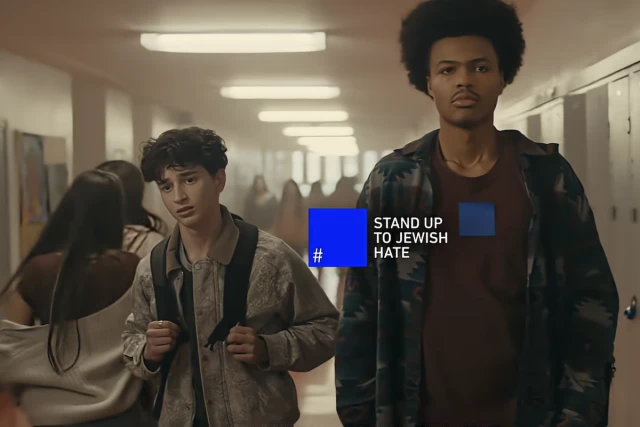
This year, with his own team playing against the Seattle Seahawks, Kraft spent $US15 million on another ad which portrays a Jewish teenager bullied in high school who grows up to become a doctor, and saves the life of his tormentor in a twist at the end.
The ad highlights the fact that 2 in 3 U.S. teens have experienced antisemitism, but the message is primarily that Jews refuse to be victims, and it encourages others to wear the “blue square” symbol of allyship and to denounce all forms of hatred.
Kraft, who is an 84-year-old millionaire, is Jewish and committed to his cause but there have been discussions in Jewish circles about how relevant his new ad really was. Many have complained that the short video, in which the Jewish high school student is labelled “dirty Jew” with a sticky note on his back, bore little resemblance to the reality of antisemitism faced by Jewish teens in 2026.
Detractors have criticized it as “a relic of 1950s style anti-Semitism,” saying that today’s form of anti-Jew hatred is very different. Certainly, the bullying in the advert feels more like a scene from "Back to the Future" than the apocalyptic camp-outs that took over American universities after Oct. 7, 2023, with violence and intimidation from protesters rising to levels not seen since the 1930s.
Stanford student and former anti-Israel activist, Taryn Thomas, described what happened at her college during a protest in 2024 when she was 19 years old:
“They broke into the president's office, who is Jewish, threw fake blood everywhere, destroyed his office, and caused $700,000 in damages,” she recalled in an interview with the Jerusalem Post. “This was, for the sake of Palestine somehow,” she added, saying that they had also graffitied disgusting things on the walls such as “pigs taste better when dead” and “kill Israel.”
“Obviously, this makes our campus feel very unsafe for the Jewish [people] that are attending there,” she said.
The challenges and threats facing Jewish students have escalated monumentally from unkind post-its, making the super bowl commercial seem almost quaint. What Tyler witnessed was so extreme, and the atmosphere of antisemitism so prevalent, that she eventually decided to distance herself from the anti-Israel movement.
Today’s antisemitic slurs are less concerned with the personal hygiene of Jewish individuals and more to do with extremist anti-Israel rhetoric, accusing Jewish people en masse of cheering on genocide, ethnic cleansing, colonization and apartheid.
The age-old blood libel about Jews killing children and babies has once again reared its ugly head, all under the thin veneer of being anti-zionist rather than antisemitic. However, despite the often heard claim that their gripe is against the state of Israel, it is Jewish people, institutions, and areas that tend to be targeted for this hateful vitriol.
While Jews were previously hated for their religion and their race in former mutations of the “virus of antisemitism,” as the late Rabbi Sacks described it, today’s form focuses on the Jewish state – the one safe haven that Jewish people can escape to.
The wild accusations of the antizionist movement, just like those wielded by antisemites in the past, have no basis in reality and some are angry that $15 million still needs to be spent asking people not to hate Jews.
Harvard Alum Shabbos Kestenbaum wrote on social media, “American Jews: If you are spending millions to ‘fight antisemitism’ instead of building Jewish life, you are both out of touch with the needs of Gen Z Jews and have not learned the lessons of post-October 7th Jewry,” he said. “Fund Jewish Day Schools, not Super Bowl ads.”
Jewish influencer Jake Donnelly agreed, saying, “When I first watched this commercial I was annoyed. ‘Oh great, another example of wasted Jewish philanthropy and off-target Jewish activism.’" However, he moderated his criticism after some reflection, adding:
“There was no pleading for help from the Jewish student. There was no groveling. And there wasn’t even a sign that the student couldn’t take the hate. Nah. He stood in the pocket, ready for the fight,” he wrote. “That’s a message I’m down with. That’s a message I can get behind. American Jews are done with the bulls–t and we’re ready for the fight. Allies or not, we’re ready for the fight.”
Though defending the truth about Israel against the current tidal wave of hatred and misinformation is both important and exhausting, the message still needs to be communicated.
"I love this country, and we're at a danger point, I'm sorry to say," Kraft said. "I've never seen the hatred and bigotry that's going on. This is the United States of America. And it's something that really bothers me. So hopefully we're going to do something about it."
The blue square represents that Jews make up 2.4% of the American population, yet are the victims of 55% of religious-based hate crimes.
For more information, including how to receive a blue square pin, visit www.StandUpToJewishHate.org.
You might also like to read this: