US VP Vance visit to Armenia, Azerbaijan – a ‘win’ for Israel, blow to Iran, Russia
VP’s brief but significant trip to the Caucasus sent strong signals about American aspirations in the region




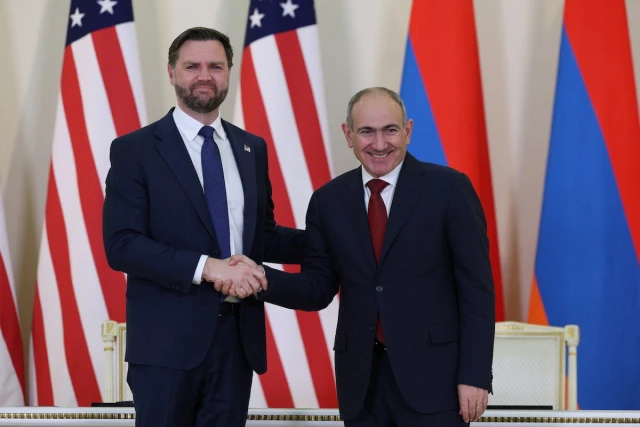
When U.S. Vice President JD Vance swung through the Caucasus on an official state visit this week, his presence put an American stamp on the region and made a statement that reverberated to Russia, Iran and all the way to the Middle East.
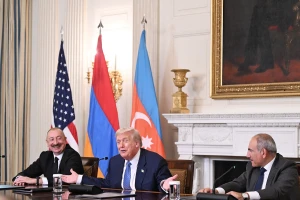
Advancing a peace process set in motion in the White House last August between Armenia and Azerbaijan, Vance became the highest-ranking American official ever to visit Yerevan and the first vice president to return to Baku since Dick Cheney in 2008.
With the region long under Russian and Soviet influence, this evolving American involvement presents a significant twist in the geopolitical landscape and ups the ante when it comes to who controls regional connectivity.
U.S. President Donald Trump brokered the institution of a land corridor which has the potential to connect China and Central Asia to Europe and the Middle East. The eponymously named "Trump Route for International Peace and Prosperity (TRIPP)" will span the 26-mile southern border of Armenia (with Iran), connecting Azerbaijan to its enclave Nakhchivan while opening up the possibility for mass regional commerce.
This comes after four decades of war between Armenia and Azerbaijan over disputed territories, which culminated in 120,000 Armenians fleeing Nagorno-Karabakh in September 2023 following a deadly 10-month siege imposed by Azerbaijan.
FIRST STOP – ARMENIA
The deals made during Vance’s visit underscored Trump’s diplomacy-through-economics approach. Both Armenia and Azerbaijan signed unprecedented energy, business and security agreements with America.
Vance’s first stop was Armenia, the first nation to declare Christianity its national religion back in the year 301 A.D. Vance, who is a Christian, resonated deeply with the religious roots of the country.
“This is one of the oldest Christian countries in the entire world, a true bedrock of Christian civilization and culture,” Vance said. “As a devout Christian myself, I know the meaning of this country to the entire world and to the religion that the prime minister and I share.”
Armenia and the United States struck deals enabling Armenia to purchase American drone technology and providing an inroad to the U.S. military market. Another deal gives Armenia access to American nuclear technology to upgrade its aging Soviet-era nuclear plant.
These breakthrough agreements coincided with a $US4 billion investment in a data center that will put Armenia in the top five AI clusters in the world, said Stepan Sargsyan, a former governor and a founding organizer of the Republic of Armenia Prayer Breakfast.
“This will allow Armenia to become more powerful and prosperous,” Sargsyan said in an interview with ALL ISRAEL NEWS. “A lot of the detractors to these agreements try to paint it as Armenia moving away from Russia and going toward the West. Armenia is rather restoring and increasing the level of its autonomy to conduct its own foreign policy, to be a state. Armenia is trying to come further to the center and enhance its autonomy and its statehood.”
Sargsyan views the vice president's visit as a U.S. effort to “institutionalize” the peace process, still in in the beginning stages and not widely accepted in either country.
“For America to have a more profitable risk-calculation, obviously it is better off to make a deal with these two countries,” he said. “This brings them to a state of trade and open borders so that this larger American plan can work.”
The nuclear technology deal also tilted in favor of the U.S.
“For over a decade Armenian authorities have been negotiating on who will replace this existing power plant with a new one,” Sargsyan said, the U.S. winning out over companies from Russia, China, South Korea and France.
“This agreement will open a new chapter in the deepening energy partnership between Armenia and the United States,” Armenian Prime Minister Nikol Pashinyan said at a joint news conference with Vance.
Sargsyan, who works closely with Pashinyan, was careful to note that despite this advancement with the U.S., Armenia has formal ties with Russia and is not presently an American ally despite “active – even expedited – steps to make it happen.”
Armenia is still formally part of the Collective Security Treaty Organization (CSTO), aligning it with Russia, but froze its membership in 2024 when the organization failed to defend Armenia against Azerbaijani troops crossing the border.
ON TO AZERBAIJAN
The TRIPP places the U.S. at the center of a region in which it hadn’t formerly had a foothold.
“This is a major land corridor that allows trade, transportation and crisscrossing of goods and energy across land mass from China to Europe. This creates a very important, very valuable piece of real estate for the United States to integrate into it[s] economic and geopolitical calculations,” Sargsyan noted. “If you want to transport all the oil and gas that comes out of Central Asia, it is either through Russia or this corridor.”
In Baku, to further galvanize Armenian-Azeri cooperation, Vance promised the delivery of American patrol boats to Azerbaijan to protect its territorial waters in the Caspian Sea, along with other economic agreements between oil-rich Azerbaijan and the United States.
Emphasizing the Trump administration's approach to solving conflicts through business, Vance focused on the opportunity “to create prosperity where once there was only fighting and conflict.”
At a joint press conference, Azerbaijan President Ilham Aliyev said that Washington and Baku were entering “an entirely new phase” in relations. He also noted Azerbaijan’s key resource: oil, which pits his nation as a counter to Russian energy supplies.
“Azerbaijan today provides energy security with its natural gas resources to 16 countries, 11 of them are NATO members, allies of the United States,” Aliyev said.
HOW THIS IS A WIN FOR ISRAEL
While Azerbaijan already has strong diplomatic ties with the Jewish state, “increased U.S. engagement in the Caucasus, and especially with Azerbaijan, is a clear win for Israel,” said Joseph Epstein, direction of the Turan Research Center in Washington, D.C.
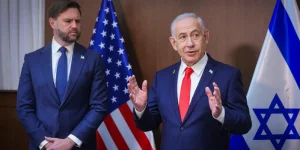
“Official Jerusalem and pro-Israel lobbying groups have long pushed for stronger U.S.-Azerbaijani relations. Just last year, [Israeli Prime Minister] Benjamin Netanyahu publicly began advocating for trilateral cooperation between Israel, Azerbaijan and the United States,” Epstein told ALL ISRAEL NEWS. “For Israel, deeper US-Azerbaijan ties serve a dual purpose: deterring Iran and amplifying the influence of its closest regional allies.”
Epstein noted that U.S. engagement with Armenia also works in Israel’s favor.
“As Yerevan draws closer to the United States and participates in U.S.-backed initiatives like TRIPP, it drifts further from Iran,” he said. “Armenia has signaled that it won't repeat the mistake it made with Moscow: over-relying on a bellicose neighbor whose patronage ultimately hollowed out Armenian sovereignty. A Western-oriented Armenia is one less foothold for Tehran in the region, which aligns directly with Israeli strategic interests.”
Sargsyan also believes that Armenia’s relationship with America will have repercussions for Israel.
“This visit by JD Vance definitely helps that. There is a lot to be gained by both countries in the sphere of technological development,” he said. “Israel has a vibrant IT sector and there’s a lot we can gain just from interacting with them.”
Sargsyan hopes to see this cooperation extend to Christian and biblical tourism that connects Armenia to Jerusalem, which contains an Armenian Quarter and national history in the Old City.
“The birth of Christianity happened in the territories that [are] currently Israel, but Armenia was the first Christian nation,” he noted. “Two of Christ's disciples, Bartholomew and Thaddeus, came to Armenia.”
Now that Armenia is on the map with U.S. security support, Sargsyan hopes that the main “grievance” Armenians have with Israel – military alliance and the support of Azerbaijan – can be overcome.
“The situation has changed to be a lot more conducive to this possibility. There is a lot more rationale for Armenia and Israel to enhance their diplomatic relations,” he said.
TENSIONS AND CONTROVERSY
This high-level visit by Vance comes at a time of high tensions between the U.S. and Iran, which shares its northern border with both Armenia and Azerbaijan.
Vance’s visit was not without backlash from Armenians in the opposition and diaspora for failing to mention Armenian POWs in Azerbaijan, visiting refugees from Artsakh or meeting with political opponents and clergy embroiled in domestic clashes.
The biggest uproar came after the VP’s social media account deleted a photo of him and his wife placing flowers at the Armenian Genocide Memorial. Between 1914-1917, 1.5 million Armenians were killed in Ottoman-era Turkey – atrocities that are denied by Turkey and have become a political quagmire for countries when it comes to genocide recognition.
The Trump administration has not formally recognized the events as a ”genocide” and neither has Israel.
Want to help more people find our reporting from Israel? Leave a quick Google review of our website HERE .
You might also like to read this: