









ANALYSIS The Trump offer that no country in the region can afford to refuse
Upcoming transit route in Armenia is the missing link to connect Central Asia to Israel, Middle East
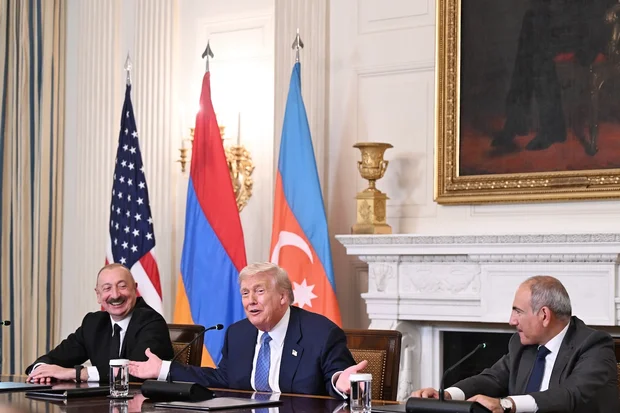
JERUSALEM—A new transit corridor that will be built in Armenia jointly with the United States is the missing link in connecting nations from Central Asia to Europe carving a path all the way to the Middle East with the hope of creating trade—and, ultimately, peace.
That is likely the underpinning strategy of U.S. President Donald Trump’s peace deal that he brokered between Armenia and Azerbaijan in August, one that is now gaining attention in Israel as well.
The cornerstone of the agreement is the Trump Route for International Peace and Prosperity (TRIPP). The commercial corridor will be built along the 27-mile border of southern Armenia, creating the groundwork for the missing link of a contiguous transcontinental corridor from the Caspian Sea to the Black and Mediterranean Seas.
The road not only opens vast opportunities for economic interconnectivity, it also – at least for now – quelled tensions between Armenia and Azerbaijan.
“The American participation and President Trump’s personal engagement in the process was key to unlocking these developments. We managed to unlock a very difficult political situation with economic solutions,” said Armenia’s Deputy Foreign Minister Vahan Kostanyan referring to hostilities between Yerevan and Baku.
Last week, Kostanyan landed in Israel for talks with the Jewish state, his arrival a reflection of the regional shuffle taking place.
“It’s not a secret that during the last couple of years that relations between Armenia and Israel were not in their best times,” he said during a lecture hosted by the European Forum at the Hebrew University on Nov. 26. “But with recent developments in our region, and also here in the Middle East with the common friends that we have… we see quite a big avenue for relaunching of relations and concentrating especially on the economic pillar of relations because, nowadays, to some extent, economy drives politics and international affairs.”
Currently, Armenia’s only export points are through Georgia to the north and Iran to the south. The long borders with Turkey and Azerbaijan are closed, limiting the small nation to two countries, and sometimes just one when tensions flare with Iran.
“We believe that Armenia has a unique geographical stance to become a crossroads for communications, but also for peace,” Kostanyan said at the aptly titled lecture, "Crossroads of Peace: Armenia’s Foreign Policy of Cooperation and Interconnection Between Europe, Eurasia and the Middle East."

CENTRAL ASIA & THE ABRAHAM ACCORDS
If the TRIPP has anything to do with it, the tiny landlocked nation of Armenia will indeed serve as a regional intersection of commerce, if not peace. The route is expected to connect the Caspian Sea (east of Azerbaijan) to the Mediterranean and the Black Sea (on the Turkish border) as a continuous commercial corridor.
According to Kostanyan, it has the potential to link “goods from China through Central Asia to Europe,” reducing dependence on routes dominated by Russia, China and Iran. This one road could shift the regional balance of power toward Washington.
In fact, Trump hosted the leaders of Kazakhstan, Uzbekistan, Turkmenistan, Kyrgyzstan and Tajikistan – Central Asian nations rich in natural energy and minerals – early November in Washington, D.C.
After these meetings, Kazakhstan announced it would join the Abraham Accords, the normalization agreement with Israel. While Kazakhstan – a Muslim-majority nation – already had diplomatic ties with Israel, joining the Abraham Accords signifies an intent to increase trade.
The road crossing through Armenia will facilitate that.
In an interview at the Republic of Armenia Prayer Breakfast last month, retired U.S. Army Col. Greg Pipes noted that Central Asian leaders were discussing TRIPP “because they want their goods to be able to get to the Mediterranean and that’s how they are going to do it.”
“You get this route working and you’ll be able to get products from all the way [from] deep in the Central Asian states to the Mediterranean,” he said.
The TRIPP is not without challenges. The nations involved have to work out what can be shipped and to whom, including military supplies, Pipes said.
For Azerbaijan, the corridor was something its leader, President Ilham Aliyev, had threatened to take by force. Currently, Azerbaijan is separated from its enclave Nakhchivan (on Armenia’s western border) and must ship its goods north via Georgia and Turkey to get there rather than a mere 27 miles across Armenia.
“What that's going to do is, if you open that up for trade, then you have Azerbaijan being able to connect to their exclave. And that exclave borders Turkey. Turkey borders the Mediterranean,” Pipe noted.
Another player is Iran, which ships its goods to Europe through Armenia – its only northern neighbor with whom it has good relations. Though Iranian leaders have opposed the construction of a road controlled by America on its border, promises of connectivity may placate their resistance as well.
“The first reactions coming from Iran were manageable,” Kostanyan said.
AMERICA FIRST – EVEN IN THE MIDDLE EAST
Pipes, formerly a military attaché to the U.S. embassy in Armenia, said this agreement solves an issue that the U.S., France, and Russia failed to resolve for decades. Armenia and Azerbaijan were embroiled in war for decades and discouraging war was futile.
“As a military guy, I don’t want war. However, that doesn't stop people from pursuing it,” he said. “And so Trump, in six months, is able to get Aliyev and (Armenia Prime Minister Nikol) Pashinyan, the two leaders of these two countries, to shake hands and agree on a new framework for an actual peace.”
Pipes said the agreement reflects the “America first” foreign-policy approach of the current U.S. administration, despite its distance from the mainland, with countries often overlooked by and mispronounced in the West.
It’s not just about peace, he said.
“I think it’s because those markets are huge for American interests,” Pipes explained.
“Now, if the Abraham Accords goes all the way up to the rest of Central Asia, then we have Israel now being interested. And here’s what this does: As a result, there's so many reasons why President Aliyev in Azerbaijan wouldn’t want to attack across this corridor to reunite Nakhchivan and Azerbaijan,” Pipes noted.
The American presence and investment in this corridor essentially represents a deterrent to future attacks by Azerbaijan. A disruption to the route would destabilize the Central Asia Abraham Accords partners with Israel.
“The U.S. is going to be the one funding this road – major U.S. investment that the U.S. would be very upset, and (Aliyev) would have now all these states, these Central Asian states, trying to get their goods across,” Pipes noted. “Now, he potentially (would have) Israel upset with him. And last I checked, Israel provides a lot of military hardware to Azerbaijan.”
“So what it does is it disincentivizes conflict,” Pipes continued. “In this world, I don’t think we can have true peace, but we can do a lot of things to pull back conflict and disincentivize nations so that they’re not inclined to do that.”
Popular article:

interview Easter message of resurrection hope amid war at Jerusalem's Garden Tomb
biblical commentary Let my people go: a Passover message for today
4 IDF soldiers killed, 2 wounded in fighting in southern Lebanon, as Israel eliminates dozens of Hezbollah terrorists

Receive latest news & updates
A message from All Israel News
Help us educate Christians on a daily basis about what is happening in Israel & the Middle East and why it matters.
For as little as $10, you can support ALL ISRAEL NEWS, a non-profit media organization that is supported by readers like you.
Latest articles:
ANALYSIS Hamas openly threatens Israel with ‘more Oct 7 attacks’ as intelligence shows terror group is rearming

ANALYSIS More than 1,300 antisemitic posts blame Israel, Jews for French riots – report

ANALYSIS Thailand turns to Israeli anti-drone technology to counter growing battlefield threat
ANALYSIS Israeli fighter jets flew to Iranian border in ‘power projection,’ deterrence exercise ahead of elections next week
ANALYSIS Israel targets nuclear fusion leadership as AI drives soaring energy demand