Iranian regime celebrates anniversary by burning ‘Baal’ statue labeled with Star of David amid cries of ‘death to Israel’
President Pezeshkian claims regime doesn't want nuclear weapons but regime threatens war




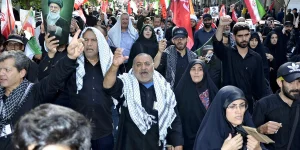
The Islamic Republic on Wednesday celebrated the 47th anniversary of the revolution that toppled the monarchy led by the Shah and, eventually, led to the creation of the current mullah regime under the first “Supreme Leader,” Ruhollah Khomeini.
As every year, the festivities were accompanied by raucous displays of hatred and hostility toward Israel and the United States, which Khomeini had dubbed the “little” and “great Satan,” respectively.
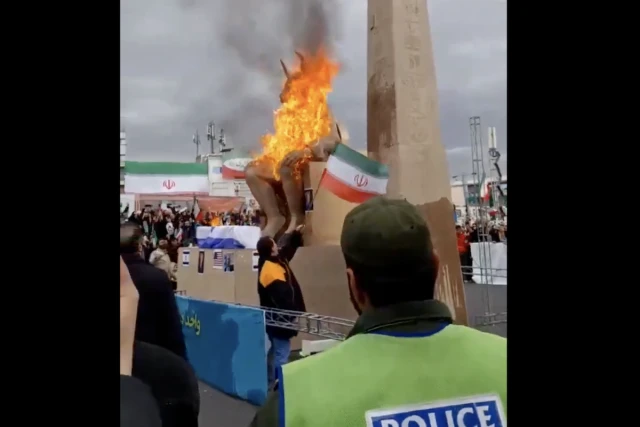
One of the “high” points of the state-sponsored mass rallies this year was the burning of a statue of Baal, the ancient Canaanite god often mentioned in the Bible.
The statue was adorned with Israeli flags, a picture of U.S. President Donald Trump, and had a Star of David carved into it, apparently meant to associate the deity, which the Biblical Israelites had fought against, with the modern state of Israel. The statue was eventually torched amid chants of “Death to Israel.”
Iranian protesters in Tehran set fire to a sculpture labeled Baal, depicted with a Star of David, a photo of President Trump and cast as a satanic figure, while chanting “Death to Israel,” during celebrations of the anniversary of the Islamic revolution. Baal, an ancient… pic.twitter.com/i3zGT1PPDX
— Ariel Oseran أريئل أوسيران (@ariel_oseran) February 11, 2026
In addition, pictures circulating online showed a poster displaying the deity as “pulling the strings” of Trump, Israel’s Prime Minister Benjamin Netanyahu, Saudi Arabia’s Crown Prince Mohammed Bin Salman, as well as Jeffrey Epstein, the infamous convicted sex offender.
Other activities at the rallies included the ritualistic trampling of Israeli and American flags, displays of mock coffins of senior American military leaders, including CENTCOM Commander Gen. Brad Cooper, and the display of Israeli Air Force drones allegedly shot down during last year’s 12-Day War.
The regime also showcased its military capabilities, parading various types of missiles, while several senior figures made rare public appearances amid ongoing tensions with the U.S. and fears of a surprise strike.
🇮🇷⚡️- Visuals continue to emerge from Iran today where people burned many statues and posters associated with the devil Baal, a holy symbol among the zionists and elites, also mentioned in the epstein files for child offering.
— Monitor𝕏 (@MonitorX99800) February 11, 2026
Iranian continue to piss off the world elites. pic.twitter.com/lIJ4tuX20D
This underscored the importance the regime sees in the sponsored mass rallies. According to some reports, the regime this year forced workers to attend, threatening that their salaries would be affected otherwise.
Senior Iranian officials who joined marches included Foreign Minister Abbas Araghchi, IRGC Quds Force commander Ismail Qaani, Parliament Speaker Mohammad Bagher Ghalibaf, and Chief of Staff, Maj.-Gen. Abdolrahim Mousavi.
President Masoud Pezeshkian, who had struck a more conciliatory and understanding note in his comments about the recent protest wave than other officials, used his speech on the occasion to call for unity, after the regime is estimated to have killed up to 40,000 protesters.
Senior Iranian 🇮🇷 regime officials participated in marches celebrating the 47th anniversary of the Islamic Revolution.
— Aleph א (@no_itsmyturn) February 11, 2026
Spotted:
Abdolrahim Mousavi, Chief of the General Staff of the Iranian Armed Forces
Esmail Qaani, Commander of the IRGC Quds Force
Gholam-Hossein… pic.twitter.com/LtopyPn3fP
Without directly addressing the bloody crackdown, he said, “We are ashamed before the people. We are obliged to serve all those who were harmed in this process. We are ready to hear the voice of the people. We are servants of the people and we do not seek to confront the people.”
Despite this, Pezeshkian so far refused to publicly support members of the Reformist Movement, with which he has been associated, after several leading politicians were arrested by the regime in recent weeks.
Regarding the tensions with the U.S. and the ongoing nuclear talks, he claimed again that the regime doesn’t seek nuclear weapons. “The high wall of mistrust that the United States and Europe have created through their past statements and actions does not allow these talks to reach a conclusion.”
We are not seeking nuclear weapons. We have stated this repeatedly, time and again. And we are ready for any kind of verification,” Iran’s President Masoud Pezeshkian said in a speech marking the Islamic revolution’s anniversary on Wednesday. pic.twitter.com/O3mH3jy56T
— Iran International English (@IranIntl_En) February 11, 2026
“At the same time, we are engaging with full determination in dialogue aimed at peace and stability in the region alongside our neighbouring countries,” he said.
However, the president has little authority regarding foreign policy and security matters. Ali Shamkhani, a confidante of Supreme Leader Ali Khamenei and head of Iran’s Supreme National Security Council, sounded a much more defiant note in his speech on Wednesday.
Shamkhani reiterated the regime’s refusal to negotiate over its ballistic missile program, warning that “the negotiations that come in parallel with the American president's threats fall within the framework of the usual American approach,” and, “the war will not remain limited to a specific geographical framework or between only two sides.”
Threatening the entire world with war, he continued, “the nature of the region causes any confrontation to have implications that go beyond the military aspect. Considering the energy resources and potential in the region, any escalation could have implications for many factors. Any escalation could affect the lives of people around the world."
You might also like to read this: