How Israel’s ambiguity on Judea and Samaria led to a Palestinian embassy in London
.jpg "Maayan Hoffman")


If Israel does not enact sovereignty over Judea and Samaria and formally declare the territory its own, more countries will likely move beyond symbolic recognition of a Palestinian state and begin opening embassies, expanding diplomatic ties, and cooperating with the Palestinian Authority as they would with a fully sovereign government.
Over time, that momentum could lead to formal United Nations recognition of Palestine, at which point Israel’s rejection would carry little practical weight.
That process may already be underway.
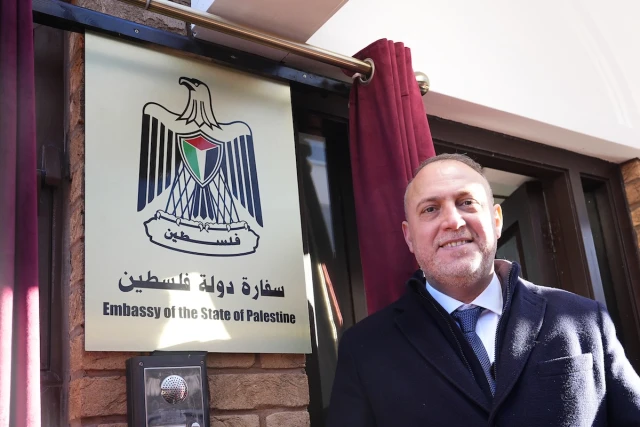
Last week, on Jan. 5, the United Kingdom inaugurated a Palestinian embassy in London, converting what had previously been known as the Palestinian Mission to the UK in west London into a full embassy. According to Palestinian Ambassador Husam Zomlot, the move grants the mission “full diplomatic status and privileges.”
This marks the first Palestinian embassy to open in a Western country since the recognition of the State of Palestine in September 2025 in New York. It is widely expected that other Western countries will follow suit.
Yet, as Lt. Col. (res.) Maurice Hirsch, director of the Initiative for Palestinian Authority Accountability and Reform at the Jerusalem Center for Public Affairs, warned that this trajectory is closely tied to Israel’s own decisions.
“If Israel doesn't choose to enact sovereignty over Judea and Samaria and to say this land is ours, then there's no reason it can't go to the Palestinians,” Hirsch told ALL ISRAEL NEWS.
“For more than five decades, Israel has been reluctant to unequivocally realize its internationally acknowledged historic and legal sovereign rights over Judea and Samaria,” Hirsch wrote in a paper published last May with Amb. Alan Baker. “This hesitance has served to strengthen Palestinian claims that the areas are ‘Palestinian territory,’ and as such they have succeeded in establishing a fiction that has been willingly accepted within the international community.”
While any state is free to recognize another state, such decisions are often driven more by political calculations and foreign relations than by legal or factual benchmarks.
The State of Palestine does not meet the United Nations criteria for statehood. Those criteria require a permanent population, a defined territory, an effective government, and the ability to enter into international relations. A state must also declare itself a “peace-loving state” and accept the obligations of the UN Charter.
France, Australia, and Canada, among others, recognized Palestine in the fall, partially in response to the humanitarian situation in Gaza, which followed the Oct. 7, 2023, Hamas massacre. Israel entered Gaza and began its attempt to eradicate Hamas after more than 6,000 Gazans infiltrated Israel and murdered 1,200 people, and took 251 hostage. Their recognition came even though the State of Palestine still could not meet the required criteria, particularly as the Palestinian Authority has clearly not been an effective government, exercising control over the territory of Gaza, for around 20 years.
Moreover, the decision to recognize a Palestinian state while simultaneously recognizing Israel runs counter to even the longstanding Palestinian ideology, which has consistently rejected a two-state solution. That rejection dates back to 1937, when the Peel Commission first proposed partition. Since then, Arab leadership has refused a Palestinian state alongside a Jewish state multiple times, including in 1947 with the UN Partition Plan, at the Camp David peace summit in the summer of 2000 under the auspices of President Bill Clinton, and again in 2008, when Israeli Prime Minister Ehud Olmert offered the Palestinians more land than the pre-1967 lines in yet another peace proposal, among others.
Hirsch said the United Kingdom may now seek to deepen its business and diplomatic relations with Palestine following the opening of the embassy. However, there is little room for meaningful economic expansion given the Palestinian economy's current state. More troubling, he argued, is that the UK has effectively recognized what he described as a “terror state” and rewarded the actions of the Oct. 7 massacre.
“While the British and Canadians both clarified that their decision to recognize the non-existent state was not a reward for terror, including the October 7 massacre, for the Palestinians, the connection is crystal clear: The more Jews they murder, the greater the diplomatic reward,” Hirsch wrote recently in a separate paper.
He told ALL ISRAEL NEWS, “This is an embassy of hatred, of terror promotion, of violence and a reward for the October 7 massacre.”
Hirsch also stressed that the UK government under Prime Minister Keir Starmer has capitulated to violence on the streets of England in an effort to secure reelection.
“It's all about pandering to these fanatics in England so that they ensure that they continue voting for them,” Hirsch said, noting that Muslims today make up around 10% of England’s population and are wielding growing political influence.
“England is losing its values, is losing its standing, is losing its moral position to try and garner a few votes for the Labour Party that was so desperate to get back into power after so long being sidelined,” Hirsch claimed. “For that power, they're willing to do basically anything, even to the detriment of the United Kingdom.”
Hirsch warned that Britain will ultimately face the consequences of these decisions, including an increased risk of terror attacks linked to Islamic extremism on its own territory.
At the same time, Israel will face consequences as well.
If Israel continues its policy of ambiguity regarding Judea and Samaria, territory that is more biblically and historically tied to the Jewish people than Tel Aviv, and if more Western countries follow England’s lead by opening Palestinian embassies, Israel risks having reality dictated to it.
In the absence of a clear Israeli decision, similar moves, such as the opening of a Palestinian embassy in Britain, will continue. Once that process gains momentum, it may no longer matter what Israel chooses to reject.
Want to help more people find our reporting from Israel? Leave a quick Google review of our website HERE .
You might also like to read this: