









Preserving Purim: How Iran’s Jewish community protected the tomb of Esther and Mordechai
As Israel and the United States wage war against Iran in an expanding regional conflict, the ancient story of Purim – recounting a Persian plot to destroy the Jewish people and the courage that foiled it – carries renewed relevance.
This week, Israelis celebrated the holiday commemorating those events described in the Book of Esther. More than two millennia later, as Israel and its allies confront the modern Iranian regime, the story’s historical echoes are striking.
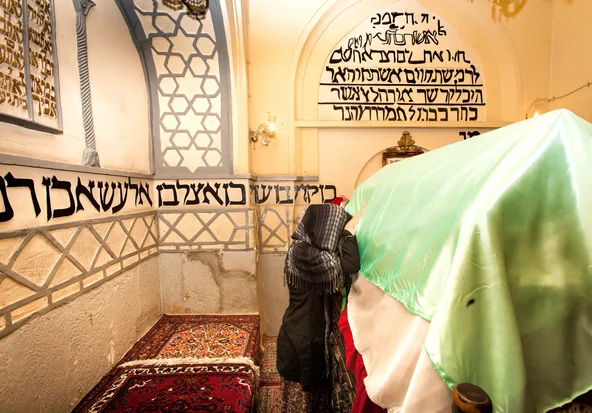
The tomb of Esther and Mordecai, located about 200 miles west of Tehran in Hamadan (ancient Ecbatana) is one of the most important Jewish heritage sites in Iran. Its preservation in modern times is largely the result of determined efforts by Iran’s Jewish community in the early 1970s.
In 1971, Iran marked the 2,500-year anniversary of the decree issued by Cyrus the Great allowing Jews to return to Jerusalem. The celebrations, held during the reign of then-Shah Mohammad Reza Pahlavi – whose son, Reza Pahlavi, has since become a leading opposition figure calling for the end of the Islamic Republic – highlighted Persia’s ancient heritage and longstanding ties to the Jewish community.
Recognizing a rare opportunity, the Iranian Jewish community moved to secure one of its most cherished sites.
Community leaders, including architect Elias (Yassi) Gabbay, purchased the land surrounding the tomb from the Iranian government. According to the National Library of Israel (NLI) blog, purchasing the land “would allow for the renovation and preservation of the site for future generations.”
The acquisition cleared surrounding buildings and created a spacious courtyard and entrance plaza. Gabbay’s design integrated the historic brick mausoleum, crowned by its distinctive dome, with an underground synagogue and gathering spaces, allowing pilgrims to visit without compromising the site’s sanctity.
Although the Purim story takes place in Susa (Shushan), tradition holds that Esther and Mordechai were later buried in Hamadan. Local accounts suggest they fled there following King Ahasuerus’s death to escape lingering enemies.
The current structure dates from the 13th to 17th centuries and was built on top of older foundations. Its small stone entrance, only four feet high, requires visitors to bow, a gesture widely seen as a mark of respect. Inside, two wooden sarcophagi bear Hebrew inscriptions, often adorned with colorful fabrics and scarves left by pilgrims.
The tomb of Esther and Mordechai has served as a pilgrimage site for Jews all over Iran and beyond for more than a millennium.
For centuries, the tomb also served as a shared sacred space. The NLI blog notes, “The site has long been visited not only by Jews, but also by local Muslims and Christians, demonstrating its shared cultural significance.”
In 2008, the Iranian government declared the tomb a National Heritage site. Still, it has occasionally been a point of political tension amid hostility toward Israel. Calls to remove its heritage status or repurpose the site have surfaced during regional conflicts.
Today, only a few thousand Jews remain in Iran, a small remnant of a community whose roots stretch back more than 2,700 years.
The survival of the tomb – maintained despite centuries of upheaval – continues to symbolize the deep historical connection between the Jewish people and the land of Persia.
Popular article:
interview Easter message of resurrection hope amid war at Jerusalem's Garden Tomb
biblical commentary Let my people go: a Passover message for today
4 IDF soldiers killed, 2 wounded in fighting in southern Lebanon, as Israel eliminates dozens of Hezbollah terrorists
Receive latest news & updates
A message from All Israel News
Help us educate Christians on a daily basis about what is happening in Israel & the Middle East and why it matters.
For as little as $10, you can support ALL ISRAEL NEWS, a non-profit media organization that is supported by readers like you.
Latest articles:

More than 1,300 antisemitic posts blame Israel, Jews for French riots – report

Thailand turns to Israeli anti-drone technology to counter growing battlefield threat

Israeli fighter jets flew to Iranian border in ‘power projection,’ deterrence exercise ahead of elections next week
Israel targets nuclear fusion leadership as AI drives soaring energy demand

Israel's Sheba Medical Center climbs to 6th in global smart-hospital rankings