UAE & Saudi Arabia pressure US to go ‘all the way’ against Iranian regime amid perceived lack of Arab support
Emiratis and Saudis oppose negotiated end of war, want regime destroyed




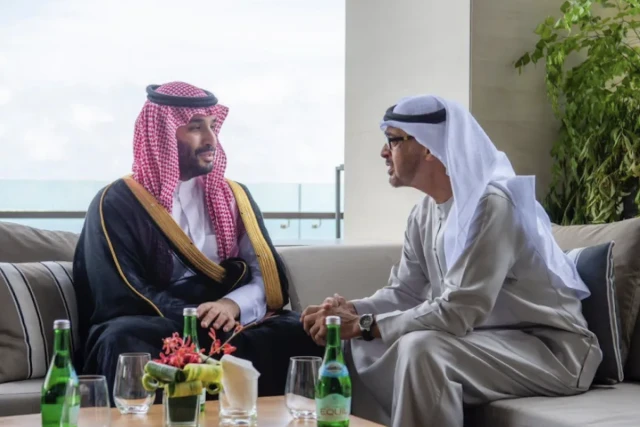
Saudi Arabia and the United Arab Emirates have reportedly been pushing the U.S. to go “for the kill” against the Iranian regime behind the scenes, and now, the Emirates are also doing so in increasingly public fashion.
Emirati ambassador to the U.S., Yousef Al Otaiba, wrote in a Wall Street Journal column, “The past 3½ weeks of war have confirmed what we have known for nearly 50 years – Iran’s revolution is a threat to global security and economic stability.”
Located across the Gulf from Iran’s southern coast, the UAE has taken the brunt of Iran’s attacks, even more than Israel. Otaiba argued that the extreme enmity shown by the regime, despite the UAE having tried to avert the war through diplomacy, is because “the U.A.E. is the argument Iran can’t win, the idea it can’t accept.”
Notably, Otaiba advocated against a “simple” ceasefire but demanded “a conclusive outcome that addresses Iran’s full range of threats: nuclear capabilities, missiles, drones, terror proxies and blockades of international sea lanes,” which, in effect, signals full support for Israel’s position.
“We can’t let Iran hold the U.S., the United Arab Emirates and the global economy hostage… We want Iran as a normal neighbor. It can be reclusive and even unwelcoming, but it can’t attack its neighbors, blockade international waters, or export extremism. Building a fence around the problem and wishing it goes away isn’t the answer. It would simply defer the next crisis,“ wrote Otaiba.
His column highlights an opinion that seems to be taking hold across the Gulf. According to Reuters, several states in the region told the UN Human Rights Council on Wednesday that Iranian missile and drone attacks posed an “existential threat” to them, with Emirati and Kuwaiti representatives accusing the regime of seeking to destabilize the international order.
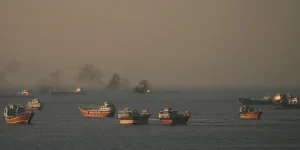
The Wall Street Journal also reported that the leadership in the UAE and Saudi Arabia, in particular, fear that a ceasefire that leaves the regime in place would grant it significant regional leverage after the war, enabling it to dangle over their heads the threat of renewed attacks on energy sites and the closure of the Hormuz Strait .
The UAE has also been directing its ire at the Arab League and other states that it says have not offered enough support. Anwar Gargash, an advisor to the UAE President, Mohammed bin Zayed, strongly criticized Arab countries and institutions in several posts on 𝕏 this week, warning that the lack of support is pushing Gulf states closer to the U.S.
“Where are the joint Arab and Islamic institutions, chief among them the Arab League and the Organization of Islamic Cooperation, while our countries and peoples are subjected to this treacherous Iranian aggression? And where are the ‘major’ Arab and regional countries?” wrote Gargash.
“In absence and impotence, it is unacceptable later to speak of the decline of the Arab and Islamic role or to criticize the American and Western presence,” he added.
In another post, he stressed, “The Emirates has proven its ability to confront and endure, and it does not need equipment and troops as much as it needs clarity of positions and knowledge of who can be relied upon in times of hardship.”
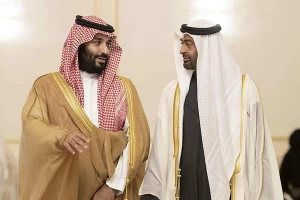
Several reports over the past few days also suggested that the UAE and Saudi Arabia are still mulling whether to join the military operation against Iran with their own troops, while Crown Prince Mohammed bin Salman has reportedly been pushing President Trump to continue the war against Iran.
People briefed by American officials on the conversations told The New York Times that there is a “historic opportunity” to remake the Middle East, and that the U.S. should continue to pursue the destruction of the regime, rather than move toward negotiations.
However, unlike its “little brother” UAE, Saudi Arabia is still fully advocating a peaceful solution in its public statements.
The Saudi government responded to the NYT’ report, “Saudi Arabia has always supported a peaceful resolution to this conflict, even before it began,” while noting, “our primary concern today is to defend ourselves from the daily attacks on our people and our civilian infrastructure.”
Among the other countries in the region that have offered only lukewarm statements is Jordan, which, on Wednesday, joined the UAE, Saudi Arabia, Bahrain, Qatar, and Kuwait in another statement of condemnation against Iran’s “flagrant” aggressions, which also highlighted the countries’ “full and inherent right to self-defence.”
However, despite frequent attacks on military bases on Jordanian territory as well as fallout from missile attacks meant for Israel, the Saudi Kingdom's foreign minister, Ayman Safadi, said this week that Jordan is not a party to the ongoing regional conflict.
He stressed that no attacks against Iran were launched from Jordanian territory, noting that Jordan has formally communicated to Iran the need to cease any targeting of the kingdom’s territory. “We are not a party to this, and the war did not start from our side,” he said.
Safadi also stressed that, unlike several Gulf countries and Lebanon, Amman hasn’t expelled the Iranian ambassador.
Another significant nation that has remained on the sidelines is Egypt.
“Gulf governments expected more denunciations of Iran as an aggressor. It took [Egypt] five days to say a word. The Arab League hasn’t met; they usually hold emergency summits and haven’t called for one. The foreign ministers met over Zoom and issued a statement that was a nothingburger,” Hussain Abdul-Hussain, a research fellow at the Foundation for Defense of Democracies, recently told the Jewish Insider.
Even worse, the media in Egypt and Algeria are showing “happiness … that Israel is being pounded,” Abdul-Hussain added.
“They’re happy with what Iran is doing and no one really seems to care about the Gulf states. The Gulf took (was hit by) 84% of the [Iranian] missiles, as opposed to Israel, which took 16%, and they still can’t straightforwardly say Iran is a problem?”
This article originally appeared on ALL ARAB NEWS and is reposted with permission.
You might also like to read this: