‘Iran won, Israel weakened’ - Israeli public dissatisfied with Trump’s Memorandum of Understanding
Survey respondents give government failing rating on achieving goals of campaigns in Gaza and Iran





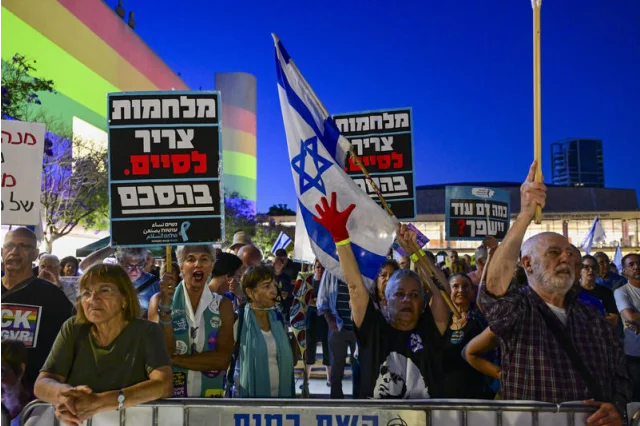
Following the signing of the Memorandum of Understanding between the Islamic Republic of Iran and the United States, the Israeli public believes that the major war goals for the Iran and Gaza conflicts have not been achieved.
A recent Hebrew University study found that 92.1% of respondents believe Iran emerged as the big winner from the U.S.-negotiated deal.
The results of the survey, conducted by the Agam Institute, in collaboration with the Hebrew University of Jerusalem, offered a stark picture of unity in a nation known for political divisions.
Asked to identify who won the war, or gained more from the conflict if the MoU is implemented, 92.1% of Israelis, including Jews and Arabs, agreed that Iran gains the most from the agreement. The results were practically identical between coalition (93.1%) and opposition (94.9%) registered voters.
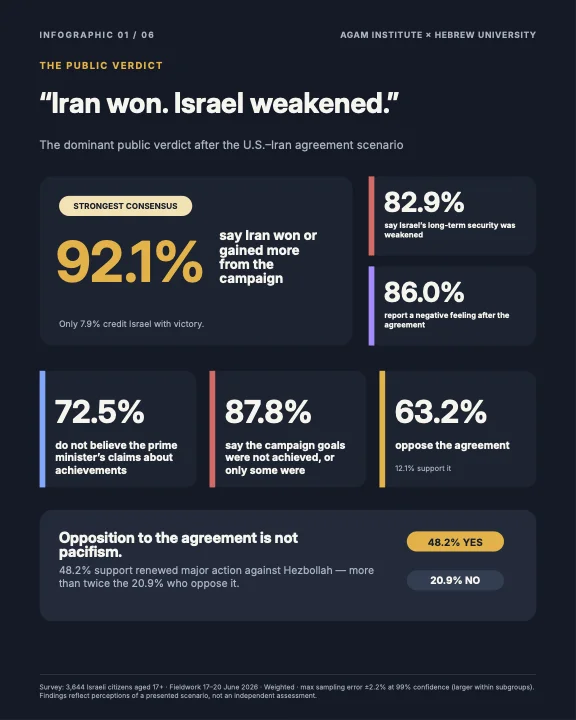
In a related question, Israelis were asked if the agreement weakens or strengthens Israel’s security. The respondents again showed a remarkable unity of opinion, with 82.9% saying the agreement weakens Israel’s long-term security.
The Israeli public has a broadly negative opinion of the Iran agreement, with 86% reporting reactions ranging from disappointment and despair to pessimism and fear. Only around 13% of Israelis expressed positive emotions, such as hope, optimism, or relief, following the signing of the agreement.
A previous survey at the end of April found that 66% of respondents expressed negative feelings about the end of the war.
Many Israelis fault the leadership of the war, particularly the political leaders. Asked to grade the performance of four leaders during the Iran military campaign, only 30% of respondents gave a failing grade to IDF Chief of Staff Eyal Zamir, with 69.8% giving a favorable view of his performance. However, for political leaders, the story was sharply different.
A majority of respondents (56.4%) rated Prime Minister Benjamin Netanyahu’s management of the war as failing, compared to 43.6% who had a favorable opinion.
Defense Minister Israel Katz scored slightly worse, with 60.3% rating his management of the war as failing, while 39.7% rated his management favorably.
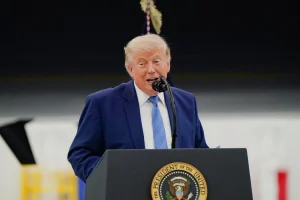
The harshest criticism was directed at U.S. President Donald Trump, however. Almost 70% (69.1%) gave his management of the war a failing grade, while only 30.9% rated it favorably.
The assessment of Netanyahu’s performance showed the clearest indication of political allegiance: the majority of coalition-affiliated respondents rated his performance favorably (81.3%), compared with Arab (85.4%) and opposition (83%) respondents, who rated it unfavorably.
The survey also found a significant lack of trust in statements by Prime Minister Netanyahu in which he said that Israel had achieved its goals in the war.
Over two-thirds of Israelis (72.5%) do not believe Netanyahu’s comments, as opposed to 27.5% who do. Even among coalition supporters, the split between those who believe Netanyahu’s statements (52.2%) and those who do not (47.8%) is almost equal, indicating that Netanyahu could be losing trust ahead of upcoming elections.
The Israeli public especially doubts Netanyahu’s claims of achieving “total victory” during the Gaza and Iran campaigns.
A large majority (61.3%) of Israelis said that Israel had not achieved any of the major objectives Prime Minister Netanyahu set for the campaign, such as the toppling of Hamas in Gaza, the freeing of the hostages, the removal of the Hezbollah threat in Lebanon, and the end of the Iranian threat.
A significant minority (26.5%) agreed that Israel had “achieved some of the goals” for the campaigns, while only 12.2% said Israel had “achieved most of the goals.”
Among the coalition-aligned voters, the numbers were higher, with 70% assessing that Israel had achieved some (41.7%) or most (28.3%) of the goals.
The survey also found a steady decline over the past four months in support for Netanyahu to continue in the role of prime minister. While 40.5% of respondents in early March preferred Netanyahu for that role, only 29.4% did so in the most recent survey.
However, the respondents have not consolidated their opinions around any potential challenger to Netanyahu. While 33.5% prefer a candidate other than Netanyahu, only 18.3% support former Prime Minister Naftali Bennett, and 18.8% support former IDF chief Gadi Eisenkot.
The survey’s authors, Dr. Nimrod Nir, Dr. Gayil Talshir, and Asa Shapira, concluded that “The public is looking for an alternative - but has not yet coalesced around an agreed one.”
Notably, the survey did not find war fatigue to be a factor in the results. Roughly half (48.2%) of respondents support renewed major action against Hezbollah – even at the price of a direct confrontation with President Trump. While only 21% oppose it.
According to the authors, “This may be the report's most important finding: the public does not reject the use of force or the campaign's objectives; it rejects the claim that force was used successfully and that the objectives were achieved.”
“A large part of the public wants a more forceful policy but believes the current campaign failed to deliver the promised result,” the authors noted.
The survey indicates that heading into an election season, the Israeli public is largely dissatisfied with the performance of its leaders, but divided over new leadership.
Please take a moment to join believers worldwide praying for Israel right now. Add your light to the live prayer map—and show the world one more watchman praying for the peace of Jerusalem.

You might also like to read this: