Ebola is spreading in Central Africa. Should Israelis panic?



Although Ebola is a severe disease with a high mortality rate, Israelis should not panic, even if they need to travel to Africa, according to local infectious disease experts. They stressed that the chance of an Ebola outbreak in Israel is extremely small, if not nonexistent. Moreover, the likelihood of dying from Ebola in a Western country is quite low.
In the last 10 days, two Israelis were suspected of having Ebola after returning from the Democratic Republic of the Congo. However, the Health Ministry said that epidemiological testing showed they were negative for the virus. As such, Israel has no confirmed Ebola cases at this time.
Ebola is transmitted through direct contact with a symptomatic infected person or with their blood, bodily fluids, or other secretions. The Health Ministry is closely monitoring the Ebola outbreaks in the Democratic Republic of the Congo and Uganda, it said in a statement, and is maintaining system-wide preparedness to ensure the healthcare system is ready for any possible scenario.
The ministry has also asked the public to avoid non-essential travel to areas with active Ebola transmission. If people do travel to those areas and develop a fever or other symptoms within 21 days of their return, they are asked to remain at home, avoid contact with others, and call the Ministry of Health's hotline at *5400.
In the two previously suspected cases, the Health Ministry conducted epidemiological investigations to identify relevant contacts and assess possible links to the suspected infections. Contact tracing was conducted in accordance with professional medical protocols to ensure that only those genuinely at risk were contacted.
Israel has several hospitals with specialized centers for receiving suspected Ebola cases, including Sheba Medical Center. In addition, the ministry procured protective equipment and specialized medical supplies, established early identification mechanisms for travelers returning from affected areas, and set up a laboratory system capable of diagnosing Ebola when the outbreak was first reported last month.
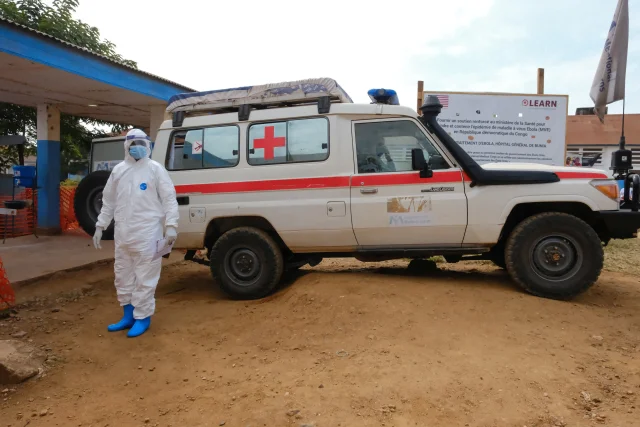
The current outbreak is in the Democratic Republic of the Congo (DRC) near the border with Uganda. To date, around 1,000 people have been diagnosed with the disease in the DRC and a couple of dozen in Uganda.
Prof. Eli Schwartz, director of the Center for Geographic Medicine at Sheba, told ALL ISRAEL NEWS that this outbreak likely began sometime in April but only received attention a few weeks later due to the challenging medical situation in the DRC, which is plagued by internal conflict and is an active military zone. This is one of the largest recorded outbreaks of Ebola since the disease was first identified 50 years ago, in 1976.
The first outbreak also occurred in the DRC, then known as Zaire. As a result, the strain became known as the Zaire strain.
Schwartz said that approximately every three years, there is an Ebola outbreak in the DRC. Across Africa as a whole, outbreaks occur nearly every year. As such, experiencing an Ebola outbreak is not unusual. However, there are two unusual features of the current outbreak, he said.
The first is its magnitude. In 2020, an outbreak involving nearly 4,000 patients occurred in two areas of the DRC. However, the largest Ebola outbreak occurred in West Africa around 2014. That outbreak lasted more than two years and resulted in more than 28,000 reported cases.
The number of cases linked to the current outbreak is still climbing.
In addition, this is a different Ebola strain than usual. It is called the Bundibugyo strain, named after a Ugandan town near the border with the DRC. The positive aspect of this strain, Schwartz said, is that its mortality rate is lower than that of the Zaire strain, around 15% compared with 80%.
“In that sense, it is much less dangerous,” Schwartz said. “However, to have an infectious disease with a 15% mortality rate is still very high, and we should not ignore it.”
Schwartz said symptoms are flu-like, meaning headaches, muscle pain, and fatigue, but they can also include severe abdominal pain, vomiting, diarrhea, rashes, and, in many cases, viral hemorrhagic fever, which can damage the circulatory system and cause internal bleeding.
Now, the question is whether Ebola is a real threat to the world, and according to Schwartz, “the answer is a definite no.”
"There's no chance of an Ebola outbreak outside of its endemic area,” Schwartz stressed. “There’s no chance because to transmit the disease, you need to be in close contact without good precaution methods.”
Unlike the coronavirus, which is a respiratory disease that is transmitted through the air from an infected person to another, even before symptoms appear, Ebola can only be transmitted through direct contact. Moreover, a person must be symptomatic to spread the disease.
Schwartz said that at the beginning of the current outbreak, a group of people traveled from the infected area to the West, some of whom had Ebola. Because they did not know they had the disease, they had close contact with others on airplanes, trains, buses, and even in supermarkets.
“Altogether, we found reporting of more than 600 close contacts with Ebola patients outside of hospitals,” Schwartz noted. “How many people did they infect? The answer is none.”
Schwartz said that maintaining standard Western hygiene practices, especially in hospitals, should almost completely eliminate secondary infections. He also said that the mortality rate for Ebola patients treated in Western countries is much lower than in the DRC.
Finally, he said that Israelis should be cautious about traveling to areas of the DRC affected by the outbreak, but they do not need to be concerned about traveling to Africa more broadly. Africa is a vast continent, Schwartz pointed out, and given the method of transmission, someone could go on a safari in Tanzania, for example, and be at virtually no risk of contracting the disease.
On the other hand, he said that people should also be careful not to become overly cautious.
Schwartz witnessed the widespread panic during one of the previous Ebola outbreaks, when everyone with a fever was suspected of having the disease. At the time, he recalled, an American businessman developed a fever in a West African country. No hospital wanted to admit him because everyone feared he might have Ebola. Eventually, one hospital was forced to admit him. They placed him on the third floor, but nobody treated him. After he died, his blood was tested, and it was found that he had died of malaria, not Ebola.
“I’m afraid that being over-cautious may kill patients with treatable diseases,” Schwartz said. “If you ask my advice, people traveling to Africa should take anti-malaria prophylaxis because malaria is the most common severe disease they are likely to return with.”
He said there are many diseases that spread more readily in Africa, including malaria, dengue and the flu.
“Don’t rush, only thinking about Ebola,” he said.
There is a vaccine for the Zaire strain of Ebola. However, the World Health Organization has decided not to use it for the Bundibugyo strain, a decision Schwartz said he believes is a mistake.
“We know that the vaccine is safe, so we're not going to lose anything by trying it,” he told ALL ISRAEL NEWS. “It’s still Ebola, and many times we know there is cross-protection between different strains.” He said that receiving the vaccine may reduce symptom severity and improve survival.
Prof. Nadav Davidovitch of the Faculty of Medicine at Bar-Ilan University and chair of the Health Policy Program at the Taub Center told All Israel News that the WHO is working with pharmaceutical companies to develop a new vaccine for the Bundibugyo strain.
In addition, the WHO said that a clinical trial of two antivirals that may be effective in treating the Bundibugyo strain is expected to begin in the DRC next week. The drugs are MVPC 134 and remdesivir.
Davidovitch added that multidisciplinary teams have arrived in the DRC and Uganda to help contain the spread. Although the outbreak has been declared a public health emergency, it is not considered a pandemic, and “we don’t feel there will be a pandemic.”
“This is one of the areas where Israel is extremely strong,” Davidovitch added. “We need to be on alert. I don’t think we need to panic.”
You might also like to read this: