The Lebanon / Hezbollah factor


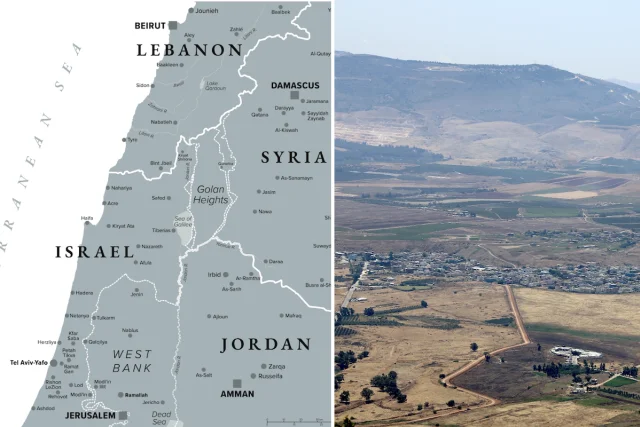
The final Memorandum of Understanding between the United States and Iran includes within clause one the wording “ensuring the territorial integrity and sovereignty of Lebanon” [1]. Iran’s emphasis on Lebanon is likely a ploy to cause a rift between Israel and the United States. Israeli forces occupy an area five to eight miles deep into southern Lebanon [2]. The reason for this is to degrade Hezbollah’s military capability and provide a buffer zone so that Hezbollah cannot attack Israeli territory with close-range missiles [2]. For years there has been disputed territory in northeast Israel [3].
Historical Background
The border between Israel and Lebanon is based on a 1923 agreement on the boundary between the British and French mandates. The primary considerations in reaching the agreement were the desires of the local inhabitants, including Lebanese Shiites and isolated Jewish settlements. During the 1948 Arab-Israeli War, in response to the Lebanese army attacking and capturing two small Israeli villages, Israel invaded southern Lebanon. Israeli forces withdrew according to the 1949 armistice agreement that reestablished the 1923 borderline except for a small ambiguous section around the area where the borders of Israel, Lebanon, and Syria converge. In the 1970s the Palestinian Liberation Organization (PLO) became established in south Lebanon and from there carried out attacks on Israel, prompting Israel to again invade Lebanon in 1982 to expel the PLO [4]. In the wake of this, Hezbollah was formed [3] by radical Shiites. In the year 2000 Israeli forces again withdrew to what UN Resolution 425 worded as “internationally recognized boundaries,” but dispute remained over the aforementioned area. It is further complicated by the fact that the area is in the Golan Heights, which Israel captured from Syria in the 1967 Six Day War [4]. For years, Hezbollah has used the dispute to justify attacks on Israel [3].
Lesson from the British Empire
In their handling of the British Mandate for Palestine, Britain separated about 75% of the area for Transjordan as an Arab nation [5]. This in fact correlated with the decline of the British Empire. Joel 3:1-2 clearly states that nations responsible for dividing up the land of Israel will receive judgement. Furthermore, there is Genesis 12:3 – I will bless those who bless you, and whoever dishonors you I will curse. The English Standard Version is a good translation here because the Hebrew word translated as “dishonor” is indeed different from the Hebrew word translated as “curse”. The Hebrew word translated as “dishonor” means “to slight”. In other words, not necessarily blatantly cursing, but slighting in perhaps more subtle ways. No nation is exempt from these simple concepts.
Israel–U.S. Relations
The Israeli Defense Minister has asserted that Israel Defense Forces will not be withdrawing from south Lebanon even if demanded by the United States, because of past experience with security zones [6]. That is a hard stance, and a reasonable one considering the circumstances and historical background. How does that stance relate to the Memorandum of Understanding between the United States and Iran? The wording “ensuring the territorial integrity and sovereignty of Lebanon” is vague and needs clarification, especially considering the territorial disputes. The U.S. administration has already shown characteristics of slighting Israel in regards to the Lebanon / Hezbollah factor.
References
[1] Rezaei, B., N. Morrison, P. Hempel, B. Schmida, C. Moorman, and B. Carter. Iran Update Special Report, June 17, 2026. Institute for the Study of War.
[2] Mansour, H. 2026, June 11. What Iran Wants in Lebanon, and Why it Cannot be Allowed to Get It, JINSA Insight. Jewish Institute for the National Security of America.
[3] Thomas, C., and J. Zanotti. 2024. In Focus: Lebanese Hezbollah, Document IF10703. U.S. Congressional Research Service.
[4] Eshel, D. The Israel – Lebanon Border Enigma. In: IBRU Boundary and Security Bulletin 8, No. 4 (Winter 2000-2001).
[5] Fleischman, L. 2025. The Legitimacy of Israel: A Sociological Perspective. FIU Law Review 19(3): 641-659.
[6] Fabian, E. 2026, June 24. Live Update: Katz vows IDF won’t withdraw from south Lebanon ‘even if there’s an American demand’. The Times of Israel.
You might also like to read this: