Why is the dollar rising against the shekel again?

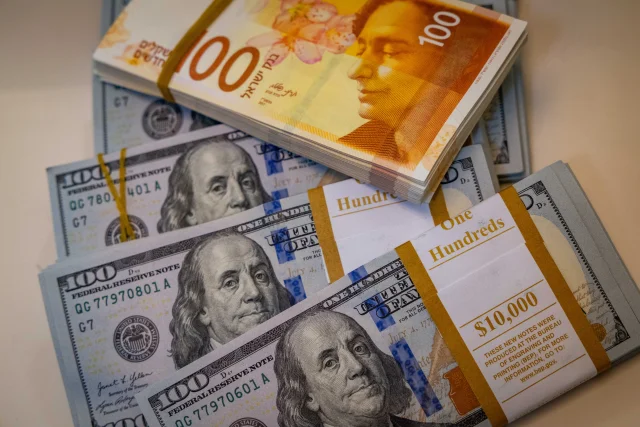
Few currencies have been as resilient as the Israeli shekel. Even against a backdrop of war and political uncertainty, it strengthened to below NIS 2.80 per dollar in late May – its strongest level since the 1990s. But markets never move in straight lines. After climbing almost uninterrupted for months, the dollar has rebounded around 7% to trade close to NIS 3, raising the prospect that the shekel's remarkable appreciation is entering a more volatile phase.
The reversal is not the result of a single event. Rather, several forces that had favored the shekel have begun moving in the opposite direction at the same time. Some are cyclical, others structural. Together, they suggest that betting on continued one-way appreciation has become considerably less straightforward.
The most immediate driver is the United States. Expectations that the Federal Reserve could keep monetary policy tighter for longer – and may even raise interest rates later this year – have lifted the dollar against most major currencies. Ronen Menachem, chief market economist at Mizrahi Tefahot, notes that the dollar has strengthened globally "against the backdrop of increasing estimates that US interest rates will rise by 0.25%-0.75% by the end of the year." A higher interest-rate differential naturally improves the dollar's relative appeal.
The recovery in the dollar has also coincided with softer US equity markets. The S&P 500 has retreated around 3.5% from its recent record high, as a sell-off in semiconductor and technology shares interrupted this year's rally. For Israel, such moves matter more than they do for most developed economies. Domestic institutional investors hold substantial overseas equity portfolios and actively hedge their foreign-currency exposure. When US equities decline, the value of those holdings shrinks, prompting institutions to purchase dollars to restore predetermined hedge ratios. Those flows create additional demand for the US currency and weaken the shekel.
Menachem notes that "the shekel tends to weaken against the dollar during periods of declines in US equity markets." Bank of America places even greater emphasis on that relationship, arguing that US equities are the single most important structural driver of the dollar-shekel exchange rate. Its analysts believe the recent pullback in the S&P 500, together with tighter US monetary policy and what they view as an overvalued shekel, supports further dollar appreciation over the coming months.
Portfolio positioning has also changed. The sharp appreciation of the shekel over the past year forced many institutional investors to reassess their currency exposure. According to Ran Sinai, chief economist at Ultra Finance, "the abnormal decline forced institutional investors to rebalance their investment portfolios." Some increased their foreign-currency exposure again, while others simply stopped selling dollars in the volumes seen earlier this year. "This move helped create a floor for the exchange rate and support an upward correction," he says.
Sinai believes technical factors have reinforced the move. After falling below NIS 2.80, the dollar had entered what he describes as "an extreme oversold situation". Once it recovered above NIS 2.95, momentum accelerated, opening the way for a move back towards NIS 3. In his assessment, the dollar could stabilize around that level in the near term, establishing a new short-term equilibrium.
International investors have reached similar conclusions. Bank of America recently recommended clients take a three-month-long position in the dollar against the shekel, targeting approximately a 5% appreciation to around NIS 3.14. Its analysts argue that the shekel has become overvalued relative to both emerging-market currencies and the performance of US equities. In their view, investors are underestimating how quickly those relationships could reassert themselves if Wall Street weakens further or US monetary policy tightens.
Geopolitics has added another layer of uncertainty. Shmuel Katzvian, chief strategist at Discount Bank, argues that the recent weakening reflects growing concerns over the implications of the emerging US-Iran agreement. "The shekel has weakened mainly due to concerns about the implications of the agreement between the US and Iran in a way that could harm Israel's strategic position," he says. That marks a reversal from earlier this year, when improving perceptions of Israel's security environment helped strengthen the currency.
The Bank of Israel has also become more active. After years in which intervention was relatively limited, the central bank disclosed that it purchased approximately $800 million in the foreign-exchange market during May. The intervention signaled a greater willingness to moderate excessive shekel appreciation, particularly as the currency reached levels that risked weighing on exporters. Investors will now closely watch the upcoming Bank's next interest-rate decision and updated economic forecasts for further clues about policymakers' tolerance for additional shekel strength.
None of this necessarily overturns the longer-term case for the Israeli currency. Katzvian argues that the structural foundations remain intact, pointing to robust high-tech services exports, accelerating defense exports and a gradual decline in Israel's risk premium. He also notes that geopolitical developments since October 2023 have repeatedly surprised markets on the upside, supporting Israeli assets more broadly. His conclusion is notably balanced: investors with a horizon of a year or more should use periods of dollar strength for hedging or gradual sales of foreign currency, while recognizing that the short-term outlook has become considerably less certain.
So what does all this mean?
The forces that propelled the shekel to its strongest level in three decades are no longer pointing in the same direction. Firmer US monetary policy, softer US equity markets, institutional portfolio adjustments, and renewed geopolitical uncertainty have all shifted the short-term balance in favor of the dollar. None of that guarantees a sustained reversal, but it does suggest that the extraordinary strength that pushed the dollar below NIS 2.80 may have run ahead of fundamentals.
Yet a moderation in the shekel's strength may ultimately prove beneficial rather than harmful. Israel's economy depends heavily on exports, and many of its technology and defense companies generate a significant share of their revenue in dollars while incurring much of their research, engineering, and administrative costs in shekels. A modestly weaker currency, therefore, improves international competitiveness, increases the shekel value of overseas earnings, and supports profitability. The Bank of Israel's recent intervention in the foreign-exchange market suggests policymakers recognize that an excessively strong shekel is not an unqualified sign of economic success. For investors, a dollar trading closer to NIS 3 may consequently represent not a weakening economy, but a healthier balance between financial markets and the needs of one of the world's most export-oriented developed economies.
You might also like to read this: