80% of Israelis concerned about Lebanon security despite Beirut-Jerusalem agreement - poll
59% support military action in Lebanon even at the cost of a confrontation with President Trump




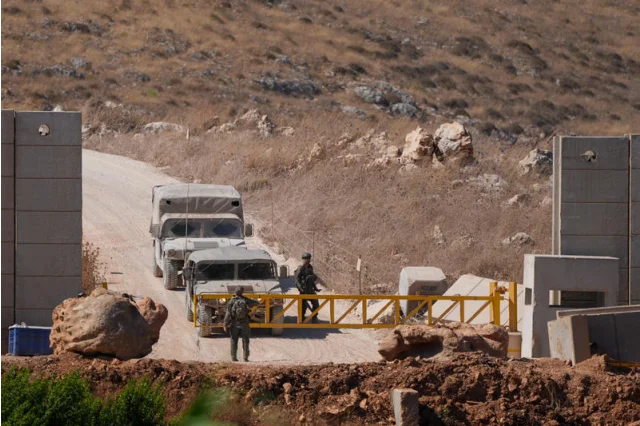
Despite the historic agreement between Lebanon and Israel a few weeks back, the security situation in Lebanon remains at the top of the list of concerns for Israelis, according to this month’s National Security Survey by the Institute for National Security Studies (INSS).
Eighty percent of respondents said they see the situation in Lebanon as a concern for national security, while 76% said the same about Iran, 61% about Judea and Samaria, and 57% about Gaza.
Concern about Syria, where former terrorist Ahmed al-Sharaa replaced the Assad regime just over a year ago, and Yemen, where the Houthis have largely stopped firing at Israel over the past months, was only at 32% and 30%, respectively.
Residents of northern Israel have raised their voice to protest against the government’s handling of their situation for months. 81% of respondents said that the current security situation in the north “does not provide safety for residents,” while only 15% believe that it does.
Even before the ceasefire with Hezbollah had completely broken down, they were suffering from almost daily drone strikes that made normal life almost impossible in towns near the border.
“Compared to the April survey, there has been a moderate decline in levels of concern across all major arenas, yet Lebanon and Iran remain at the top of public security concerns,” INSS noted.
Today, after fighting has largely stopped and the Israeli advances pushed Hezbollah terrorists deeper into Lebanese territory, the danger has subsided; but northern residents are still expressing concern over the highly touted agreement between Jerusalem and Beirut which, again, places the responsibility for disarming Hezbollah in the hands of the Lebanese government.
Smaller-scale fighting currently persists mainly along the ceasefire “Yellow Line”. On Wednesday, the IDF said its troops apprehended a terrorist from Hezbollah’s elite Radwan Force during a clash in the area of Bint Jbeil. “The terrorist was transferred to Unit 504 for further questioning in Israeli territory,” said the military.
According to the survey, 57% of the public believe that Israel should not vacate the Security Zone—as it has committed to do per the agreement—even if Hezbollah complies with its terms, meaning, if it allows the Lebanese Armed Forces to take control of the border region.
Only 33% said they believe that a full withdrawal from Lebanon, which often still brings up memories of the failed occupation of the security zone in the eighties, is preferable or necessary.
For a large number of respondents, the question of providing security for northern Israel is worth risking the alliance with U.S. President Donald Trump.
According to media reports, Trump has opposed Israeli strikes against Hezbollah over the past months while seeking agreements with Lebanon and the Iranian regime, which has used Israeli strikes in Lebanon as a pretext to pressure the U.S. in their separate negotiations.
“59% of Israelis support military action in Lebanon even at the cost of a confrontation with President Trump, compared to 30% who oppose such action,” the survey found.
The survey also highlighted the growing discontent with Trump in Israeli society, with 66% seeing the Washington-Tehran Memorandum of Understanding as detrimental to Israel. The deal also called for a full ceasefire in Lebanon, but was later superseded by the separate Jerusalem-Beirut agreement – at least from Israel’s perspective.
“57% of the public believe that President Trump supports Israel only when it serves his own interests; 27% perceive him as an unpredictable leader who cannot be relied upon in security matters; and only 12% view him as highly committed to protecting Israel’s security interests.”
Overall, most Israelis are not happy with the national security situation after almost three years of war.
42% said they see the situation as bad or very bad, 37% rated it as moderate, and only 20% thought it was either good or very good; these figures show a slight deterioration since the last survey in May.
Once again, there was a strong contrast between voters of the coalition, who were much more likely to see the situation as good (41%), and opposition voters, where only 5% rated the current situation as being good.
The June survey was conducted between June 16–22, 2026, by the Data Center at the INSS by means of an online survey completed by 805 respondents in Hebrew and 152 in Arabic.
“After sectoral weighting, the sample constitutes a representative sample of Israel’s adult population (aged 18 and over). The maximum sampling error for the total sample is ±3.17%, at a 95% confidence level.”
Please take a moment to join believers worldwide praying for Israel right now. Add your light to the live prayer map—and show the world one more watchman praying for the peace of Jerusalem.

You might also like to read this: