Haym Salomon: The financier of American independence

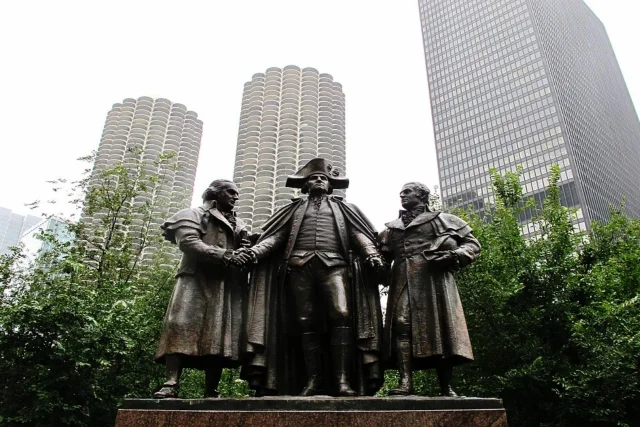
Haym Salomon played a crucial role in the birth of the United States as a financier. Salomon also co-founded the Mikveh Israel synagogue in Philadelphia and championed religious freedom.
Born around 1740 in Leszno, Poland, Haym Salomon was a Jewish immigrant who settled in the American colonies before the American Revolution. He is famous for playing a major financial role in supporting the independence cause, serving as a financial broker for the revolutionary government, raising funds, and granting numerous personal loans to American officials. Notably, he helped finance the operations of the Continental Army when the government ran out of money, and supported Robert Morris, the Superintendent of Finance for Congress, who worked closely with George Washington (the statue is located in Chicago).
Yorktown and the $20,000 That Changed History
In August 1781, General George Washington, joined by the Comte de Rochambeau and French troops, marched south to deliver what would become the decisive blow of the American Revolutionary War. Together, they surrounded British General Charles Cornwallis's army at Yorktown.
Yet, Washington faced a critical situation. The coffers were empty, Congress had no funds left, and the army lacked food, uniforms, and essential supplies. Soldier morale was at its lowest, and the specter of mutiny loomed. Washington estimated that he needed at least $20,000 to finance the Yorktown campaign. According to a widely reported tradition, when he was told that neither funds nor credit remained, he reportedly replied: "Send for Haym Salomon."
Haym Salomon then mobilized the necessary funds. Thanks to this financial support, the army was able to pursue its campaign, which led to the victory at Yorktown.
Trapped by land and sea, Cornwallis surrendered on October 19, 1781. The surrender of nearly 7,000 British soldiers sent a massive shockwave through London. After Yorktown, the British government realized that reconquering the colonies would be extremely costly and chose to open peace negotiations.
Two years later, the Treaty of Paris (1783) officially sealed Great Britain's recognition of the independence of the United States.
The victory at Yorktown was the result of several decisive factors. French aid played an essential role—Admiral Paul de Grasse's fleet prevented the arrival of British reinforcements, while Rochambeau's troops and their artillery pounded the English. Added to this military support was the action of financiers like Robert Morris and Haym Salomon, whose cash advances and credit operations helped sustain the war effort at a decisive moment. This is why the Battle of Yorktown is generally considered the victory that paved the way for the independence of the United States.
An irony of history: The man who helped finance the birth of the United States died in poverty a few years later. A large portion of the sums owed to him was never reimbursed.
You might also like to read this: