Secretary Marco Rubio’s faith, testimony, and perspective on End Times


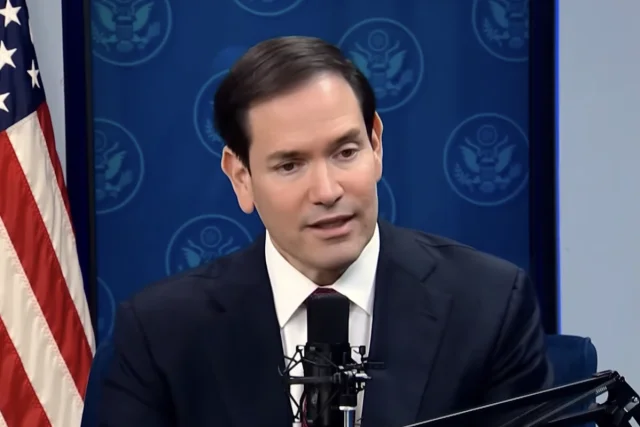
In a recent sit-down interview with Pastor Greg Laurie at the State Department, Secretary of State Marco Rubio spoke openly and extensively about his Christian faith, his understanding of the Bible, and his view of the end times. Without notes and speaking from the heart, Rubio offered a clear theological testimony and a framework for how his beliefs inform his public service.
A Spoken Gospel Testimony
Perhaps the most striking moment came when Laurie recounted Rubio’s remarks at Charlie Kirk’s memorial service. Rubio had delivered what Laurie called a “stunning talk” – “theologically accurate,” “passionate,” and delivered without notes. In that speech, Rubio presented the gospel in full:
“He has a deep belief that we were all created, every single one of us, before the beginning of time, by the hands of the God of the universe, an all-powerful God who loved us and created us for the purpose of living with him in eternity. But then sin entered the world and separated us from our creator. And so God took on the form of a man and came down and lived among us and he suffered like men and he died like a man. But on the third day, he rose unlike any mortal man. And to prove any doubters wrong, he ate with his disciples so they could see, and they touched his wounds. He didn't rise as a ghost or as a spirit, but his flesh. And then he rose to the heaven, but he promised he would return. And he will. And when he returns, because he took on that death, because he carried that cross, we were freed from the sin that separated us from him. And when he returns, there will be a new heaven and a new earth. And we will all be together.”
Rubio confirmed that speaking without notes “works out better that way sometimes,” explaining that while there are speeches he must write out, “these things always come best from the heart.”
View of the End Times: Knowing How the Story Ends
When Laurie asked whether Rubio sees current world events as signs that Christ could return soon, Rubio offered a measured and biblically grounded response. He acknowledged that he does see things that make him think of the end times, but he also placed that feeling in historical context:
“If you look at the 2,000 years of Christianity, every generation has believed they lived in the end times. They couldn't imagine things getting any worse than they were. I imagine if you lived in the 1940s and saw the growth of Nazi Germany, that was a very scary time.”
Rubio cautioned against trying to predict the timing, citing Scripture directly:
“We're basically told that whether it's death or the second coming, it will come as a thief in the night. People will be out there basically doing normal life activities. So rather than try to predict it or anticipate it, I think you just sort of understand that's how the story ends and in the meantime this is what we're called to do – to live our faith.”
Christians and Fear
Rubio articulated a distinctive Christian approach to anxiety and fear, especially given the weight of his responsibilities. He noted that fear is “an enemy” and “a paralytic.” But for Christians, he said, the situation is unique:
“Of all the faiths in the world, the ones who should never live in fear or worry that becomes paralyzing are Christians because we know how it ends.”
He used a simple analogy:
“You watch a scary movie, you've seen it 10 times, you know how it ends, you know the lead character survives, but nonetheless, you still get nervous every time you see it. And I think that's our story. The story that we know that at the end of time there'll be a new heaven and a new earth and that Jesus will return. We also know that between now and then there'll come a period of great tribulation, of great challenges. The world's never been free of them. So for us to somehow aspire to live in a world free of problems and free of worry is not realistic. It's also not biblical. It's not true to our faith.”
He concluded that “the thematic of it is victory and the restoration of what we should have been from the very beginning.”
The Cost of Faith and the Cross
Laurie asked whether Rubio’s faith has ever cost him politically. Rubio responded that he cannot point to a specific example, but he grounded his answer in the nature of Christianity itself:
“The gospel is clear. You'll be hated for it. Ours is the faith of the cross – it's not the faith of winning the lottery. I think it's a misunderstanding of Christianity to believe that it leads to happiness and prosperity. Our faith is the faith of the cross. In fact, if you look at the era in Christianity where Christianity has been strongest and most vibrant is when it's countercultural, when it's been oppressed. Now, I don't seek oppression, but it's going to happen.”
He added that even if his faith had cost him politically, “it really wouldn't matter,” and he stated plainly: “I'd rather lose an election than be wrong on those issues on the public stage.”
Marriage, Family, and Scripture
Rubio also reflected on the biblical view of marriage, noting that in both the Gospels and the Old Testament, “when it describes God's love for his people, it's always discussed in marital terms.” He called marriage “a sacramental union that really reflects God's love for people” and described it as “the most important job I'll ever have.”
He connected the health of families to the health of the nation, saying: “The most important thing that happens in our country is not what happens in the White House. It's what happens in your house.”
How He Wants to Be Remembered
Asked about his legacy, Rubio turned first to his faith and family:
“I'd like to be remembered as someone who was a good husband and a good father and who tried the best he could to live out the teachings and tenets of his faith and to model that behavior. We were all created for a purpose and a reason. In the end, you hope that when you come face to face with your creator, he'll say, ‘Well done. You walked the path that I had created you for.’”
Throughout the interview, Rubio presented a faith that is neither naive about the world’s troubles nor fearful of them. He holds firmly to the return of Christ and the coming of a new heaven and a new earth, but he refuses to set dates or speculate excessively. Instead, he insists that Christians are called to live faithfully in the present, knowing that the final victory has already been secured.
You might also like to read this: