St Mark's in Jerusalem: The world's first church?




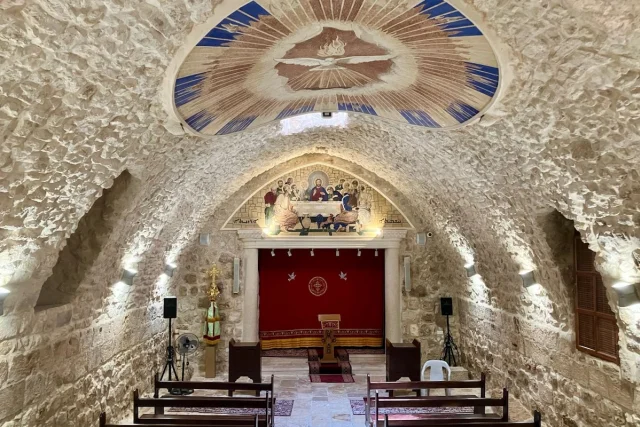
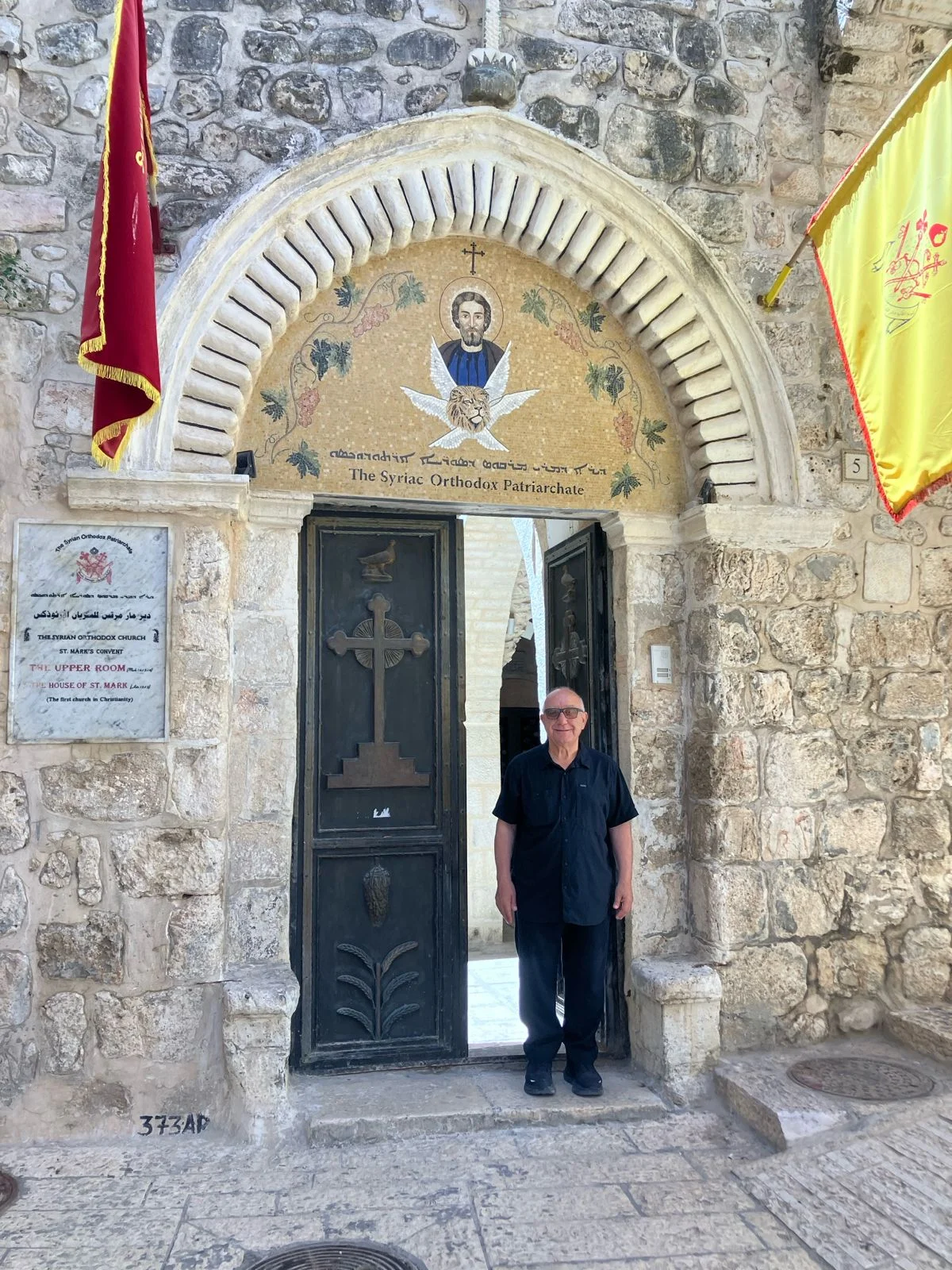
Buried deep in Jerusalem’s Old City, accessed through winding paths and narrow alleys, lies a little-known church called St. Mark’s, which may be much more significant than most realize.
The Old City is famously divided into four quarters, but in typical Jerusalem style, the reality is far more complicated than that simple division suggests.
St. Mark’s is in the Assyrian quarter, a fifth quarter after the Muslim, Jewish, Christian and Armenian quarters. Some would argue that there are eight, but that’s another story.
St. Mark’s has some big claims to fame. Much hangs on an ancient inscription which declares it to be the house of Mary, mother of John Mark, author of Mark’s gospel. Huge, if true.
In the book of Acts, we read it was at Mary’s house that Peter showed up at the door after angels miraculously released him from jail:
“When he realized this, he went to the house of Mary, the mother of John whose other name was Mark, where many were gathered together and were praying.
"And when he knocked at the door of the gateway, a servant girl named Rhoda came to answer. Recognizing Peter's voice, in her joy, she did not open the gate but ran in and reported that Peter was standing at the gate. They said to her, “You are out of your mind.” But she kept insisting that it was so, and they kept saying, “It is his angel!” But Peter continued knocking, and when they opened, they saw him and were amazed" (Acts 12:12-16).
These verses tell us that it was at Mary and Mark’s house that the first believers gathered to meet after the death and resurrection of Jesus, serving as a Messianic headquarters in those first heady days and making it the first church in the world.
Further, if this unheralded little church on Ararat Street is indeed the site of Mary’s house, then, according to widely accepted, ancient Christian tradition, it is also the real “Upper Room.”
Although there is little to verify this established tradition beyond circumstances that seem to align with rather than contradict it, the fact that this tradition has been held for so long has led to a broad consensus among Orthodox Christians that this is the case.
If so, St Mark’s could reasonably be the location of the Passover Jesus celebrated with His disciples and the institution of the Lord’s Supper.
However, instead of going to St. Mark’s, tourists are generally taken up some steps to a lofty Crusader-era building near the Zion Gate to see the “Upper Room,” even though there is no real evidence that it is the true location.
The real Upper Room would not be elevated above today’s streets but hidden under layers of history, along with all archaeological discoveries from the first century.
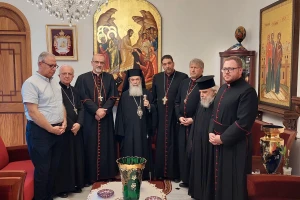
Deacon Michel George Zanbil told ALL ISRAEL NEWS how ancient ruins from the correct period were discovered underneath the dazzling sanctuary decked in gold and red velvet used by today’s worshipers.
“Excavation started in 1981. In 2011 we discovered that we have three layers of stones,” he explained, “the first one dated to the first century BC, the second to the sixth century, Byzantine era, and the third was from the twelfth century.”
Ron Lavi’s report for the Israel Antiquities Authority records the discovery of a coin from the time of Herod Agrippa I found during the dig, along with other interesting finds from the time of Jesus, including huge stone vessels, one of which can be seen there today. Like much of Jerusalem, the building was destroyed by the Romans in 70 AD.
According to Zanbil, their library contains 455 ancient manuscripts in the Syriac Aramaic language dating back to the sixth century AD, and an engraved inscription in Syriac, thought to date back to the Middle Ages at the latest, possibly centuries earlier, reads:
“This is the house of Miriam (Mary) Mother of John, who is called Mark. It was proclaimed a church by the holy Apostles and dedicated to the Virgin Mary, Mother of God, after the Ascension of our Lord Jesus Christ into heaven. It was rebuilt in A.D. 73, after the destruction of Jerusalem by Titus.”
The entire complex has undergone major renovation over the last year, and not only was the sanctuary saved from certain disaster after termites threatened to collapse the entire altar area, but the “Upper Room” (now underground) has also been restored.
“It’s for everyone,” Zanbil said seriously. The facilities are open for prayer not only to the Syriac Orthodox Community, but Catholic worshipers, other Christians, and Jewish people are also welcome.
“They don’t know how much we love them,” said Zanbil. “They are our older brothers in faith.”
While the significance of St. Mark’s is potentially enormous, the church itself is small both in dimensions and number. A small flock of around 25 people come to services each week.
The liturgy is sung in Aramaic, the mother tongue of Jesus, and Zanbil was happy to sing the Lord’s prayer in the language Jesus would have used to teach it to His disciples.
There are around 600 Assyrian Christians in Jerusalem and 1500 in Bethlehem, but not all go to church apart from on special events like Christmas and Maundy Thursday when the church remembers the time Jesus washed the feet of His disciples.
A surprisingly large number show up for the feet washing service because of course if they are correct in thinking that this is Mary’s house, and therefore the Upper Room, this would have been the place in which it happened.
“It’s such a special place,” Zanbil emphasized, saying how honored he feels to serve there. He also said he had witnessed miracles there.
“Daniella, a young girl from Colombia, had cancer in her throat. In 2024 her uncle came to tell me, “Michel, Daniella is totally healed!”” He also recalled a colorblind Brazilian lady who had visited, and after seeing the Upper Room she could suddenly see colors.
“Thank God,” said Zanbil. “Personally, I have had many, many visions… This is my greatest gift from God that they allow me to serve.”
“God is everywhere, but wherever two or three are gathered He’s especially with them,” he clarified. But as Zanbil said, it is a special place.
“If you come to the whole land, don't miss St. Mark,” he added. “You can feel the power of the Holy Spirit.”
You might also like to read this: