North American students helping to build a different kind of defense force for Israel



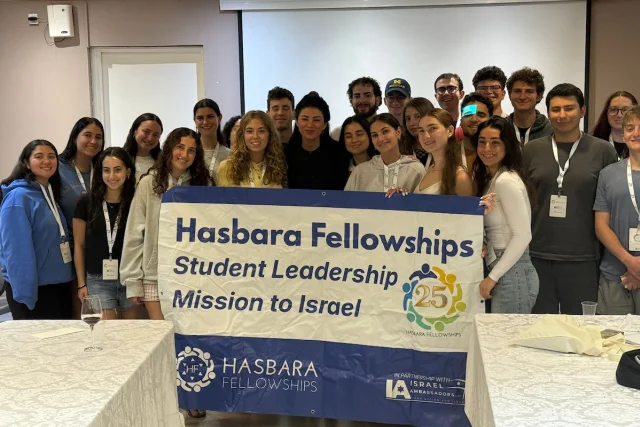
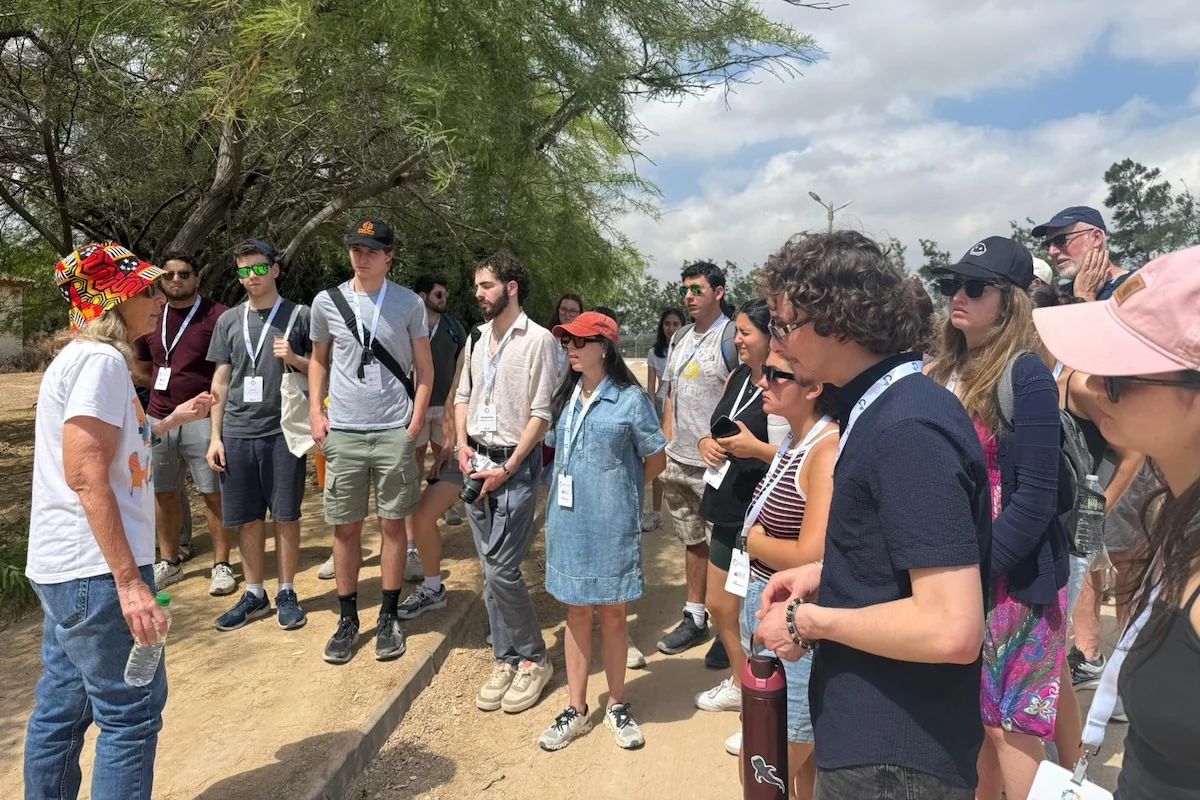
A group of North American students arrived in Tel Aviv on Monday for an intensive two-week trip to learn how to defend the Jewish state and combat antisemitism on campus.
Hasbara Fellowships, in partnership with IsraelAmbassadors.com, brings students to see, hear, and experience the realities on the ground in Israel to better equip them to explain them to others.
Even the word “Hasbara” has become pejorative in circles where anti-Israel sentiment has become entrenched, but it is simply the Hebrew word for “explaining.” It refers to the process of explaining Israel’s point of view in the “chatosphere” of social media and on the battleground of most campuses post Oct. 7.
So far, the group of 25 students from 18 leading universities has toured some of the sites most devastated by the Hamas invasion along the Gaza border, speaking to survivors and learning salient facts surrounding the events.
They received a warm reception from Rawan Osman, a Syrian-born influencer who has described herself as a “recovering antisemite.” Osman was once a Hezbollah supporter, but after a radical encounter with Jewish people in Strasbourg, she embarked on a journey that led to her conversion to Judaism.
“She taught us how to have these conversations about Israel or with people who don't necessarily agree with us, and who don't understand the facts, and what's happening on the ground,” said Amit Rimon, a student at Queen’s University in Kingston, Ontario.
“It was only when she started meeting with Jews that she started doing her own research,” said Rimon, explaining that Osman did not grow up with access to the history of Israel or many of the facts around the Middle East conflict.
“Today, we have a similar situation, but it's still different, because people have access to that information. They see those narratives online and on social media, yet they choose to ignore it. And she said that the most important thing we can do as advocates for Israel is to tell our story, tell the Jewish people's story, and to stand up… and get that message out,” he said.
Although they have only been in Israel for two days, their time has already been packed with intense experiences. Rimon relayed what happened on their morning visit to Kibbutz Kfar Aza in the Gaza Envelope.
“We got to hear from a resident, Rafaela,” he said. “She took us to the kibbutz and showed us around, where people were murdered, where people were killed. But she also showed us where heroism and action took place on that date. It was an incredible experience.”
Michael Eglash, co-founder of IsraelAmbassadors.com, explained why this trip is so important:
“At a time when misinformation, antisemitism, and polarization are exploding across campuses and across America, they understand that real leadership means showing up, asking difficult questions, and seeing the truth with their own eyes.”
Rimon confirmed that antisemitism is a big problem in Canada, but said the experiences of students vary from campus to campus. “Especially in Montreal, Jewish students regularly fear for their safety. They are being assaulted, verbally, and physically and emotionally on campus.”
He attributed the relative calm on his campus to the hard work Jewish groups like Hillel had put into establishing a relationship with the administration.
“They're such strong student leaders. But at the end of the day, some of them just want to be students. They just want to be who they are, to be Jewish, and live their life, to do their undergraduate degree, but a lot of us don't have that opportunity,” he said.
Zachary Seaver from The Ohio State University (OSU) agreed:
“No Jew has the responsibility to be a spokesman for all Jewish people, but still it can make such a massive difference to someone’s life, by being a good representative,” he said, adding that Osman’s words really struck a chord with him.
“She put so much emphasis on this one specific single person interaction having such a big impact on her life, and that it affected her so much that she decided to become an advocate for Israel,” he said.
Seaver, who is on the executive board for OSU Chabad at his university, had previously been part of a Birthright trip to get acquainted with Israel, but appreciated the unique focus of this experience and the benefits he was gaining from it:
“Knowing our history, our people, and our connections to the land of Israel, and just being able to represent our community in a positive light, and actually have those peaceful conversations with people and learn their side, as well,” he summarized.
“Anti-Israel and antisemitic rhetoric has become an unfortunate reality on campus. My friends and I have been called “baby killers,” “dirty Zionists,” and other hateful terms simply for supporting Israel’s right to exist as the homeland of the Jewish people."
He said he chose to join the trip to Israel because he wants "to strengthen [his] ability to advocate constructively and confidently on campus," adding he wants "to engage in meaningful and respectful dialogue with those willing to have honest conversations."
The group is scheduled to visit northern communities near the Lebanese border to hear from those living under constant rocket fire, as well as security experts and military analysts. Participants will meet Arab-Israeli and Druze leaders, as well as social media activists and members of the Knesset.
In addition to sites in Israel proper, they will visit Hebron, ancient Shiloh, and Jerusalem to gain a fuller picture of the area's history and geopolitics, and will receive training in media literacy, social media strategy, coalition-building, and effective pro-Israel advocacy.
Alan Levine, CEO of Hasbara Fellowships, stressed that we are at a pivotal moment in Jewish history:
“These student leaders understand they have a responsibility to return to their campuses and communities informed, empowered and prepared to speak the truth about what they witnessed in Israel,” he said.
“It’s when people forget or actively choose to ignore our history, that's when misinformation and propaganda spreads,” Rimon reflected. “So that's my main message: to know who you are and where you come from.”
You might also like to read this: