New café becomes latest flashpoint in Jerusalem’s Shabbat tensions



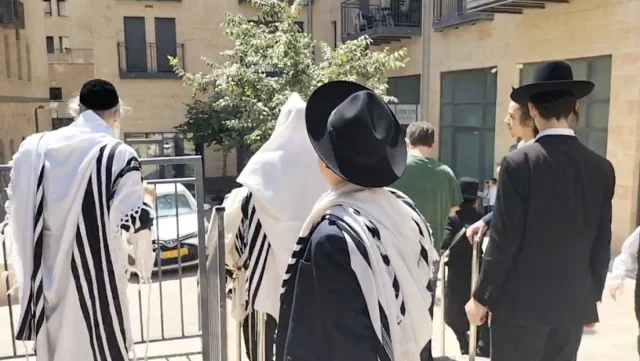
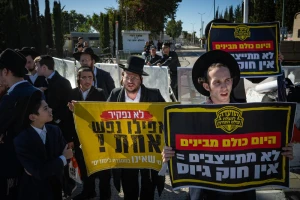
Jerusalem – A specialty coffee shop that opened barely a month ago in a quiet alley off Agrippas Street has become an unlikely battleground in Jerusalem's enduring struggle over the character of the city, after dozens of ultra-Orthodox protesters descended on it in four separate waves this past Saturday objecting to its operating on Shabbat.
Café Basimta, in the Nahalot neighborhood adjacent to the Mahane Yehuda market, opened at the end of May and quickly became one of the few places in the capital where secular residents could find a cup of coffee on the Jewish day of rest.
On Saturday, ultra-Orthodox (Haredi) demonstrators – many of them reportedly minors – surrounded the café, banged on its windows, and overturned tables in an effort to drive customers away.
The confrontation may have centered on a neighborhood coffee shop, but it reflects far broader questions about the balance between Jerusalem's increasingly religious population and the secular minority seeking public spaces that remain open on Shabbat.
Coming amid renewed Haredi street protests over military conscription, the incident also illustrates the heightened tensions currently shaping public life in the capital.
The owner of Café Basimta, Yoel Ben David, told The Jerusalem Post he had tried to reason with the protesters, noting that the café sits inside an alley, uses no outdoor speakers, and doesn't disturb anyone.
He told JPost he was saddened to see young children sent to pound on the windows, but vowed to keep opening on weekends. What encouraged him, he said, was what happened next: Within hours, dozens of residents from across the city arrived to sit at the tables, applaud from balconies and, as one supporter from nearby Rehavia told Channel 12 News, "vote with our feet."
Jerusalem is statistically Israel's most religious major city. According to the Jerusalem Institute for Policy Research's annual report published in May, 46% of the city's Jewish population identified as haredi in 2024 – nearly triple the national figure of 16% – while just 13% identified as secular, compared with 44% nationwide.
Roughly one in five of Israel's 1.45 million ultra-Orthodox citizens lives in the capital, making it the community's largest concentration in the country.
Those same demographics also explain why a café like Basimta exists. Although Jerusalem's secular population is relatively small, it is concentrated, loyal, and chronically underserved on Saturdays, when most of the city shuts down.
Supporters who rallied to the café repeatedly cited the scarcity of Shabbat options as the reason the business deserved to be defended.
The pattern is familiar. In 2014, Café Bezalel faced nearly identical protests after it began opening on Shabbat and soon found itself packed every weekend.
In 2023, a court issued an injunction against the municipality after it attempted to require a planned park café in Talbiya to remain closed on Saturdays, following resident protests under the slogan, "yes to a café, no to coercion."
The timing of Saturday's demonstration, however, gives it added significance. It comes amid the most intense wave of Haredi street protests in years, driven not by Shabbat but by the military draft issue.
Since police announced in late May that it would resume detaining ultra-Orthodox draft evaders, demonstrators have repeatedly blocked Route 1 and the main entrance to Jerusalem, clashed with officers outside recruitment centers and, in one April incident, breached the home of the IDF's Military Police commander, leading to 25 arrests.
Last month, dozens of ultra-Orthodox men protested against the arrest of an IDF draft evader in front of the home of Isaac Amit, the president of the Supreme Court.
With elections set for October, the Knesset is now weighing a temporary freeze on such arrests.
Against that backdrop, a protest over espresso can appear to be another front in the widening confrontation between the ultra-Orthodox street and the state's institutions. Yet Haredi voices caution against conflating the two – or treating the community as a monolith.
Speaking at a Jerusalem Policy summit in June, Rabbi Karmi Gross estimated that at least 70% of Haredim oppose street demonstrations entirely.
Ben David, for his part, says he expects the protesters to return next Shabbat – and that his doors will be open when they do.
In a city where 13% of the Jewish population is looking for somewhere to go on Saturday morning, he is betting the customers will be back, too.
You might also like to read this: