Jordan's historical and contemporary role in the Israeli-Palestinian conflict
How Jordan's rule over the West Bank and its evolving policies have shaped the Palestinian issue from 1948 to the present





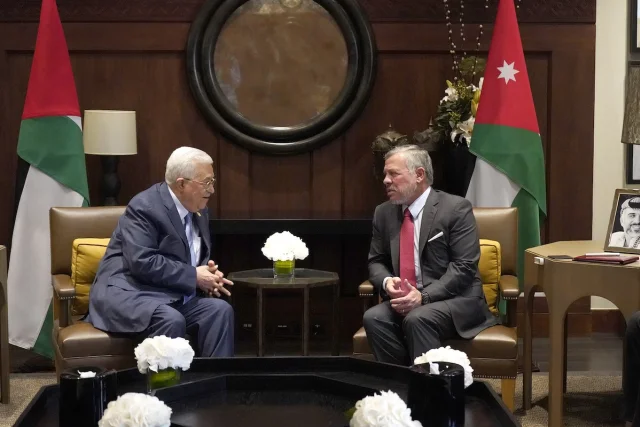
Let’s talk about Jordan. What is the role of the Hashemite Kingdom in the Israeli-Palestinian conflict, historically and currently?
When I grew up in Sweden, back in the 80s, I loved Israel and I remember at some point looking up “Bethlehem” in an encyclopedia and getting mad reading in the entry which said that Bethlehem is “in the part of Jordan that Israel occupied in 1967.” That kind of language would not work today, but before 1988, that was the way many anti-Israel individuals would phrase the status of the West Bank.
But let’s take it from the beginning. The area today known as Israel, Palestine, and Jordan was together the British Mandate of Palestine. The British took two-thirds of this area – everything to the east of the Jordan River – and called it Transjordan. They brought in the Hashemite royal family to rule it in 1921 and banned Jewish immigration there.
Transjordan received full independence in 1946. In the 1948 war against Israel, the Jordanian army was the most successful, most organized, and most effective army. They had many high-ranking British officers, and they successfully conquered half of Jerusalem and the majority of the region known biblically as Judea and Samaria. Israel opted not to conquer it back, as they didn’t want to rule a large hostile Arab population, and they worried that initiating battles against British officers would annoy the British Empire.
The Jordanians named this newly acquired piece of land “the West Bank.” In 1950, Palestinian leaders met with the (Jordanian) king in Jericho and officially swore allegiance to him, and the West Bank was annexed by Jordan. All the inhabitants received Jordanian citizenship.
The move was not universally accepted, especially because there were (possibly true) rumors going around that King Abdullah was secretly negotiating a peace deal with Israel. They were angry that he wasn’t fully committed to the destruction of Israel, and that he annexed the West Bank rather than establish it as an independent State of Palestine.
In 1951, a Palestinian nationalist assassinated King Abdullah in the Al-Aqsa Mosque in Jerusalem. After this, Jordan saw Palestinian nationalism as a threat to the regime, and the name “Palestine” was banned from all official documents. They instead tried to create a unified Jordanian identity. Ramallah, Bethlehem, and Jenin were all Jordanian cities. When the Palestine Liberation Organization (PLO) was formed in 1964 in East Jerusalem, it promised the king that it had no claims whatsoever to the West Bank. They were formed solely to “liberate” the parts of Palestine that the “Zionist entity” was ruling.
But then 1967 happened, and Jordan found itself between a rock and a hard place. Egypt and Syria were getting ready for the war that would wipe Israel off the map, and Israel sent envoys through back channels urging King Hussein not to join. He knew that if he joined the war, he risked losing the West Bank. But he also knew that if he stayed out of the war and they successfully defeated Israel, his legitimacy in the Arab world would be over, and his assassination would be imminent. To save face, he took the fateful decision to join what would later be known as the Six-Day War – and subsequently lost the West Bank to Israel.
After 1967, Palestinian nationalism in Jordan exploded – and not only figuratively. The PLO’s armed militias effectively created a state within a state – similar to what the Hezbollah terrorist organization is doing in Lebanon today – and they increasingly began threatening Jordanian sovereignty. Palestinian groups started launching attacks against Israel from Jordanian territory and bringing hijacked airplanes to Jordanian airports, and some openly called for the overthrow of the Hashemite monarchy. King Hussein had seen how his cousin in Iraq had been overthrown in 1958, and he was not going to let it happen in Jordan. In 1970, he launched the operation known as Black September, when the PLO was expelled from Jordan in an extremely messy and bloody confrontation. The PLO relocated to Lebanon.
Throughout this whole era, Israel had relatively amicable, semi-secret relations with the Hashemite royal court. The Zionist leadership had cooperated with King Abdullah as far back as the 1920s. Even though they saw many issues differently, Israel saw Jordan as a pragmatic and stabilizing force in the region.
After 1967, Israel annexed East Jerusalem but allowed Jordan to retain its special custodial role over the Islamic holy sites on the Temple Mount through the Jordanian Waqf, a role Jordan still holds today. The rest of the West Bank was “set aside” as an occupied territory under international law. Large-scale settlement expansion had not yet begun, and Israel allowed Jordan to remain involved. Israel controlled all security aspects, but Jordan managed civil infrastructure, paid teachers' salaries, and the inhabitants of the West Bank were still Jordanian citizens. Many saw Jordan as a partner for the future of the West Bank and envisioned a deal in which Israel and Jordan would recognize one another and reach some sort of territorial compromise. This idea was called “The Jordanian Option.”
None of these negotiations reached fruition. Hussein couldn’t let go of Jerusalem, and Israel wasn’t ready to give up all of the West Bank. After the 1973 Yom Kippur War, when Israelis began building more settlements to secure the country’s future borders – and especially after 1977 when the right-wing Likud took over the reins, and settlement activity increased – they offered Hussein only about 70% of the West Bank, but no more. But many Israelis also asked themselves, what was the alternative? Bringing in the terror group PLO under Arafat was out of the question, and so was annexing the area and giving all Palestinians Israeli citizenship.
The last attempt to reach a Jordanian solution was in 1987, when then-Israeli Foreign Minister Shimon Peres and King Hussein secretly met in London and carved up an agreement. The deal actually looked broadly similar to the Oslo agreement of 1993, only the ruler of the West Bank would have been Jordan and not the PLO. Today, it feels like a missed opportunity.
Many Israeli officials later argued that if Hussein had been offered in the 1970s or 1980s what Israel later offered Arafat – most of the West Bank and parts of Jerusalem – he might well have accepted it “with both hands.” Instead, Hussein returned from these negotiations frustrated that Israel was willing to discuss only limited territorial concessions.
Ultimately, the London Agreement was torpedoed by the Israeli prime minister, Yitzchak Shamir, who was against Israel's withdrawal from the West Bank. When the First Intifada broke out shortly afterwards, Jordan's leader decided that they had to disconnect from the turmoil. Remaining tied to the West Bank now threatened the kingdom itself.
In 1988, they officially declared “Jordan is not Palestine,” relinquished all formal claims on the West Bank, ceased payment of teachers’ salaries, and effectively stripped most West Bank Palestinians of their Jordanian citizenship, leaving many stateless overnight. The only thing they kept was the Waqf in Jerusalem.
Jordan’s disengagement in 1988 did not automatically lead to Oslo, however. Other forces were reshaping the region as well. The First Intifada strengthened Palestinian national identity inside the territories, while the collapse of the Soviet Union weakened the PLO and pushed it toward negotiations.
When Rabin returned to power in 1992, many Israeli leaders increasingly saw a weakened PLO as a more practical negotiating partner than either Jordan or the rising Islamist movements such as Hamas. Once the Oslo Accords were signed, Jordan was the next country to sign a peace agreement with Israel, which took place in 1994.
Today, Jordan remains involved on the sidelines, often mediating between Israel and Palestinian nationalist ambitions, but they absolutely refuse to be drawn back into some sort of ruling authority over parts of the West Bank. Putting a Jordanian option back on the table today, when Palestinian nationalism is much stronger than it was back then, could be a serious threat to the stability of the kingdom. Israel and Jordan both have each other’s backs because of mutual interests and mutual enemies. They have a long common border that both sides want to keep calm and without incidents; they have mutual enemies in radical Islamist groups as well as the Iranian threat; and they have an important and lucrative agreement which supplies the Jordanian economy with vital water for its agriculture. Jordan has to maintain a balance between these interests, avoid becoming Palestine, and still cater to its population, which is often strongly anti-Israel, especially since the war in Gaza.
Jordan’s role in the Israeli-Palestinian conflict is often overlooked because it does not fit neatly into the modern narrative. Today, people speak as if the conflict was always primarily between Israelis and Palestinians. But for decades, the future of the West Bank was deeply tied to Jordan, ruled by Jordan, and negotiated with Jordan.
The Hashemite Kingdom spent much of its modern history trying to balance contradictory pressures: cooperation with Israel while maintaining legitimacy in the Arab world; ruling Palestinians while suppressing Palestinian nationalism; and preserving stability while surrounded by revolutions and radical movements.
In many ways, Jordan’s entire modern identity has been shaped by the fear of becoming “Palestine.” Understanding that hidden Jordanian dimension does not solve the conflict, but it does explain why the region looks the way it does today – and why both Israel and Jordan still view stability – more than ideology – as the key to survival.
Help more people find our reporting from Israel! Leave a quick Google review of our website HERE .
You might also like to read this: